Use this collection to develop a fictional setting whose rules create believable choices and consequences. The theme is community gardens: a shared project that turns small tasks into visible change. You will find a practical method, 60 original exercise variations, a worked planning example and a checklist for choosing a useful next step. Start with one prompt rather than trying to complete the whole collection at once.
Practice collection: the scenarios and examples are invented. Adapt them to your own work; a real review or factual claim requires your own experience and evidence.
A practical method for community gardens
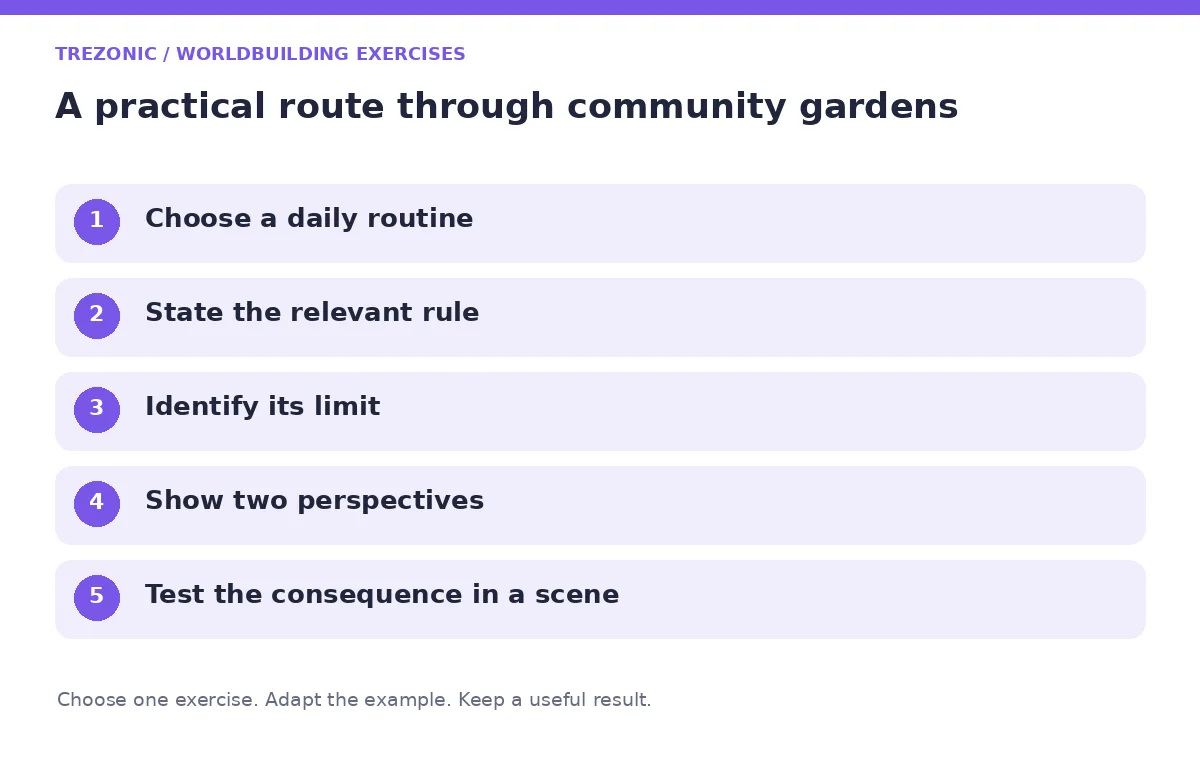
Worldbuilding is most useful when a rule changes what a character can do. Before designing a complete history, choose a small part of daily life: how people obtain a resource, enter a place, share an obligation or recognize a promise. Ask who benefits from the current arrangement and who has to work around it.
A setting can be speculative, realistic or somewhere between them. In every case, separate what is normal in that world from what is unusual in the scene. If everything is surprising, a reader has no stable point from which to understand the change. Show one ordinary routine clearly, then introduce the exception that creates the story's problem.
Rules need limits. A convenient system that always provides the required answer removes decisions from the characters. Give the system a cost, delay, constraint or disputed interpretation. Let different people encounter the same rule from different positions. That difference makes the setting feel inhabited rather than built solely for the protagonist.
Use a scene to test the world. A person trying to borrow an object or correct a misunderstanding can reveal more than a page of general background. Keep a separate note of the rules already demonstrated in the draft. When a new rule would solve a problem too easily, decide whether it needs to be introduced earlier, limited more carefully or removed. The goal is a setting readers can reason about as the story unfolds.
Choose the version that fits your session
For a solo session, choose one prompt and keep a written record of the result. For a pair or small group, explain the task before reading the first question and decide how turns will work. For a longer project, save two or three prompts that address different parts of the task. The collection offers options; completing more exercises is not automatically a better result.
60 exercise variations: Community Gardens
The six rounds change the perspective or constraint while returning to the theme. Read a complete prompt and its follow-up before choosing. You can adapt an object, move the setting or replace a complication when that makes the exercise more useful. Keep the function of the question rather than treating the wording as a rule.
Choose your next prompt
Choose “Next prompt” to select an exercise from this page.
Use a fictional answer or pass when playing with a group.
Round 1: Start with one concrete detail
-
Invent a rule governing the use of a seed envelope at a community garden. Give the rule a reasonable purpose, then show an ordinary situation in which following it creates a difficulty.
For this version, keep the scene in one location and let a plot marker influence a decision before the ending.
-
In a fictional version of a community garden, a disagreement over a shared task happens for a different reason than it would in everyday life. Define that reason and one limit on how people can respond.
For this version, keep the scene in one location and let a pair of gloves influence a decision before the ending.
-
Let the sound of water in a can signal a change that locals understand but a newcomer does not. Explain the meaning through a practical response rather than a lecture about the world.
For this version, keep the scene in one location and let a shared tool influence a decision before the ending.
-
Imagine that possession of a pair of gloves grants a modest privilege. Decide how the object is obtained, who verifies it and what happens when the claim is disputed.
For this version, keep the scene in one location and let a harvest basket influence a decision before the ending.
-
Design a shared routine at a community garden. Give two participants different reasons for maintaining it, then introduce a change that affects their reasons differently.
For this version, keep the scene in one location and let a seed envelope influence a decision before the ending.
-
Create a fictional custom for resolving a plant developing differently than expected. Include one step that is fair in principle but difficult for a particular character to complete.
For this version, keep the scene in one location and let a watering can influence a decision before the ending.
-
Make a seed envelope scarce for a concrete reason. Show how people adapt their ordinary behavior before introducing a character who wants to change the arrangement.
For this version, keep the scene in one location and let a plot marker influence a decision before the ending.
-
At a community garden, a familiar service works according to an unfamiliar rule. Demonstrate the rule in one successful use and one failed use so its boundary becomes clear.
For this version, keep the scene in one location and let a pair of gloves influence a decision before the ending.
-
Use the sound of water in a can to show a difference between two areas of the same fictional place. Connect the sensory difference to a practical choice the characters have to make.
For this version, keep the scene in one location and let a shared tool influence a decision before the ending.
-
Write a scene where someone challenges a rule involving a pair of gloves. Let the defender of the rule have a credible concern, then show what a workable compromise would require.
For this version, keep the scene in one location and let a harvest basket influence a decision before the ending.
Round 2: Change the viewpoint
-
Invent a rule governing the use of a watering can at a community garden. Give the rule a reasonable purpose, then show an ordinary situation in which following it creates a difficulty.
Try the situation from the other participant's viewpoint. Include the sound of water in a can only when it affects what that person notices.
-
In a fictional version of a community garden, a plant developing differently than expected happens for a different reason than it would in everyday life. Define that reason and one limit on how people can respond.
Try the situation from the other participant's viewpoint. Include soil on a hand only when it affects what that person notices.
-
Let soil on a hand signal a change that locals understand but a newcomer does not. Explain the meaning through a practical response rather than a lecture about the world.
Try the situation from the other participant's viewpoint. Include the scent of leaves only when it affects what that person notices.
-
Imagine that possession of a shared tool grants a modest privilege. Decide how the object is obtained, who verifies it and what happens when the claim is disputed.
Try the situation from the other participant's viewpoint. Include the sound of water in a can only when it affects what that person notices.
-
Design a shared routine at a community garden. Give two participants different reasons for maintaining it, then introduce a change that affects their reasons differently.
Try the situation from the other participant's viewpoint. Include soil on a hand only when it affects what that person notices.
-
Create a fictional custom for resolving limited water. Include one step that is fair in principle but difficult for a particular character to complete.
Try the situation from the other participant's viewpoint. Include the scent of leaves only when it affects what that person notices.
-
Make a watering can scarce for a concrete reason. Show how people adapt their ordinary behavior before introducing a character who wants to change the arrangement.
Try the situation from the other participant's viewpoint. Include the sound of water in a can only when it affects what that person notices.
-
At a community garden, a familiar service works according to an unfamiliar rule. Demonstrate the rule in one successful use and one failed use so its boundary becomes clear.
Try the situation from the other participant's viewpoint. Include soil on a hand only when it affects what that person notices.
-
Use soil on a hand to show a difference between two areas of the same fictional place. Connect the sensory difference to a practical choice the characters have to make.
Try the situation from the other participant's viewpoint. Include the scent of leaves only when it affects what that person notices.
-
Write a scene where someone challenges a rule involving a shared tool. Let the defender of the rule have a credible concern, then show what a workable compromise would require.
Try the situation from the other participant's viewpoint. Include the sound of water in a can only when it affects what that person notices.
Round 3: Add a practical constraint
-
Invent a rule governing the use of a plot marker at a community garden. Give the rule a reasonable purpose, then show an ordinary situation in which following it creates a difficulty.
Introduce a small time limit. Use a shared tool to make the practical constraint visible instead of explaining it in a separate summary.
-
In a fictional version of a community garden, limited water happens for a different reason than it would in everyday life. Define that reason and one limit on how people can respond.
Introduce a small time limit. Use a harvest basket to make the practical constraint visible instead of explaining it in a separate summary.
-
Let the scent of leaves signal a change that locals understand but a newcomer does not. Explain the meaning through a practical response rather than a lecture about the world.
Introduce a small time limit. Use a seed envelope to make the practical constraint visible instead of explaining it in a separate summary.
-
Imagine that possession of a harvest basket grants a modest privilege. Decide how the object is obtained, who verifies it and what happens when the claim is disputed.
Introduce a small time limit. Use a watering can to make the practical constraint visible instead of explaining it in a separate summary.
-
Design a shared routine at a community garden. Give two participants different reasons for maintaining it, then introduce a change that affects their reasons differently.
Introduce a small time limit. Use a plot marker to make the practical constraint visible instead of explaining it in a separate summary.
-
Create a fictional custom for resolving a disagreement over a shared task. Include one step that is fair in principle but difficult for a particular character to complete.
Introduce a small time limit. Use a pair of gloves to make the practical constraint visible instead of explaining it in a separate summary.
-
Make a plot marker scarce for a concrete reason. Show how people adapt their ordinary behavior before introducing a character who wants to change the arrangement.
Introduce a small time limit. Use a shared tool to make the practical constraint visible instead of explaining it in a separate summary.
-
At a community garden, a familiar service works according to an unfamiliar rule. Demonstrate the rule in one successful use and one failed use so its boundary becomes clear.
Introduce a small time limit. Use a harvest basket to make the practical constraint visible instead of explaining it in a separate summary.
-
Use the scent of leaves to show a difference between two areas of the same fictional place. Connect the sensory difference to a practical choice the characters have to make.
Introduce a small time limit. Use a seed envelope to make the practical constraint visible instead of explaining it in a separate summary.
-
Write a scene where someone challenges a rule involving a harvest basket. Let the defender of the rule have a credible concern, then show what a workable compromise would require.
Introduce a small time limit. Use a watering can to make the practical constraint visible instead of explaining it in a separate summary.
Round 4: Keep the purpose clear
-
Invent a rule governing the use of a pair of gloves at a community garden. Give the rule a reasonable purpose, then show an ordinary situation in which following it creates a difficulty.
Write the first attempt with very little background, then add one fact about a community garden exactly where the action creates a need for it.
-
In a fictional version of a community garden, a disagreement over a shared task happens for a different reason than it would in everyday life. Define that reason and one limit on how people can respond.
Write the first attempt with very little background, then add one fact about a community garden exactly where the action creates a need for it.
-
Let the sound of water in a can signal a change that locals understand but a newcomer does not. Explain the meaning through a practical response rather than a lecture about the world.
Write the first attempt with very little background, then add one fact about a community garden exactly where the action creates a need for it.
-
Imagine that possession of a seed envelope grants a modest privilege. Decide how the object is obtained, who verifies it and what happens when the claim is disputed.
Write the first attempt with very little background, then add one fact about a community garden exactly where the action creates a need for it.
-
Design a shared routine at a community garden. Give two participants different reasons for maintaining it, then introduce a change that affects their reasons differently.
Write the first attempt with very little background, then add one fact about a community garden exactly where the action creates a need for it.
-
Create a fictional custom for resolving a plant developing differently than expected. Include one step that is fair in principle but difficult for a particular character to complete.
Write the first attempt with very little background, then add one fact about a community garden exactly where the action creates a need for it.
-
Make a pair of gloves scarce for a concrete reason. Show how people adapt their ordinary behavior before introducing a character who wants to change the arrangement.
Write the first attempt with very little background, then add one fact about a community garden exactly where the action creates a need for it.
-
At a community garden, a familiar service works according to an unfamiliar rule. Demonstrate the rule in one successful use and one failed use so its boundary becomes clear.
Write the first attempt with very little background, then add one fact about a community garden exactly where the action creates a need for it.
-
Use the sound of water in a can to show a difference between two areas of the same fictional place. Connect the sensory difference to a practical choice the characters have to make.
Write the first attempt with very little background, then add one fact about a community garden exactly where the action creates a need for it.
-
Write a scene where someone challenges a rule involving a seed envelope. Let the defender of the rule have a credible concern, then show what a workable compromise would require.
Write the first attempt with very little background, then add one fact about a community garden exactly where the action creates a need for it.
Round 5: Try an alternative
-
Invent a rule governing the use of a shared tool at a community garden. Give the rule a reasonable purpose, then show an ordinary situation in which following it creates a difficulty.
Change the expected response. Let a seed envelope help someone act reasonably even though the result complicates the original plan.
-
In a fictional version of a community garden, a plant developing differently than expected happens for a different reason than it would in everyday life. Define that reason and one limit on how people can respond.
Change the expected response. Let a watering can help someone act reasonably even though the result complicates the original plan.
-
Let soil on a hand signal a change that locals understand but a newcomer does not. Explain the meaning through a practical response rather than a lecture about the world.
Change the expected response. Let a plot marker help someone act reasonably even though the result complicates the original plan.
-
Imagine that possession of a watering can grants a modest privilege. Decide how the object is obtained, who verifies it and what happens when the claim is disputed.
Change the expected response. Let a pair of gloves help someone act reasonably even though the result complicates the original plan.
-
Design a shared routine at a community garden. Give two participants different reasons for maintaining it, then introduce a change that affects their reasons differently.
Change the expected response. Let a shared tool help someone act reasonably even though the result complicates the original plan.
-
Create a fictional custom for resolving limited water. Include one step that is fair in principle but difficult for a particular character to complete.
Change the expected response. Let a harvest basket help someone act reasonably even though the result complicates the original plan.
-
Make a shared tool scarce for a concrete reason. Show how people adapt their ordinary behavior before introducing a character who wants to change the arrangement.
Change the expected response. Let a seed envelope help someone act reasonably even though the result complicates the original plan.
-
At a community garden, a familiar service works according to an unfamiliar rule. Demonstrate the rule in one successful use and one failed use so its boundary becomes clear.
Change the expected response. Let a watering can help someone act reasonably even though the result complicates the original plan.
-
Use soil on a hand to show a difference between two areas of the same fictional place. Connect the sensory difference to a practical choice the characters have to make.
Change the expected response. Let a plot marker help someone act reasonably even though the result complicates the original plan.
-
Write a scene where someone challenges a rule involving a watering can. Let the defender of the rule have a credible concern, then show what a workable compromise would require.
Change the expected response. Let a pair of gloves help someone act reasonably even though the result complicates the original plan.
Round 6: Review the consequence
-
Invent a rule governing the use of a harvest basket at a community garden. Give the rule a reasonable purpose, then show an ordinary situation in which following it creates a difficulty.
Create a quieter version. Use soil on a hand and one changed action to carry the consequence without adding a dramatic announcement.
-
In a fictional version of a community garden, limited water happens for a different reason than it would in everyday life. Define that reason and one limit on how people can respond.
Create a quieter version. Use the scent of leaves and one changed action to carry the consequence without adding a dramatic announcement.
-
Let the scent of leaves signal a change that locals understand but a newcomer does not. Explain the meaning through a practical response rather than a lecture about the world.
Create a quieter version. Use the sound of water in a can and one changed action to carry the consequence without adding a dramatic announcement.
-
Imagine that possession of a plot marker grants a modest privilege. Decide how the object is obtained, who verifies it and what happens when the claim is disputed.
Create a quieter version. Use soil on a hand and one changed action to carry the consequence without adding a dramatic announcement.
-
Design a shared routine at a community garden. Give two participants different reasons for maintaining it, then introduce a change that affects their reasons differently.
Create a quieter version. Use the scent of leaves and one changed action to carry the consequence without adding a dramatic announcement.
-
Create a fictional custom for resolving a disagreement over a shared task. Include one step that is fair in principle but difficult for a particular character to complete.
Create a quieter version. Use the sound of water in a can and one changed action to carry the consequence without adding a dramatic announcement.
-
Make a harvest basket scarce for a concrete reason. Show how people adapt their ordinary behavior before introducing a character who wants to change the arrangement.
Create a quieter version. Use soil on a hand and one changed action to carry the consequence without adding a dramatic announcement.
-
At a community garden, a familiar service works according to an unfamiliar rule. Demonstrate the rule in one successful use and one failed use so its boundary becomes clear.
Create a quieter version. Use the scent of leaves and one changed action to carry the consequence without adding a dramatic announcement.
-
Use the scent of leaves to show a difference between two areas of the same fictional place. Connect the sensory difference to a practical choice the characters have to make.
Create a quieter version. Use the sound of water in a can and one changed action to carry the consequence without adding a dramatic announcement.
-
Write a scene where someone challenges a rule involving a plot marker. Let the defender of the rule have a credible concern, then show what a workable compromise would require.
Create a quieter version. Use soil on a hand and one changed action to carry the consequence without adding a dramatic announcement.
A worked planning example
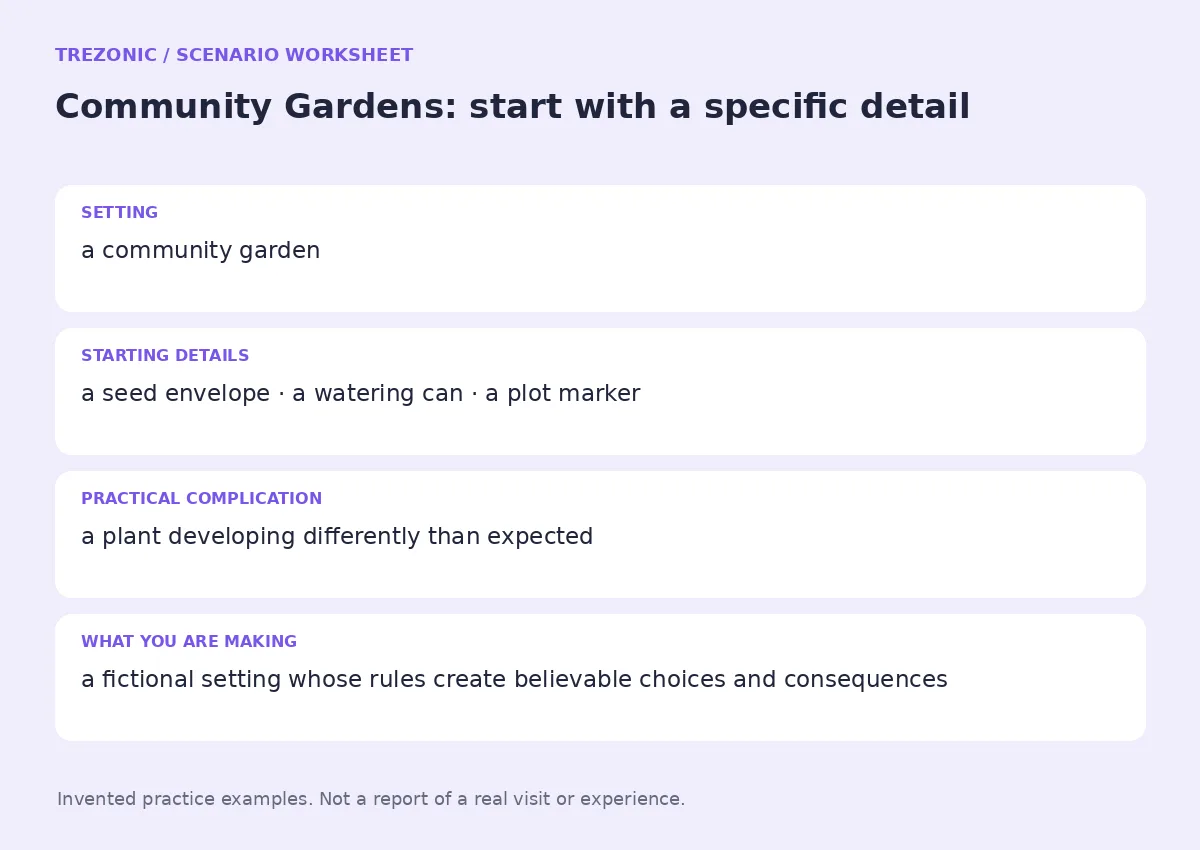
Imagine a practice session centered on a harvest basket at a community garden. The complication is a plant developing differently than expected. This is an invented setup, so there is no claim that the event happened or that a particular real location has these conditions. The purpose is to make a fictional setting whose rules create believable choices and consequences. Start by writing one sentence about that purpose and one sentence about the concrete detail you will use.
In the first pass, describe what is available in the scene or task. A detail such as the sound of water in a can can provide context, but it should not replace the practical decision. Record the object, the setting and the immediate difficulty separately. That small separation makes it easier to see which parts of the setup you can change without losing the point of the exercise.
Next, apply the first step: choose a daily routine. Keep the attempt small enough to finish. If the exercise involves a written scene, draft the action before adding all the background. If it involves a conversation, ask the concrete question and let the answer determine the follow-up. If it involves a plan or review, write down the relevant observation and identify what still needs confirmation. Use the instruction that matches the selected exercise rather than treating every example as the same kind of task.
Now change one condition. Replace the starting object with a watering can, shorten the available time or move the attention to another participant. Keep the rest of the setup steady long enough to compare the results. This is a comparison of practice attempts, not evidence that one response always works better for every person or place. Notice which change makes the intended outcome clearer.
Check your result before sharing it
- The result supports the purpose: a fictional setting whose rules create believable choices and consequences.
- The starting situation is clear without needing a long explanation.
- Each important detail has a practical job in the exercise.
- An invented example is identified as invented.
- A real experience is described within the limits of what you observed.
- A factual detail that may change is checked with an appropriate primary source.
- A participant can choose how much to contribute and can pass.
- Private information and another person's image are handled with appropriate permission.
- Commercial recommendations, affiliate links or sponsorships are clearly disclosed when present.
- The next useful action is small enough to complete with the time and resources you have.
Common mistakes to avoid
A broad label can feel like a complete answer when it only names the subject. Replace a general claim with one observable detail, one choice or one example. Avoid adding an elaborate explanation before the reader or participant knows the practical situation. When a question does not fit, adapt it openly rather than forcing an irrelevant answer. Repeating the same effect in different words can make a piece longer without making it more useful.
A second common mistake is treating a practice result as a verified account. A fictional scene does not establish what a real place is like, and a game answer does not establish a permanent fact about a person. Keep those boundaries clear when you move from a private exercise to a public post, review or conversation. If the result depends on something you have not checked, name the missing information and decide how to obtain it.
Common questions
Do I need to complete all 60 prompts?
No. Choose one that fits the task you want to work on. A completed, specific attempt usually gives you more to revise or discuss than many unfinished starts. The remaining prompts are options you can return to when you want a different focus.
Can I change the setting or objects?
Yes. Replace a detail when the new version makes the exercise useful for your project or group. Preserve the practical relationship that creates the question: a choice, a limitation, a difference in attention or a consequence worth following.
Are these examples factual accounts?
No. The sample situations are invented for practice. A real review or practical claim needs your own accurately described experience and suitable evidence. The collection does not supply live prices, provider rules, opening times or a first-hand test of a product.
How can I use a prompt with a group?
Explain the format, invite a brief answer and offer a pass option. You can use an imagined response. Choose one question at a time and let the next contribution follow what someone actually says instead of demanding a more personal disclosure.
What if a prompt does not fit the book or project?
Choose another prompt or adapt the function to a relevant detail. A reading exercise should stay grounded in the book you actually read. A creative task can use a new fictional detail. Neither requires you to invent a factual claim to make the question fit.
What is a useful next step after the exercise?
Keep the part that made the task clearer. You might revise one paragraph, record one checked fact, select a stronger frame or ask a more specific follow-up. Write down the next action and complete it before expanding the plan into a much larger project.
Keep a useful result
For community gardens, begin with a harvest basket and the task that makes it relevant. Choose one exercise, complete a small attempt and review whether the result supports a fictional setting whose rules create believable choices and consequences. Save the question that helped, adapt the part that did not fit and keep the next step concrete. You can return to a different round when you need a new perspective.