Artificial intelligence is no longer a technology reserved for global corporations, research laboratories, or billion-dollar technology companies.
In 2026, AI has become one of the most powerful business tools available to small companies, local shops, startups, freelancers, and entrepreneurs.
What makes this shift remarkable is not the technology itself.
It is accessibility.
Only a few years ago, implementing advanced automation or intelligent systems often required significant budgets, specialized developers, and dedicated IT teams.
Today, many of the same capabilities are available to businesses with only a handful of employees.
A local restaurant can automate customer communication.
A real estate agency can qualify leads automatically.
An online store can improve customer support around the clock.
A small marketing agency can increase productivity without hiring additional staff.
The playing field is changing.
For the first time, many small businesses have access to tools that can help them compete more effectively against much larger organizations.
However, there is also a great deal of confusion.
Some business owners believe AI will replace employees.
Others assume AI is too complicated or expensive to implement.
Many simply do not know where to begin.
The reality is much more practical.
Most successful businesses are not using artificial intelligence to replace people.
They are using it to eliminate repetitive work, improve decision-making, increase productivity, and deliver better customer experiences.
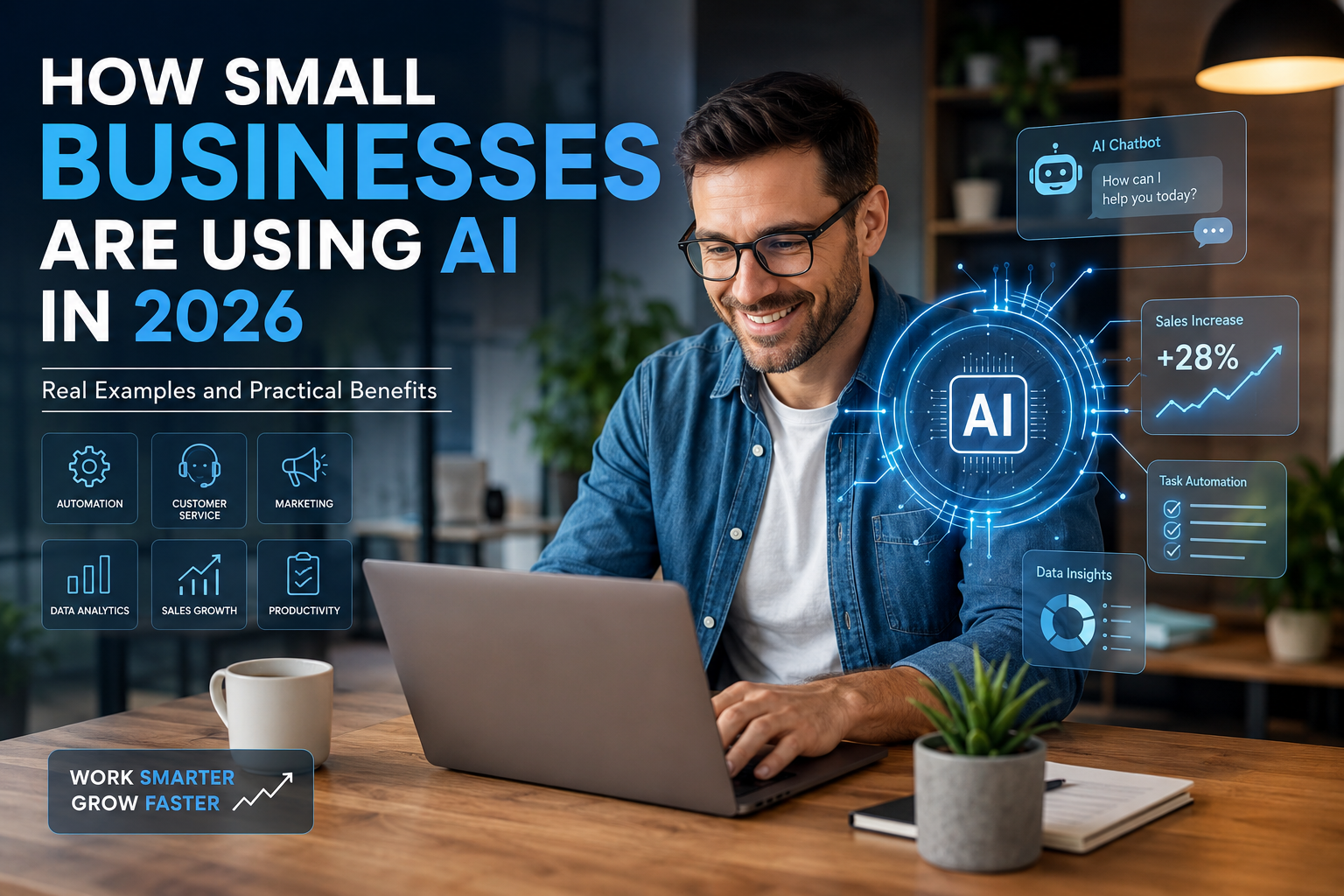
This article explores how small businesses are actually using AI in 2026.
Rather than focusing on hype, we will examine real-world applications, practical benefits, common challenges, and examples that demonstrate how AI is transforming everyday business operations.
Why AI Matters More Than Ever for Small Businesses
Running a small business has never been easy.
Owners often wear multiple hats simultaneously.
On any given day, they may be responsible for:
- Sales
- Marketing
- Customer support
- Operations
- Accounting
- Hiring
- Business development
Large corporations solve these challenges by building departments.
Small businesses rarely have that luxury.
Resources are limited.
Time is limited.
Budgets are limited.
This is precisely why artificial intelligence has become so valuable.
AI allows businesses to increase output without increasing headcount at the same rate.
Instead of hiring additional staff to perform repetitive tasks, many organizations are using technology to handle routine work while employees focus on higher-value activities.
The result is not simply cost savings.
It is improved efficiency.
And efficiency often becomes a competitive advantage.
The Biggest Misconception About AI
One of the most common myths surrounding artificial intelligence is that businesses use it primarily to reduce staff.
In reality, the most successful implementations often focus on helping employees perform their jobs more effectively.
Think about a customer support representative.
Instead of spending hours answering repetitive questions, AI can provide suggested responses, summarize customer histories, and automate routine inquiries.
The employee still plays a critical role.
However, their time is spent solving more important problems.
The same principle applies across many industries.
AI is increasingly being used as a productivity multiplier rather than a replacement for human expertise.
Businesses that understand this distinction often achieve better results.
1. Customer Service and Support
Customer service is one of the earliest and most successful business applications of artificial intelligence.
Small businesses frequently struggle to provide fast responses because they have limited staff available.
Customers, however, increasingly expect immediate answers.
This creates a challenge.
AI helps bridge the gap.
Modern AI-powered customer service systems can:
- Answer common questions.
- Track orders.
- Schedule appointments.
- Provide product information.
- Route complex issues to human staff.
Many businesses now provide support outside normal working hours without employing additional personnel.
For customers, this improves convenience.
For businesses, it improves efficiency.
Real Example
Imagine a small online store receiving dozens of inquiries every day.
Questions such as:
- Where is my order?
- What are your shipping times?
- Do you offer refunds?
- Which product should I choose?
Individually, these questions are simple.
Collectively, they consume significant time.
An AI-powered support assistant can answer many of these inquiries instantly.
The result is faster service and reduced workload.
Key Benefits
Businesses implementing AI-assisted customer support frequently report:
- Faster response times
- Improved customer satisfaction
- Reduced repetitive work
- Increased productivity
- Better scalability
As customer expectations continue to rise, support automation is becoming increasingly important for small businesses.
2. Marketing and Content Creation
Marketing is another area where AI is creating substantial advantages.
Many small businesses understand the importance of marketing but struggle to publish content consistently.
Creating:
- Blog posts
- Social media content
- Email campaigns
- Product descriptions
- Marketing materials
requires time and resources.
AI helps reduce this burden.
Instead of starting from a blank page every time, businesses can accelerate brainstorming, planning, research, and content creation.
Why This Matters
Consistent marketing often separates growing businesses from stagnant ones.
Companies that regularly communicate with customers remain visible.
Companies that disappear from view often lose opportunities.
AI makes consistent communication more achievable.
A small business can now produce content at a scale that previously required larger teams.
Real Example
Consider a local fitness studio.
The owner may have limited time available for content creation.
Using AI-assisted workflows, the business can generate:
- Weekly blog articles
- Social media posts
- Email newsletters
- Promotional campaigns
in a fraction of the time previously required.
This allows the business to maintain a stronger online presence while focusing on serving customers.
AI Is Not Just About Automation
One of the most important lessons business owners are learning is that AI is not merely an automation tool.
It is also a decision-support tool.
The strongest businesses use AI not only to save time but also to gain insights, identify opportunities, improve planning, and make smarter decisions.
This shift from simple automation to intelligent assistance is one of the reasons AI adoption continues to accelerate across industries worldwide.
In the next section, we will examine how small businesses are using AI for sales, lead generation, data analysis, hiring, operations, and business growth strategies that were previously available only to larger organizations.
3. Sales and Lead Generation
For most small businesses, growth ultimately comes down to one thing:
Generating more customers.
Without a consistent flow of qualified leads, even excellent products and services can struggle.
This is one of the reasons AI is becoming increasingly valuable.
Many business owners initially focus on AI-powered content creation.
In reality, some of the highest returns often come from AI-powered sales and lead generation systems.
Instead of waiting for customers to appear, businesses can use AI to identify opportunities, engage prospects, and improve conversion rates.
How AI Improves Lead Generation
Traditional lead generation often involves repetitive tasks such as:
- Responding to inquiries
- Qualifying prospects
- Following up with leads
- Scheduling appointments
- Organizing customer information
AI can automate much of this process.
For example, a business website may receive dozens of inquiries every week.
An AI assistant can:
- Ask qualifying questions.
- Determine customer needs.
- Collect contact information.
- Schedule meetings automatically.
- Forward qualified prospects to sales staff.
This reduces delays and increases the likelihood of conversion.
Real Example: Real Estate Agency
A small real estate company may receive hundreds of inquiries every month.
Many prospects are simply browsing.
Others are actively looking to buy.
Traditionally, staff members spend significant time determining which leads are serious.
AI can automate the initial screening process.
Potential buyers can answer questions about:
- Budget
- Property type
- Location preferences
- Purchase timeline
By the time a human agent becomes involved, much of the qualification process has already been completed.
The result is greater efficiency and higher productivity.
Why This Matters
Sales teams should spend most of their time closing deals.
Not sorting through unqualified leads.
AI helps businesses focus resources where they create the greatest impact.
4. Data Analysis and Business Intelligence
One of the greatest challenges facing small businesses is not the lack of data.
It is understanding the data they already have.
Every day businesses generate information through:
- Sales transactions
- Customer inquiries
- Marketing campaigns
- Website visits
- Inventory systems
- Financial records
The problem is that valuable insights often remain hidden inside spreadsheets and reports.
AI helps transform raw information into actionable intelligence.
What AI Can Analyze
Modern AI systems can identify:
- Sales trends
- Customer behavior patterns
- Seasonal demand fluctuations
- Product performance
- Marketing effectiveness
- Operational inefficiencies
Instead of spending hours reviewing reports manually, business owners can receive summaries, recommendations, and forecasts.
Example: Retail Store
Imagine a small retail business selling hundreds of products.
Without analysis, it may be difficult to identify:
- Which products generate the highest profit.
- Which products rarely sell.
- Which marketing campaigns drive purchases.
- Which customer groups spend the most.
AI can analyze these patterns quickly and highlight opportunities for improvement.
Small decisions based on better data often produce significant financial results over time.
The Competitive Advantage
Large corporations have relied on business intelligence for decades.
Artificial intelligence is making similar capabilities accessible to smaller organizations.
This levels the playing field in ways that were previously impossible.
5. Human Resources and Hiring
Finding talented employees has become increasingly difficult.
For small businesses, hiring mistakes can be especially expensive.
A poor hiring decision can result in:
- Lost productivity
- Additional recruitment costs
- Training expenses
- Reduced team performance
Artificial intelligence is helping businesses improve hiring processes while reducing administrative work.
AI Applications in Recruitment
Businesses are using AI to:
- Screen resumes
- Identify relevant candidates
- Draft job descriptions
- Analyze qualifications
- Schedule interviews
- Answer applicant questions
This allows managers to focus on evaluating people rather than processing paperwork.
Real Example
A growing startup receives 300 applications for a single position.
Reviewing every application manually may require days.
AI can quickly identify candidates who meet predefined requirements.
The hiring team still makes the final decision, but the initial screening process becomes significantly more efficient.
Important Limitation
AI should support hiring decisions.
It should not replace human judgment.
The strongest organizations combine technology with human evaluation.
People hire people.
AI simply helps identify promising candidates more efficiently.
6. Financial Management and Forecasting
Cash flow remains one of the most important factors in business survival.
Many profitable businesses fail because they manage cash poorly.
Artificial intelligence is helping business owners gain better visibility into their finances.
How AI Supports Financial Management
AI-powered systems can assist with:
- Expense tracking
- Revenue forecasting
- Budget planning
- Invoice management
- Financial reporting
- Risk identification
This allows business owners to make more informed decisions.
Instead of reacting to financial problems after they occur, businesses can identify potential issues earlier.
Example: Service-Based Business
A marketing agency may experience seasonal fluctuations in revenue.
AI can analyze historical data and identify patterns.
This allows the business to:
- Plan hiring decisions.
- Manage cash reserves.
- Forecast future revenue.
- Reduce financial uncertainty.
Better forecasting often leads to better business decisions.
7. Operations and Workflow Optimization
Many small businesses lose productivity not because employees are lazy, but because processes are inefficient.
Tasks become fragmented.
Information becomes difficult to locate.
Workflows become inconsistent.
As businesses grow, these inefficiencies multiply.
This is where AI can create significant operational improvements.
Common Operational Challenges
Many businesses struggle with:
- Repetitive administrative tasks
- Document management
- Internal communication
- Project tracking
- Process consistency
AI helps streamline these activities.
The goal is not simply automation.
The goal is creating smoother operations.
Example: Small Manufacturing Company
Consider a manufacturing company with limited administrative staff.
AI can assist with:
- Production reporting
- Inventory monitoring
- Maintenance scheduling
- Quality control documentation
- Supplier communication
These improvements may seem small individually.
Together, they can save hundreds of hours annually.
The Businesses Benefiting Most From AI
Artificial intelligence is creating value across nearly every industry.
However, some sectors are adopting it particularly quickly.
Examples include:
Professional Services
- Consulting firms
- Marketing agencies
- Accounting practices
- Legal services
Retail and E-commerce
- Online stores
- Local retailers
- Product-based businesses
Real Estate
- Agencies
- Property management companies
- Investment firms
Healthcare
- Clinics
- Medical practices
- Healthcare providers
Education
- Training organizations
- Tutoring businesses
- Educational platforms
Manufacturing
- Industrial companies
- Equipment suppliers
- Production facilities
The common theme is simple:
Businesses that handle large amounts of information, communication, or repetitive work tend to benefit most from AI adoption.
From Productivity Tool to Competitive Advantage
Perhaps the most important shift happening in 2026 is this:
Businesses are no longer experimenting with AI.
They are integrating it into everyday operations.
The conversation has evolved from:
“Should we use AI?”
to:
“How can we use AI more effectively?”
Companies that learn to integrate AI strategically often gain advantages in speed, efficiency, customer experience, and decision-making.
And in highly competitive markets, even small advantages can compound into significant business growth over time.
8. Real-World Examples of AI Adoption in Small Businesses
One of the reasons many business owners hesitate to adopt AI is that they struggle to connect the technology with their daily operations.
They understand the concept.
They hear the headlines.
But they often ask a simple question:
“How does this actually help my business?”
The answer becomes much clearer when examining real-world use cases.
The most successful AI implementations are often surprisingly practical.
They focus on solving ordinary business problems more efficiently.
Example 1: Local Restaurant
Restaurants operate in one of the most competitive industries in the world.
Margins are often tight.
Customer expectations continue to increase.
Staff shortages can create additional pressure.
A small restaurant may use AI to assist with:
- Reservation management
- Customer inquiries
- Menu recommendations
- Social media content
- Customer feedback analysis
Instead of spending hours responding to repetitive questions, staff can focus on delivering better customer experiences.
Even small improvements can have meaningful effects on profitability.
For example:
Reducing response times may increase reservations.
Improving customer satisfaction may generate more repeat visits.
More repeat visits often mean higher revenue without increasing advertising costs.
Example 2: E-Commerce Store
Online stores generate large amounts of data.
Every visitor leaves clues about their interests and buying behavior.
The challenge is understanding that information.
AI can help e-commerce businesses:
- Recommend products
- Predict purchasing behavior
- Improve customer support
- Generate product descriptions
- Analyze sales performance
- Optimize marketing campaigns
A business selling hundreds or thousands of products simply cannot analyze every detail manually.
AI allows smaller teams to operate with greater efficiency.
This creates opportunities that were previously available only to large retailers.
Example 3: Marketing Agency
Marketing agencies often manage multiple clients simultaneously.
This creates challenges related to:
- Content creation
- Reporting
- Research
- Campaign management
- Performance analysis
AI can assist throughout the process.
For example:
Instead of spending hours compiling reports, AI can summarize campaign performance and identify key trends.
Instead of starting every article from scratch, AI can help create outlines and research frameworks.
The agency remains responsible for strategy and quality.
AI simply reduces the amount of repetitive work required.
Example 4: Accounting Firm
Many people assume AI only benefits technology companies.
In reality, professional service businesses are among the fastest adopters.
Accounting firms frequently use AI to assist with:
- Document organization
- Data extraction
- Financial analysis
- Client communication
- Report preparation
This allows professionals to focus more on interpretation and advisory services rather than administrative tasks.
As a result, firms can often serve more clients without dramatically increasing staff.
Example 5: Manufacturing Company
Manufacturing may seem far removed from artificial intelligence.
However, many industrial businesses are already benefiting from AI-powered systems.
Applications include:
- Predictive maintenance
- Inventory optimization
- Quality control
- Production planning
- Supply chain analysis
Imagine identifying equipment problems before a breakdown occurs.
Preventing even a single production interruption can save substantial amounts of time and money.
For industrial companies, AI often delivers value through operational efficiency rather than content creation.
The ROI of Artificial Intelligence
Whenever businesses invest in technology, the most important question is not:
“What can it do?”
The most important question is:
“What value does it create?”
This is where Return on Investment (ROI) becomes critical.
AI should not be adopted simply because it is popular.
It should be adopted because it improves business outcomes.
Where ROI Usually Comes From
The strongest AI implementations generally create value through one or more of the following:
Time Savings
Reducing administrative workload.
Reducing repetitive tasks.
Increasing employee productivity.
Revenue Growth
Generating more leads.
Improving conversion rates.
Increasing customer retention.
Enhancing marketing performance.
Cost Reduction
Reducing manual labor requirements.
Lowering operational expenses.
Improving resource allocation.
Reducing errors.
Better Decision-Making
Identifying trends faster.
Analyzing larger data sets.
Improving forecasting accuracy.
Reducing uncertainty.
A Simple ROI Example
Imagine a business owner spends:
- 10 hours per week on repetitive administrative work.
After implementing AI automation:
- Administrative workload falls to 3 hours per week.
The business saves:
- 7 hours weekly.
- Approximately 30 hours monthly.
- More than 350 hours annually.
Those hours can be redirected toward:
- Sales
- Customer relationships
- Marketing
- Strategic planning
The financial impact often extends far beyond the direct time savings.
The Biggest AI Adoption Mistakes
While AI offers enormous potential, many businesses fail to achieve meaningful results because they approach implementation incorrectly.
Understanding these mistakes is often just as important as understanding the technology itself.
Mistake #1: Adopting AI Without a Business Problem
Some companies start with tools instead of problems.
They ask:
“Which AI platform should we buy?”
Instead of:
“Which business challenge are we trying to solve?”
The strongest implementations begin with clear objectives.
Technology should support business goals.
Not the other way around.
Mistake #2: Expecting Instant Transformation
Artificial intelligence is not magic.
It rarely transforms a business overnight.
Successful adoption usually happens gradually.
Companies test.
Learn.
Adjust.
Improve.
Over time, small improvements accumulate into significant advantages.
Mistake #3: Ignoring Employee Training
Even the best technology delivers limited value if employees do not understand how to use it.
Training is often one of the highest-return investments in any AI initiative.
Organizations that educate employees frequently outperform those that focus exclusively on software.
Mistake #4: Automating Bad Processes
Automation magnifies existing systems.
If a process is poorly designed, automation may simply make the inefficiency happen faster.
Before implementing AI, businesses should evaluate and improve workflows whenever possible.
The Future of Small Business AI
The next phase of AI adoption will likely look very different from today.
Businesses are moving beyond experimentation.
AI is becoming embedded into everyday operations.
Future systems are expected to become:
- More accurate
- More affordable
- More specialized
- More integrated
- More autonomous
As barriers continue to fall, the competitive gap between adopters and non-adopters may widen.
The businesses that learn how to use AI effectively today are often building capabilities that will become increasingly valuable in the years ahead.
The question is no longer whether artificial intelligence will influence small businesses.
The question is how quickly businesses can learn to leverage it effectively.
AI Is Not Replacing Small Businesses
Perhaps the most important takeaway from this discussion is that AI is not replacing small businesses.
It is empowering them.
For decades, large corporations enjoyed advantages that smaller competitors could not easily match.
Artificial intelligence is helping close that gap.
A small company can now:
- Operate more efficiently.
- Analyze more information.
- Serve customers more effectively.
- Produce more content.
- Automate more processes.
This does not guarantee success.
But it creates opportunities that were previously unavailable.
And for many entrepreneurs, that may be one of the most important business developments of the modern era.
Comparing the Most Common AI Applications for Small Businesses
Not every business needs the same AI solutions.
A local restaurant faces different challenges than an accounting firm.
A marketing agency operates differently from a manufacturing company.
The key is understanding which applications create the greatest value for your specific business model.
The table below provides a practical overview.
| Business Function | AI Application | Primary Benefit |
|---|---|---|
| Customer Service | AI Chat Assistants | Faster response times |
| Marketing | Content Creation & Campaign Support | Increased visibility |
| Sales | Lead Qualification & Follow-Ups | More conversions |
| Finance | Forecasting & Analysis | Better decision-making |
| Human Resources | Resume Screening & Scheduling | Reduced administrative workload |
| Operations | Workflow Automation | Increased efficiency |
| Manufacturing | Predictive Maintenance | Reduced downtime |
| E-Commerce | Product Recommendations | Higher sales |
| Research | Data Analysis | Better insights |
| Business Strategy | Decision Support | Improved planning |
One of the most important observations is that AI creates value across nearly every business function.
This explains why adoption continues accelerating worldwide.
Companies are no longer viewing AI as a standalone technology.
They are increasingly treating it as part of their everyday business infrastructure.
How Small Businesses Should Get Started With AI
Many business owners make the mistake of trying to transform everything at once.
This often creates unnecessary complexity.
The most successful businesses usually begin with a single high-impact problem.
For example:
Step 1: Identify a Repetitive Task
Look for activities that consume significant time.
Examples:
- Answering customer questions.
- Creating weekly reports.
- Scheduling appointments.
- Managing inquiries.
- Organizing documents.
Step 2: Test a Small Solution
Avoid large-scale implementation immediately.
Start with a single process.
Measure results.
Learn from the experience.
Adjust when necessary.
Step 3: Expand Gradually
Once value becomes clear, additional use cases can be introduced.
This approach reduces risk while maximizing learning.
Small improvements often lead to larger transformation over time.
What Will Successful Small Businesses Look Like in 2030?
The next few years may fundamentally change how small businesses operate.
Historically, large organizations enjoyed advantages because they had:
- Bigger budgets
- Larger teams
- Better access to technology
- More specialized expertise
Artificial intelligence is reducing some of these barriers.
A business with five employees can now perform tasks that previously required dozens of people.
A small company can analyze data, create content, automate processes, and communicate with customers at a scale that would have been difficult just a few years ago.
This does not eliminate competition.
In many ways, competition will become even stronger.
However, it gives smaller organizations opportunities to compete more effectively.
The businesses that embrace learning and adaptation may find themselves operating at levels previously reserved for much larger enterprises.
Frequently Asked Questions
Is AI too expensive for small businesses?
Not necessarily.
Many AI solutions offer affordable pricing and can often generate savings or productivity gains that outweigh their costs.
Can AI replace employees?
In most cases, AI works best when supporting employees rather than replacing them.
The strongest implementations combine technology with human expertise.
Which departments benefit most from AI?
Customer service, marketing, sales, operations, finance, and administration are among the most common areas where businesses see measurable improvements.
Do small businesses need technical expertise?
No.
Many modern AI platforms are designed for non-technical users and can often be implemented without advanced programming knowledge.
What is the biggest benefit of AI?
The answer varies by business, but common benefits include:
- Time savings
- Increased productivity
- Better customer experiences
- Improved decision-making
- Reduced operational costs
What is the biggest risk?
The biggest risk is implementing AI without a clear objective.
Technology should solve business problems rather than create additional complexity.
Is AI a temporary trend?
Most experts believe artificial intelligence will become a permanent part of business operations, similar to the internet, cloud computing, and smartphones.
Related Articles
To continue learning about artificial intelligence and business transformation, you may also find these guides useful:
ChatGPT vs Claude vs Gemini vs Perplexity (2026): The Ultimate AI Comparison Guide
Explore the strengths and weaknesses of today’s leading AI platforms and discover which tools are best suited for different business needs.
Best AI Tools to Make Money Online in 2026
Learn how entrepreneurs, freelancers, and creators are using AI-powered tools to increase productivity and build online income streams.
Best AI Side Hustles in 2026: 15 Real Ways to Make Money With Artificial Intelligence
Discover practical opportunities for generating additional income using AI-assisted business models and services.
How to Make Passive Income With AI in 2026
Explore long-term strategies for building digital assets and scalable income streams with artificial intelligence.
Final Thoughts
Artificial intelligence is often discussed as a revolutionary technology.
While that description is accurate, it can sometimes distract from what matters most.
For small businesses, AI is not primarily about technology.
It is about solving problems.
It is about helping a business owner respond to customers faster.
Helping a team work more efficiently.
Helping managers make better decisions.
Helping companies grow without increasing complexity at the same rate.
The most successful businesses in 2026 are not necessarily those using the most advanced AI systems.
They are the businesses using AI to create genuine value for customers.
That distinction matters.
Technology changes constantly.
Business fundamentals do not.
Customers still want:
- Better service
- Faster responses
- Higher quality
- Greater convenience
- More value
Artificial intelligence simply provides new ways to deliver those outcomes.
The companies that understand this principle will not view AI as a replacement for human expertise.
They will view it as a powerful tool that amplifies it.
And that may be the most important lesson of all.
The future does not belong to businesses that merely adopt artificial intelligence.
It belongs to businesses that learn how to combine artificial intelligence with human creativity, experience, trust, and vision.
Those organizations will not simply survive the coming transformation.
They will help shape it.