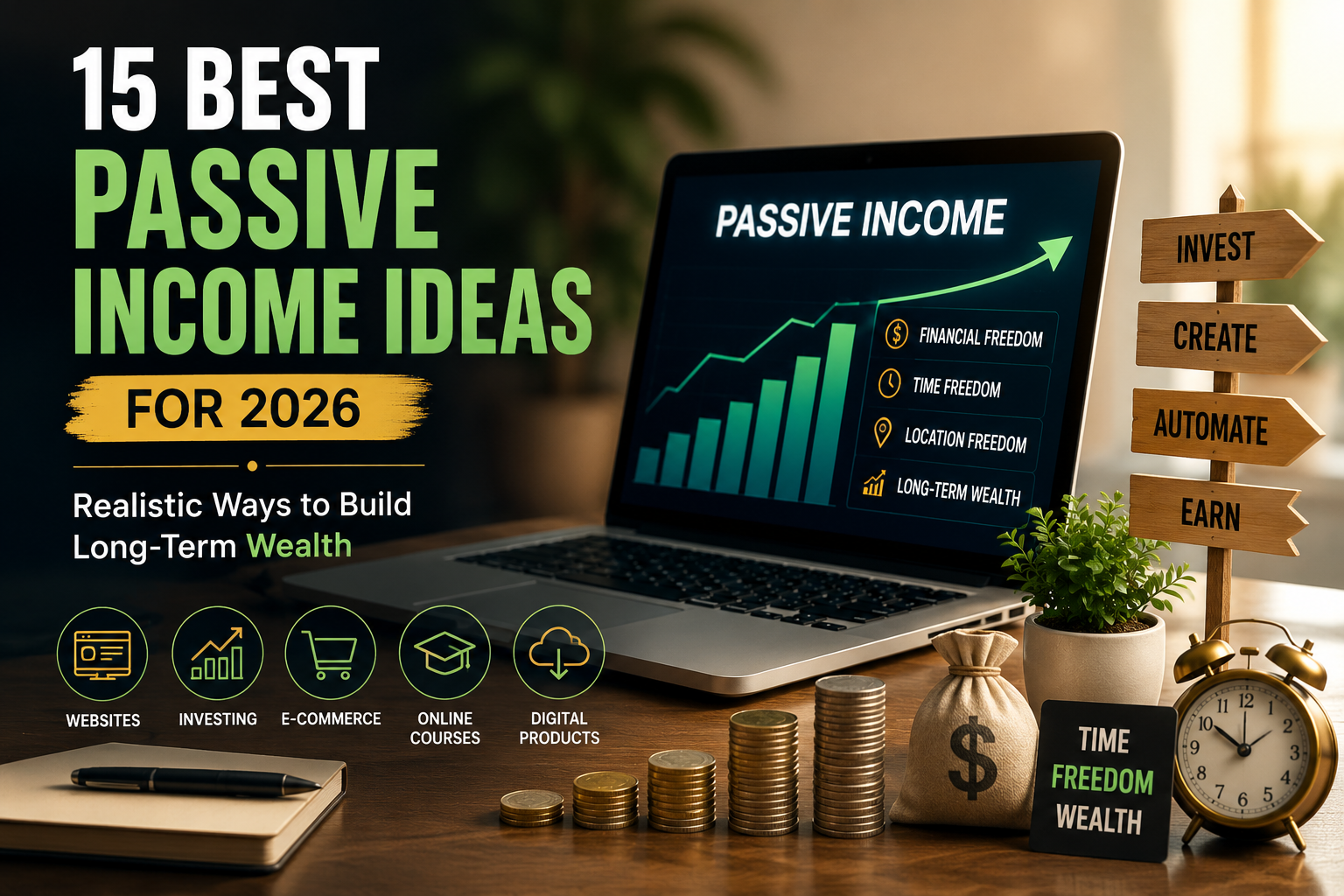
Introduction: Why Passive Income Matters More Than Ever in 2026
For decades, most people followed a simple financial formula.
Study hard.
Get a job.
Work full-time.
Receive a paycheck.
Repeat for 30 or 40 years.
While this approach still works for many people, the world has changed dramatically.
The cost of living continues to rise in many countries.
Housing prices have increased.
Education costs remain high.
Healthcare expenses continue to grow.
At the same time, technology is creating new opportunities to earn money outside of traditional employment.
This is why passive income has become one of the most searched financial topics in the world.
Millions of people are looking for ways to generate income that does not depend entirely on trading time for money.
But there is a problem.
Most passive income advice online is unrealistic.
Many websites promise quick riches.
Many social media influencers exaggerate results.
Many videos suggest that making money is easy.
The truth is very different.
Real passive income usually requires one of three things:
- Money
- Time
- Skills
Sometimes all three.
There is no magic formula.
However, there are legitimate strategies that can create long-term income streams over time.
The goal of this guide is not to sell a dream.
The goal is to explain realistic passive income opportunities that people are actually using in 2026.
Some require capital.
Some require effort.
Some require patience.
But all of them can potentially help build financial security over the long term.
What Is Passive Income?
Passive income is money earned with limited ongoing effort after the initial setup phase.
This definition is important because many people misunderstand passive income.
Passive income does not mean doing absolutely nothing.
In reality, most income streams require some maintenance.
For example:
A landlord may receive rental income but still manage repairs.
A website owner may earn advertising revenue but still update content.
An investor may receive dividends but still monitor investments.
A creator may sell digital products but still handle customer support.
The difference is that passive income becomes less dependent on your daily labor.
Instead of being paid only when you work, you begin building assets that can continue generating income.
Think of active income as pushing a car.
Think of passive income as building an engine.
The engine still requires maintenance, but it can continue moving even when you are not pushing constantly.
Why More People Are Pursuing Passive Income
The popularity of passive income is not simply a trend.
It reflects major economic changes.
Many people want additional income because:
- Inflation reduces purchasing power.
- Job security feels less certain.
- Living expenses continue increasing.
- Retirement planning has become more difficult.
- Financial independence has become more attractive.
In addition, digital technology has lowered barriers to entry.
Twenty years ago, creating an online business required significant technical expertise.
Today, a single person can:
- Build a website
- Start a newsletter
- Publish digital products
- Launch an online store
- Create educational content
- Reach a global audience
This accessibility has created opportunities that were unavailable to previous generations.
The result is a growing interest in income streams that can scale beyond traditional employment.
The Three Types of Passive Income
Nearly every passive income strategy falls into one of three categories.
1. Asset-Based Income
This category involves owning assets that generate revenue.
Examples include:
- Stocks
- Bonds
- Real estate
- Businesses
- Intellectual property
The asset performs work on your behalf.
For example, dividend stocks may distribute income without requiring daily involvement.
Rental properties may generate cash flow from tenants.
The challenge is that asset-based income often requires capital.
2. Content-Based Income
This category involves creating something once and earning repeatedly.
Examples include:
- Websites
- Blogs
- YouTube channels
- Online courses
- E-books
- Digital downloads
The initial work may be substantial.
However, successful content can continue attracting visitors, customers, and revenue for years.
This model often requires more time than money.
3. System-Based Income
This category involves creating systems that generate value with limited ongoing effort.
Examples include:
- Automated online businesses
- Affiliate marketing systems
- Software products
- Subscription businesses
- Digital services with automation
System-based income often sits between asset ownership and content creation.
It can be highly scalable when executed correctly.
The Biggest Myth About Passive Income
One of the most dangerous financial myths is the idea that passive income is easy.
This misconception causes many people to quit too early.
The reality is that passive income often requires intense effort before it becomes passive.
A website owner may spend hundreds of hours creating content before earning meaningful revenue.
A YouTuber may publish dozens of videos before gaining traction.
A real estate investor may spend years saving for a property.
A software entrepreneur may work months developing a product.
People often see the result but ignore the preparation.
This creates unrealistic expectations.
The most successful passive income builders usually think long term.
They focus on assets rather than shortcuts.
Understanding the Passive Income Pyramid
Not all passive income opportunities offer the same risk and reward.
Imagine a pyramid.
At the bottom are lower-risk opportunities.
Examples include:
- Dividend investing
- High-yield savings accounts
- Government bonds
These methods are generally safer but produce lower returns.
In the middle are moderate-risk opportunities.
Examples include:
- Rental properties
- Affiliate websites
- Online businesses
- Digital products
These require more work and carry greater uncertainty but can generate significantly higher returns.
At the top are high-risk opportunities.
Examples include:
- Startup investments
- Speculative assets
- Emerging technologies
These may offer exceptional returns but also carry substantial risk.
Understanding this pyramid helps investors avoid unrealistic expectations.
Higher rewards almost always involve higher risk, higher effort, or both.
Why Building Assets Is the Key
Many people focus on earning more money.
Fewer focus on building assets.
This distinction matters.
Income pays today’s bills.
Assets can pay tomorrow’s bills.
For example:
A salary is income.
A dividend-paying stock is an asset.
A freelance project is income.
A website generating monthly ad revenue is an asset.
Selling a service is income.
A digital course that sells repeatedly is an asset.
Wealthy individuals often spend years accumulating assets that continue producing value.
The more assets you own, the less dependent you become on a single income source.
This is one of the core principles behind long-term wealth building.
Why Passive Income Takes Time
One reason many people fail is that they underestimate the timeline.
Building meaningful passive income rarely happens overnight.
Most successful income streams go through four stages.
Stage 1: Learning
You acquire knowledge.
You make mistakes.
You experiment.
Revenue is often zero.
Stage 2: Building
You create systems.
You invest time.
You produce assets.
Revenue remains small.
Stage 3: Growth
Traffic increases.
Customers arrive.
Assets begin performing.
Income becomes noticeable.
Stage 4: Scale
The asset becomes established.
Growth compounds.
Income becomes increasingly predictable.
This process may take months or years depending on the strategy.
Patience is often the hidden ingredient behind successful passive income stories.
The Opportunity Landscape in 2026
The opportunities available today are broader than at any point in history.
Artificial intelligence.
Digital publishing.
Online education.
Remote work.
Creator platforms.
Software tools.
Global e-commerce.
These trends have created entirely new paths to financial independence.
The challenge is not finding opportunities.
The challenge is choosing the right opportunity and remaining committed long enough to see results.
In the next sections of this guide, we will explore 15 realistic passive income ideas for 2026, examining how each works, who it is best suited for, the startup requirements, risks, advantages, and long-term income potential.
Some strategies require money.
Some require skills.
Some require persistence.
But all have the potential to become valuable assets when approached correctly.
Passive Income Is Not About Money First—It Is About Leverage
Most people think passive income starts with money.
In reality, passive income starts with leverage.
Leverage is the ability to produce a larger result without increasing your effort proportionally.
For example:
If you work one extra hour and earn one extra hour of pay, there is no leverage.
If you create something once and it continues generating income for years, leverage exists.
This is the core principle behind nearly every successful passive income strategy.
A rental property is leverage.
A website is leverage.
A software application is leverage.
A YouTube video is leverage.
A digital course is leverage.
A book is leverage.
A stock portfolio is leverage.
Each of these assets allows future value creation beyond the original effort.
The wealthiest individuals in the world rarely focus solely on working more hours.
Instead, they focus on acquiring or building assets that scale.
This is why passive income is ultimately a game of leverage rather than labor.
The Four Levers of Modern Wealth
In 2026, there are four primary forms of leverage available to ordinary people.
Understanding them may be one of the most valuable financial lessons you ever learn.
1. Capital Leverage
Money works on your behalf.
Examples include:
- Stocks
- Bonds
- Real estate
- Private investments
- Businesses
This is the oldest form of leverage.
The challenge is obvious.
You need capital first.
People with large amounts of money can often generate significant passive income simply because their assets produce returns.
However, most people start without substantial capital.
That is why the next three forms of leverage have become increasingly important.
2. Technology Leverage
Technology allows one person to do the work of many.
Examples include:
- Websites
- Software
- Automation
- AI systems
- E-commerce platforms
Technology is one of the reasons small businesses can now compete globally.
A website can serve thousands of visitors simultaneously.
A software product can serve millions of users.
An AI-powered system can automate tasks that previously required employees.
Technology leverage continues growing every year.
3. Media Leverage
The internet has created unprecedented distribution power.
A single article can reach millions.
A single video can generate revenue for years.
A single social media post can attract thousands of customers.
Historically, media distribution required television stations, newspapers, publishing houses, or radio networks.
Today anyone can publish.
This dramatically changes the economics of wealth creation.
Content itself has become an asset class.
4. Network Leverage
Relationships create opportunities.
Strong networks often lead to:
- Partnerships
- Investments
- Customers
- Referrals
- Business opportunities
Network leverage is often underestimated because it is difficult to measure.
Yet many successful entrepreneurs attribute a significant portion of their success to relationships rather than capital.
The strongest passive income strategies often combine multiple forms of leverage simultaneously.
Why Most People Never Build Passive Income
Despite widespread interest, relatively few people succeed.
The reasons are surprisingly predictable.
They Quit Too Early
Many passive income systems appear unsuccessful at the beginning.
A new blog may earn nothing for months.
A YouTube channel may receive few views.
A digital product may generate no sales.
An investment portfolio may grow slowly.
People expect immediate results.
When those results fail to appear, they abandon the project.
The problem is not always the strategy.
The problem is often the timeline.
They Constantly Change Direction
One month they pursue affiliate marketing.
The next month they try dropshipping.
The following month they attempt day trading.
Then cryptocurrency.
Then social media.
Then online courses.
Then something else.
As a result, they never remain focused long enough for compounding to occur.
Passive income often rewards consistency more than intelligence.
They Chase Trends Instead of Assets
Many people pursue whatever appears popular.
However, trends come and go.
Assets endure.
A trending opportunity may generate short-term excitement.
A valuable asset may generate income for years.
The most financially successful individuals often focus on asset accumulation rather than trend chasing.
Understanding the Passive Income Spectrum
Not all passive income opportunities are equally passive.
It is more accurate to think of passive income as a spectrum.
Nearly Passive
Examples include:
- Dividend stocks
- Bonds
- REITs
- Savings accounts
These require minimal ongoing involvement.
However, they typically require capital.
Semi-Passive
Examples include:
- Rental properties
- Affiliate websites
- Digital products
- Online courses
These require occasional maintenance but can scale effectively.
Active-Passive Hybrid
Examples include:
- Content businesses
- YouTube channels
- Newsletters
- Membership communities
These may eventually become semi-passive but often require continuous involvement.
Understanding this distinction prevents unrealistic expectations.
Most successful passive income streams begin as active projects.
Only later do they become increasingly passive.
The Power of Compounding
Compounding is arguably the most important force in wealth creation.
Many people understand compound interest.
Fewer understand compound assets.
For example:
Imagine a website earning $10 per month.
Not impressive.
Many people would quit.
But what if that website grows:
$10/month
$50/month
$100/month
$300/month
$500/month
$1,000/month
$2,000/month
Over time, growth compounds.
The same principle applies to:
- YouTube channels
- Investment portfolios
- Software products
- Email newsletters
- Digital businesses
The early stages often appear insignificant.
The later stages often appear extraordinary.
This is why patience frequently separates successful builders from unsuccessful ones.
Why Digital Assets Have Become So Attractive
One of the biggest financial shifts of the last decade is the rise of digital assets.
Unlike physical assets, digital assets often have near-zero replication costs.
For example:
A rental property can only house a limited number of tenants.
A digital course can be sold thousands of times.
A physical book must be printed repeatedly.
An eBook can be downloaded endlessly.
A consultant can only work with a limited number of clients.
A website can attract visitors continuously.
This scalability is powerful.
It explains why so many entrepreneurs are focusing on digital businesses.
The economics are attractive.
The barriers to entry are lower than many traditional businesses.
The potential upside can be significant.
Why Content Websites Remain One of the Strongest Passive Income Assets
Many people underestimate content websites because they focus on short-term results.
However, websites possess several advantages.
They Compound
Each article becomes an asset.
Every new article increases the website’s total opportunity surface.
Over time, content accumulates.
A website with 1,000 quality articles has dramatically more opportunities to attract traffic than a website with 50 articles.
They Diversify Traffic
A strong website receives visitors from many keywords.
This reduces dependence on any single article.
The site becomes more resilient.
They Support Multiple Revenue Streams
A website can earn through:
- Advertising
- Affiliate marketing
- Sponsored content
- Digital products
- Email marketing
- Consulting services
- Lead generation
This flexibility makes websites particularly attractive as long-term assets.
They Scale Internationally
Unlike many traditional businesses, websites can reach audiences around the world.
A visitor from the United States.
A visitor from Canada.
A visitor from Australia.
A visitor from the United Kingdom.
All can access the same content.
This creates enormous scalability potential.
The Difference Between Income and Wealth
One of the most misunderstood financial concepts is the difference between income and wealth.
A person may earn a high salary and still possess little wealth.
Another person may earn less but own valuable assets.
Income is what you earn.
Wealth is what you own.
Passive income strategies focus on building ownership.
The objective is not simply to increase earnings.
The objective is to acquire assets that continue generating future earnings.
This shift in perspective changes financial decision-making dramatically.
Instead of asking:
“How can I make more money this month?”
You begin asking:
“What asset can I build today that will continue creating value years from now?”
That question often leads to better long-term outcomes.
The Psychology of Passive Income
Most passive income discussions focus on money.
Few discuss psychology.
Yet psychology may be the determining factor.
Building assets often requires delayed gratification.
You invest effort today.
You receive rewards later.
Human beings naturally prefer immediate rewards.
This creates a challenge.
Many people know what they should do.
Few remain consistent long enough.
The ability to tolerate delayed results is often one of the strongest predictors of financial success.
Passive income is therefore not merely a financial journey.
It is a psychological journey.
The people who succeed are often those who remain committed while results are still invisible.
The Reality Behind Financial Freedom
Financial freedom is frequently misunderstood.
Many imagine complete freedom from work.
In reality, most financially independent people continue working.
The difference is choice.
They work because they want to.
Not because they must.
Passive income creates options.
Options create flexibility.
Flexibility creates freedom.
This is why passive income matters.
It is not about luxury.
It is not about shortcuts.
It is not about becoming rich overnight.
It is about gradually reducing dependence on a single source of income.
The greater your asset base becomes, the greater your financial resilience becomes.
And in an uncertain world, resilience may be one of the most valuable assets anyone can possess.
The Foundation Before Building Passive Income
Before pursuing any passive income strategy, three foundations should be established.
Emergency Savings
Unexpected events happen.
Financial stability provides protection.
Debt Management
High-interest debt can destroy investment returns.
Reducing expensive debt often provides a guaranteed return on capital.
Skill Development
Skills frequently produce the capital that later becomes assets.
The fastest route to passive income is often improving active income first.
More income creates greater investment capacity.
Greater investment capacity creates stronger assets.
Stronger assets create more passive income.
This cycle reinforces itself over time.
Coming Next
Now that we understand how passive income actually works, the next section will examine the first five realistic passive income opportunities for 2026.
We will break down:
- Startup costs
- Difficulty level
- Time requirements
- Risks
- Income potential
- Long-term scalability
Most importantly, we will separate realistic opportunities from the myths that dominate much of the internet’s passive income advice.
Passive Income Idea #1: Building a Content Website
When most people hear the term passive income, they immediately think about stocks, real estate, or investments.
Yet one of the most powerful assets of the digital age is often overlooked:
A content website.
In simple terms, a content website is a collection of articles designed to attract visitors through search engines and convert that traffic into revenue.
Examples include websites about:
- Travel
- Technology
- Personal finance
- Health
- Education
- Sports
- Business
- Artificial intelligence
- Product comparisons
- Consumer guides
The model is surprisingly straightforward.
You create useful content.
Visitors find it through search engines.
Revenue is generated through advertising, affiliate marketing, sponsorships, digital products, or services.
What makes websites particularly interesting is their scalability.
A physical store can only serve a limited number of customers at a time.
A website can serve thousands or even millions of visitors simultaneously.
Startup Cost
Low to Medium
Many websites can be started for less than $200.
Difficulty
Medium
The technical barriers are lower than ever, but competition is significant.
Time to First Results
Usually 3–12 months.
Income Potential
Hundreds, thousands, or even tens of thousands of dollars per month depending on traffic and monetization.
Why Websites Remain Powerful in 2026
Despite social media growth, Google still processes billions of searches every day.
People actively search for answers.
This creates intent.
And intent is valuable.
Someone searching:
“Best AI tools for students”
is often more valuable than someone casually scrolling social media.
Because they are actively looking for information.
This is why search traffic continues to be one of the highest-quality traffic sources online.
The Biggest Mistake Website Owners Make
Many people treat websites like content factories.
They focus on publishing.
They ignore strategy.
Successful websites focus on:
- Content quality
- Topic authority
- Internal linking
- User experience
- Search intent
- Trust
Publishing 1,000 poor articles rarely beats publishing 300 excellent articles.
Quality compounds just as strongly as quantity.
Passive Income Idea #2: Dividend Investing
Dividend investing is one of the oldest passive income strategies in existence.
When you purchase shares in certain companies, those companies may distribute a portion of their profits to shareholders.
These payments are called dividends.
Examples of companies that have historically paid dividends include businesses in sectors such as:
- Consumer goods
- Utilities
- Telecommunications
- Healthcare
- Energy
The attraction is obvious.
Instead of relying entirely on stock price appreciation, investors receive cash flow.
Startup Cost
Flexible
You can start with very small amounts.
Difficulty
Low
Compared to operating a business, dividend investing is relatively simple.
Time to Meaningful Results
Usually several years.
Income Potential
Directly related to portfolio size.
For example:
A portfolio worth $100,000 generating a 4% dividend yield may produce approximately $4,000 annually before taxes.
A portfolio worth $500,000 at the same yield may generate approximately $20,000 annually.
The Reality
Dividend investing is not a shortcut.
It is primarily a wealth-preservation and wealth-building strategy.
Its strength lies in consistency and compounding rather than rapid growth.
Why Wealthy Investors Like Dividends
Dividends create predictability.
Predictability creates stability.
And stability becomes increasingly valuable as wealth grows.
Many financially independent individuals use dividend income as one layer of a diversified income strategy.
Passive Income Idea #3: Affiliate Marketing
Affiliate marketing remains one of the most misunderstood online business models.
Many people imagine spammy links and aggressive promotions.
Professional affiliate marketing is entirely different.
At its core, affiliate marketing means recommending products or services and earning a commission when someone makes a purchase through your referral link.
Examples include:
- Software tools
- Web hosting
- Financial products
- Educational platforms
- Consumer products
- Travel services
Why Affiliate Marketing Works
Businesses are willing to share revenue because acquiring customers is expensive.
Instead of spending money solely on advertising, they reward partners who generate sales.
Startup Cost
Low
Difficulty
Medium
Success depends heavily on trust and audience quality.
Time to Results
3–18 months depending on platform and niche.
Income Potential
Highly variable.
Some websites earn a few hundred dollars per month.
Others generate six or seven figures annually.
The Most Important Rule
Never recommend products solely because they pay high commissions.
Short-term commissions can destroy long-term trust.
Trust is the real asset.
Once trust is lost, revenue usually follows.
Why Affiliate Marketing Scales
The same recommendation can generate income repeatedly.
A single article written today may continue earning commissions years later.
This creates powerful compounding effects.
Passive Income Idea #4: Digital Products
Digital products represent one of the highest-margin business models available.
Unlike physical products, digital products can often be sold repeatedly without additional production costs.
Examples include:
- E-books
- Templates
- Printables
- Guides
- Checklists
- Software
- Online courses
- Digital designs
Once created, these products can be distributed globally.
Startup Cost
Low
Difficulty
Medium
Creating a valuable product requires expertise.
Time to Results
1–12 months.
Income Potential
Moderate to extremely high.
Why Digital Products Are Attractive
The economics are exceptional.
Consider an e-book.
You write it once.
You may sell it:
10 times.
100 times.
1,000 times.
10,000 times.
The creation effort remains largely fixed.
The distribution scales.
The Key Challenge
Most digital products fail because they solve insignificant problems.
Successful products solve valuable problems.
People rarely pay for information.
They pay for outcomes.
Passive Income Idea #5: Rental Real Estate
Real estate remains one of the most proven wealth-building assets in history.
The concept is simple.
You purchase a property.
Tenants pay rent.
Part of that rent becomes income.
Startup Cost
High
Difficulty
Medium
Time to Results
Often immediate after acquisition.
Income Potential
Depends heavily on location, financing, management, and market conditions.
Why Real Estate Has Created So Many Millionaires
Real estate offers multiple forms of return simultaneously.
Potential benefits include:
- Rental income
- Property appreciation
- Inflation protection
- Tax advantages (depending on jurisdiction)
- Leverage through financing
This combination makes real estate unique.
The Reality Behind Rental Income
Rental properties are often described as passive.
This is partially true.
However, they still require:
- Maintenance
- Tenant management
- Repairs
- Legal compliance
- Financial oversight
Many investors eventually hire property managers to reduce workload.
The Risk
Real estate is not risk-free.
Vacancies.
Unexpected repairs.
Economic downturns.
Interest rate changes.
Poor property selection.
These factors can significantly impact returns.
The most successful investors treat real estate as a business rather than a passive investment.
Comparing the First Five Passive Income Ideas
To understand these opportunities more clearly, consider their strengths.
Best for Long-Term Wealth
- Dividend Investing
- Real Estate
- Content Websites
Best for Scalability
- Content Websites
- Affiliate Marketing
- Digital Products
Best for Beginners
- Dividend Investing
- Affiliate Marketing
- Digital Products
Best for People With Capital
- Real Estate
- Dividend Investing
Best for People With Time but Limited Money
- Content Websites
- Affiliate Marketing
- Digital Products
Best Risk-to-Reward Balance
- Content Websites
- Dividend Investing
- Digital Products
A Critical Lesson About Passive Income
One of the most important lessons is this:
You do not need ten passive income streams.
You need one successful asset.
Many beginners spread themselves too thin.
A website.
A YouTube channel.
Stocks.
Crypto.
Affiliate marketing.
Courses.
Newsletters.
Everything at once.
As a result, nothing receives enough attention.
The people who succeed often focus intensely on one asset until it becomes meaningful.
Only then do they diversify.
This principle may seem simple.
Yet it explains why many people remain stuck while others build substantial passive income over time.
Coming Next
In the next section, we will examine passive income ideas #6 through #10, including some of the fastest-growing opportunities in 2026, such as online courses, YouTube businesses, software products, newsletters, and AI-powered digital assets.
We will analyze their real-world earning potential, startup requirements, risks, scalability, and long-term viability.
Passive Income Idea #6: Online Courses
Online courses remain one of the most powerful passive income models in 2026 because they combine education, digital distribution, and high perceived value.
People do not buy courses only because they want information.
They buy courses because they want transformation.
They want to learn a skill, solve a problem, improve their career, earn more money, pass an exam, start a business, become healthier, or achieve a specific result.
This is why online courses can be far more profitable than simple digital downloads.
A course does not just deliver content.
It delivers a structured path.
Startup Cost
Low to Medium
You may need recording equipment, presentation software, a hosting platform, and editing tools.
Difficulty
Medium to High
A successful course requires expertise, structure, clarity, examples, and trust.
Time to First Results
3–12 months depending on audience, niche, and marketing.
Income Potential
Moderate to very high.
Some courses earn a few hundred dollars per month.
Others generate thousands or even millions annually.
Why Online Courses Work
Online courses work because people value organized learning.
The internet already contains endless free information.
But free information is often scattered, confusing, outdated, or incomplete.
A great course saves time.
It gives the learner a clear path.
It reduces confusion.
It provides examples.
It organizes the learning journey.
That structure is what people pay for.
Best Course Topics in 2026
The strongest course topics usually connect to money, career growth, productivity, health, business, technology, or personal transformation.
Examples include:
- AI skills for professionals
- Digital marketing
- Coding and software development
- Excel and data analysis
- Freelancing
- Career development
- Personal finance
- Language learning
- Graphic design
- Video editing
- Business automation
- Sales and communication
- Project management
The best course idea is not always the topic with the largest audience.
It is the topic where a specific group has a painful problem and is willing to pay for a solution.
The Biggest Mistake Course Creators Make
Many creators build the course they want to teach rather than the course the market wants to buy.
This is a serious mistake.
Before creating a course, ask:
What problem does this solve?
Who exactly is it for?
What result will the student get?
Why would someone pay for this instead of watching free videos?
What makes this course clearer, faster, or more practical?
A course without a clear outcome is difficult to sell.
A course with a specific transformation is much stronger.
Passive Income Idea #7: YouTube Channels
YouTube remains one of the most powerful content-based passive income models.
A single video can continue generating views and revenue for years.
This makes YouTube very different from platforms where content disappears quickly.
YouTube is both a social platform and a search engine.
People use it for:
- Education
- Reviews
- Entertainment
- Tutorials
- Comparisons
- News
- Travel ideas
- Product research
This makes YouTube valuable for long-term digital income.
Startup Cost
Low to Medium
You can start with a smartphone, but better audio, lighting, and editing improve quality.
Difficulty
Medium to High
Success requires consistency, audience understanding, thumbnails, storytelling, retention, and search optimization.
Time to First Results
6–18 months for many serious creators.
Income Potential
High, but unpredictable.
YouTube income may come from:
- Ads
- Sponsorships
- Affiliate links
- Digital products
- Courses
- Memberships
- Consulting
- Merchandise
Why YouTube Can Become Semi-Passive
Videos become assets.
A tutorial published today may continue attracting viewers for years.
A comparison video may earn affiliate commissions long after publication.
A travel guide may rank in search results and bring traffic continuously.
This gives YouTube strong compounding potential.
The Best YouTube Niches for Passive Income
Not all niches monetize equally.
Some niches have higher advertiser demand and stronger affiliate opportunities.
Examples include:
- Personal finance
- Software reviews
- AI tools
- Business education
- Technology
- Career advice
- Real estate
- Travel planning
- Productivity
- Home improvement
- Health and fitness
Entertainment channels can gain large audiences, but educational and product-focused channels often monetize better per viewer.
The Biggest Risk With YouTube
Platform dependence.
A creator does not fully control YouTube.
Algorithm changes can affect views.
Demonetization can reduce income.
Competition can increase.
This is why serious creators often build an email list, website, or product business alongside YouTube.
YouTube is powerful, but it should not be the only asset.
Passive Income Idea #8: Software as a Service
Software as a Service, often called SaaS, is one of the most scalable passive income models.
A SaaS product is software customers pay to use, usually through a monthly or annual subscription.
Examples include:
- Project management tools
- Email marketing platforms
- Accounting software
- AI writing tools
- Design tools
- Analytics dashboards
- Customer support systems
- Automation platforms
The beauty of SaaS is recurring revenue.
Instead of selling once, the company earns repeatedly as long as customers continue using the product.
Startup Cost
Medium to High
Costs may include development, hosting, security, customer support, marketing, and maintenance.
Difficulty
High
SaaS requires technical execution, product-market fit, customer support, and continuous improvement.
Time to First Results
6–24 months in many cases.
Income Potential
Very high.
Successful SaaS companies can generate substantial recurring revenue.
Why SaaS Is So Powerful
Recurring revenue creates predictability.
Predictability makes growth easier.
If a SaaS product earns $5,000 per month and retains customers well, the business can build from that base instead of starting from zero every month.
This is different from one-time sales.
The subscription model allows revenue to compound.
The Challenge
SaaS is not truly passive in the beginning.
Customers expect reliability.
Bugs must be fixed.
Features must improve.
Support tickets must be answered.
Competitors must be monitored.
However, once a SaaS business becomes stable, it can become one of the most valuable digital assets.
SaaS Opportunities in 2026
The best SaaS opportunities are often niche-specific.
Instead of trying to build the next massive global platform, many entrepreneurs are building focused tools for specific industries.
Examples include:
- Scheduling software for clinics
- Proposal tools for consultants
- CRM systems for real estate agencies
- Reporting dashboards for small businesses
- AI tools for content teams
- Automation tools for agencies
- Inventory tools for local stores
Niche SaaS can be attractive because the target customer is clear.
Clear customers are easier to reach, understand, and serve.
Passive Income Idea #9: Email Newsletters
Email newsletters have become one of the strongest digital media assets.
Unlike social media followers, email subscribers are more directly owned.
A newsletter allows creators, businesses, and publishers to build a direct relationship with their audience.
This is extremely valuable.
Algorithms change.
Social platforms rise and fall.
But email remains one of the most reliable communication channels online.
Startup Cost
Low
You can start with basic email marketing software.
Difficulty
Medium
Growth requires useful content, consistency, positioning, and trust.
Time to First Results
3–12 months depending on niche and audience growth.
Income Potential
Moderate to high.
Newsletters can earn through:
- Sponsorships
- Affiliate links
- Paid subscriptions
- Digital products
- Courses
- Consulting
- Community access
- Lead generation
Why Newsletters Work
People are overwhelmed by information.
A good newsletter saves time.
It curates insights.
It explains trends.
It helps readers make better decisions.
This is especially powerful in niches where information changes quickly.
Examples include:
- AI
- Finance
- Startups
- Career growth
- Remote work
- Marketing
- Travel deals
- Technology
- Investing
- Real estate
A trusted newsletter can become a valuable media asset.
The Newsletter Business Model
A newsletter can be free or paid.
A free newsletter grows faster and can monetize through sponsors, affiliates, and product sales.
A paid newsletter grows slower but generates direct recurring revenue.
For example:
1,000 subscribers paying $10 per month could create $10,000 per month in gross revenue.
However, paid newsletters require exceptional value.
People will not pay for generic information.
They pay for insights, analysis, access, or useful advantages.
Passive Income Idea #10: Licensing Intellectual Property
Licensing intellectual property is one of the most overlooked passive income strategies.
It means allowing someone else to use something you created in exchange for payment.
This could include:
- Music
- Photography
- Designs
- Software
- Patents
- Templates
- Brand assets
- Educational materials
- Written content
- Video footage
Instead of selling the asset once, you license usage rights.
Startup Cost
Low to Medium
Depends on the type of asset.
Difficulty
Medium to High
You need something valuable enough for others to license.
Time to First Results
Highly variable.
Income Potential
Moderate to very high.
Why Licensing Is Powerful
Licensing allows one asset to generate repeated revenue.
A photographer can license the same image to multiple buyers.
A musician can license the same track for videos, ads, or games.
A designer can license templates.
A software creator can license code.
A company can license educational material.
The income may not always be predictable, but the model is highly scalable.
The Key Requirement
Quality and demand.
Not every asset is worth licensing.
The market must want what you created.
Successful licensing usually requires either originality, utility, exclusivity, or strong niche demand.
Comparing Passive Income Ideas #6–#10
These five ideas are mostly digital and highly scalable.
They generally require more skill than capital.
Best for Experts
- Online Courses
- Newsletters
- Licensing Intellectual Property
Best for Creators
- YouTube Channels
- Online Courses
- Newsletters
Best for Technical Founders
- SaaS
- Licensing Software
- AI Tools
Best for Recurring Revenue
- SaaS
- Paid Newsletters
- Online Courses with Memberships
Best Long-Term Asset Potential
- SaaS
- YouTube Channels
- Newsletters
- Online Courses
Highest Difficulty
- SaaS
- YouTube
- Premium Online Courses
Lowest Startup Cost
- Newsletters
- YouTube
- Licensing Digital Assets
The Most Important Lesson From These Five Ideas
The second group of passive income ideas reveals a powerful truth:
Skills can become assets.
A person who knows something valuable can turn that knowledge into:
- A course
- A newsletter
- A YouTube channel
- A software tool
- A licensed digital product
This is important because many people think passive income requires large amounts of money.
It does not always.
Capital helps.
But skills, creativity, consistency, and distribution can also create valuable income streams.
In 2026, knowledge is not only something you use at work.
Knowledge can become a product.
Expertise can become media.
Experience can become a business.
And a well-designed digital asset can continue generating value long after the original work is complete.
Coming Next
In the next section, we will examine passive income ideas #11 through #15, including high-potential models such as REITs, print-on-demand, automated e-commerce, mobile apps, and AI-powered systems.
These ideas vary widely in risk, startup cost, and scalability, but each can play a role in a modern passive income strategy when approached realistically.
Passive Income Idea #11: REITs
REITs, or Real Estate Investment Trusts, allow people to invest in real estate without directly buying property.
Instead of purchasing an apartment, house, office building, or warehouse yourself, you buy shares in a company that owns or operates real estate assets.
This can include:
- Apartment buildings
- Office spaces
- Shopping centers
- Warehouses
- Data centers
- Hotels
- Healthcare facilities
- Industrial properties
REITs are attractive because they make real estate investing more accessible.
A person may not have enough money to buy a rental property, but they may still be able to invest in real estate through publicly traded REITs.
Startup Cost
Low to Medium
You can often start with small amounts through a brokerage account.
Difficulty
Low to Medium
REITs are easier than direct real estate ownership, but investors still need to understand risk.
Time to First Results
Potentially immediate if the REIT pays regular dividends.
Income Potential
Moderate.
Income depends on investment size, dividend yield, market conditions, and REIT performance.
Why REITs Are Useful
REITs offer real estate exposure without the operational burden of property ownership.
You do not need to:
- Find tenants
- Repair buildings
- Manage rent collection
- Handle legal issues
- Deal with maintenance emergencies
This makes REITs more passive than rental properties.
The Risks
REITs are still investments.
Their prices can fall.
Dividends can be reduced.
Interest rates can affect performance.
Real estate markets can weaken.
Some REITs are safer than others.
For example, a diversified REIT with high-quality properties and stable tenants may be less risky than a highly leveraged REIT focused on a struggling sector.
REITs can be a useful part of a passive income portfolio, but they should not be treated as guaranteed income.
Passive Income Idea #12: Print-on-Demand
Print-on-demand is a business model where products are created only after a customer places an order.
Common products include:
- T-shirts
- Hoodies
- Mugs
- Posters
- Phone cases
- Tote bags
- Notebooks
- Wall art
The seller creates designs.
The print-on-demand platform handles printing, packaging, and shipping.
This makes the model attractive because you do not need to buy inventory upfront.
Startup Cost
Low
Most of the cost comes from design tools, samples, branding, and marketing.
Difficulty
Medium
The business is easy to start but difficult to scale profitably.
Time to First Results
1–6 months depending on niche, design quality, and traffic source.
Income Potential
Low to high.
Many stores earn little.
A small percentage become highly profitable.
Why Print-on-Demand Appeals to Beginners
The model feels simple.
Create designs.
Upload products.
Drive traffic.
Earn profit.
There is no warehouse.
No bulk inventory.
No shipping management.
This lowers the barrier to entry.
The Real Challenge
Competition is intense.
Generic designs rarely work.
To succeed, a print-on-demand business usually needs:
- A specific niche
- Strong design quality
- Clear audience understanding
- Good branding
- Effective marketing
- Emotional appeal
The best print-on-demand stores do not sell random shirts.
They sell identity.
For example:
A design for nurses.
A design for dog owners.
A design for hikers.
A design for teachers.
A design for a specific hobby community.
People buy products that express who they are.
That is the core psychology behind successful print-on-demand.
Passive Income Idea #13: Automated E-Commerce
Automated e-commerce refers to online stores that use systems, suppliers, and software to reduce manual work.
This may include:
- Dropshipping
- Third-party fulfillment
- Subscription boxes
- Digital product stores
- Automated email marketing
- Inventory management tools
The goal is to create a store that can operate with limited daily involvement.
However, this model is often misrepresented online.
Automated e-commerce is not effortless.
It still requires:
- Product research
- Supplier management
- Customer service
- Advertising
- Website optimization
- Returns management
- Branding
Startup Cost
Medium
Costs may include website setup, product samples, advertising, apps, branding, and fulfillment services.
Difficulty
Medium to High
Competition and advertising costs can be significant.
Time to First Results
1–12 months depending on product and marketing strategy.
Income Potential
Moderate to very high.
Why E-Commerce Can Work
E-commerce is powerful because online shopping continues to grow globally.
Consumers are comfortable buying from digital stores.
Payment systems are easier.
Logistics networks are stronger.
Marketing tools are more advanced.
This creates opportunities for focused brands.
The Biggest Mistake
Many beginners sell generic products with no brand.
This is risky.
If customers can buy the same product cheaper elsewhere, the business has little protection.
Successful e-commerce usually requires differentiation.
This may come from:
- Branding
- Product bundling
- Better content
- Better customer experience
- Niche positioning
- Faster shipping
- Stronger trust
Automated e-commerce works best when automation supports a real brand, not when it replaces strategy.
Passive Income Idea #14: Mobile Apps
Mobile apps can become powerful passive income assets when they solve a clear problem.
Apps can earn through:
- Ads
- Subscriptions
- One-time purchases
- In-app purchases
- Premium features
- Affiliate partnerships
Examples include:
- Fitness trackers
- Budgeting apps
- Language learning apps
- Productivity apps
- Meditation apps
- Educational apps
- Utility tools
- Health reminders
Startup Cost
Medium to High
Costs depend on whether you build the app yourself or hire developers.
Difficulty
High
App stores are competitive, and users expect quality.
Time to First Results
6–18 months in many cases.
Income Potential
Moderate to extremely high.
Why Mobile Apps Are Attractive
Phones are central to modern life.
People use apps daily for work, communication, entertainment, health, learning, finance, and productivity.
A useful app can become part of a user’s routine.
This creates retention.
Retention creates recurring income potential.
The Hard Truth
Most apps fail.
Not because the idea is bad.
But because distribution is difficult.
Building the app is only one part of success.
You also need:
- App store optimization
- User acquisition
- Strong onboarding
- Good retention
- Reviews
- Updates
- Customer support
- Monetization strategy
A simple, useful app with excellent execution may outperform a complicated app with weak marketing.
Best App Opportunities in 2026
Strong app ideas often solve recurring problems.
Examples include:
- Daily habit tracking
- Budget planning
- Study support
- AI productivity
- Niche fitness routines
- Small business management
- Medical reminders
- Travel planning
- Local services
- Language learning
The best apps become part of the user’s regular behavior.
Passive Income Idea #15: AI-Powered Digital Systems
AI-powered systems are one of the newest passive income opportunities in 2026.
This does not mean simply using AI to generate content.
The stronger opportunity is using AI to create systems that save time, solve problems, or automate useful workflows.
Examples include:
- AI-powered templates
- Automated research dashboards
- AI content planning systems
- AI customer support workflows
- AI lead generation systems
- AI productivity tools
- AI-powered newsletters
- AI-assisted digital products
- AI workflow packages for small businesses
Startup Cost
Low to Medium
Many systems can be built using existing AI and automation tools.
Difficulty
Medium to High
The challenge is not tool access. The challenge is solving a real problem.
Time to First Results
1–12 months depending on audience and offer.
Income Potential
Moderate to very high.
Why This Opportunity Is Powerful
AI allows individuals to create more sophisticated digital products and services than before.
A solo entrepreneur can now build systems that previously required a team.
For example:
A content creator can build an AI-powered editorial calendar.
A consultant can create automated client onboarding documents.
A marketer can build lead qualification workflows.
A small business advisor can sell AI workflow packages.
A website owner can use AI to organize content clusters and internal links.
The best AI-powered systems are not generic.
They solve a specific pain point for a specific audience.
The Main Risk
The market is becoming crowded.
Generic AI products will struggle.
People do not need another vague “AI prompt pack” unless it solves a real problem.
The winning products will be practical, niche, and outcome-focused.
A product that says:
“100 AI prompts for business”
is weak.
A product that says:
“AI client onboarding system for freelance web designers”
is much stronger.
Specificity creates value.
Comparing Passive Income Ideas #11–#15
These five ideas vary widely in difficulty, cost, and risk.
Best for Investors
- REITs
- Automated E-Commerce
- Mobile Apps
Best for Creators
- Print-on-Demand
- Mobile Apps
- AI-Powered Digital Systems
Best for People With Technical Skills
- Mobile Apps
- AI-Powered Systems
- Automated E-Commerce
Best for Low Startup Cost
- Print-on-Demand
- AI-Powered Digital Systems
- REITs
Best for Scalability
- Mobile Apps
- AI-Powered Systems
- Automated E-Commerce
Best for Beginners
- REITs
- Print-on-Demand
- Simple AI-powered templates
Highest Risk
- Mobile Apps
- Automated E-Commerce
- Poorly researched print-on-demand stores
How to Choose the Right Passive Income Idea
The best passive income strategy depends on your current situation.
There is no universal answer.
A person with strong capital but limited time may prefer REITs, dividend stocks, or rental properties.
A person with limited money but strong writing skills may prefer content websites, affiliate marketing, or newsletters.
A person with teaching ability may prefer online courses.
A person with technical skills may prefer SaaS, apps, or AI-powered systems.
A person with design skills may prefer print-on-demand or digital products.
A person with business experience may prefer consulting systems, automation products, or niche digital tools.
The key is fit.
A strategy that works for someone else may fail for you if it does not match your resources, skills, and timeline.
The Best Passive Income Strategy for Beginners
For most beginners, the best approach is to start with a low-cost, skill-building asset.
This may include:
- A content website
- A newsletter
- Affiliate marketing
- Digital products
- Print-on-demand
- A small AI-powered system
These options allow beginners to learn valuable skills without risking large amounts of money.
They teach:
- Marketing
- Audience research
- Content creation
- SEO
- Sales
- Product development
- Customer behavior
- Online business systems
Even if the first project does not succeed, the skills remain valuable.
This is why beginner-friendly passive income projects should be viewed as both income opportunities and education.
The Best Passive Income Strategy for Long-Term Wealth
For long-term wealth, diversification matters.
A strong passive income portfolio may eventually include:
- Investment assets
- Digital assets
- Business assets
- Real estate exposure
- Intellectual property
But diversification should not happen too early.
A beginner should not try to build ten income streams at once.
The better path is:
Build one asset.
Improve it.
Monetize it.
Stabilize it.
Then expand.
This approach creates stronger foundations and reduces distraction.
The Realistic Timeline
A realistic passive income timeline may look like this:
First 3 Months
Learning, setup, research, and early production.
Income is usually low or zero.
Months 3–12
First results may appear.
Traffic, sales, or dividends may begin.
Progress is often uneven.
Year 1–2
The asset becomes more mature.
Systems improve.
Income becomes more consistent.
Year 3+
Compounding becomes more visible.
Multiple assets may begin supporting each other.
This timeline may feel slow, but it is realistic.
Many people fail because they expect a three-year result in three weeks.
The Final Lesson Before Conclusion
Passive income is not about escaping work immediately.
It is about changing the relationship between work and income.
At first, you work for the asset.
Later, the asset begins working for you.
That transition takes time.
But once it happens, your financial life can change significantly.
The best passive income builders are not necessarily the smartest people.
They are often the most consistent.
They choose an asset.
They build it seriously.
They improve it over time.
They avoid distractions.
They think in years, not days.
That mindset is what turns passive income from an internet fantasy into a real financial strategy.
Related Articles
If you enjoyed this guide, you may also find these articles useful:
- Best Side Hustles That Can Make $1,000+ Per Month in 2026
- Best Online Businesses to Start in 2026
- Best Remote Jobs That Pay Well in 2026
- Best Skills to Learn in 2026
- Best AI Tools to Make Money Online in 2026
- How to Make Passive Income With AI in 2026
- AI Agents for Business in 2026
- How Small Businesses Are Using AI in 2026
These topics complement passive income strategies by helping readers increase earning potential, build digital assets, and create multiple revenue streams.
Frequently Asked Questions
What is the best passive income idea for beginners in 2026?
For most beginners, content websites, affiliate marketing, digital products, and newsletters offer some of the best combinations of low startup cost, skill development, and long-term growth potential.
The best option depends on your interests, available time, and willingness to learn.
How much money do I need to start building passive income?
It depends on the strategy.
Some methods such as dividend investing and real estate typically require capital.
Others, such as websites, newsletters, affiliate marketing, and digital products, can often be started with relatively small investments.
In many cases, time and consistency are more important than initial capital.
Is passive income really passive?
Not at first.
Most passive income streams require significant effort during the creation stage.
Over time, maintenance requirements often decrease, making the income increasingly passive.
The most successful passive income assets usually begin as active projects.
Which passive income strategy has the highest long-term potential?
There is no universal answer.
However, content websites, software businesses, digital products, online courses, and mobile applications often offer strong scalability because they can serve large audiences without proportional increases in operating costs.
How long does it take to earn meaningful passive income?
Most realistic passive income projects require months or years rather than weeks.
Many successful websites, YouTube channels, and digital businesses take 12–36 months before producing substantial results.
Patience and consistency are critical.
Should I build multiple passive income streams at once?
Generally, no.
Most beginners achieve better results by focusing on a single asset until it becomes profitable.
Once that asset is stable, diversification becomes easier and more effective.
Are passive income opportunities becoming harder because of AI?
AI is increasing competition in some areas, but it is also creating new opportunities.
The people most likely to succeed are those who use AI to improve quality, productivity, and systems rather than relying on AI to produce low-value content.
What is the biggest mistake people make when trying to build passive income?
The biggest mistake is quitting too early.
Many passive income assets require time before results become visible.
People often abandon good opportunities because they expect immediate returns.
Those who remain consistent are usually the ones who benefit from compounding.
Final Thoughts
Passive income remains one of the most powerful concepts in personal finance because it shifts your focus from earning money once to building assets that can create value repeatedly.
The most successful passive income builders understand an important principle:
Income is temporary. Assets are permanent.
A paycheck stops when work stops.
A valuable asset can continue generating income long after the original effort has been completed.
This is why entrepreneurs build businesses.
This is why investors buy assets.
This is why creators publish content.
This is why developers build software.
They are creating systems that can continue producing value into the future.
In 2026, the opportunities are greater than ever.
Technology has lowered barriers.
Global audiences are accessible.
Digital assets are scalable.
Artificial intelligence is increasing productivity.
New business models continue emerging.
Yet one thing has not changed.
There are no shortcuts.
The people who succeed are usually those who:
- Think long term
- Focus on building assets
- Stay consistent
- Improve continuously
- Avoid distractions
- Prioritize quality over hype
Whether your goal is earning an extra $100 per month, replacing a salary, achieving financial independence, or building generational wealth, the process begins with a single decision:
Start building assets today that can continue creating value tomorrow.
The sooner you begin, the more time compounding has to work in your favor.