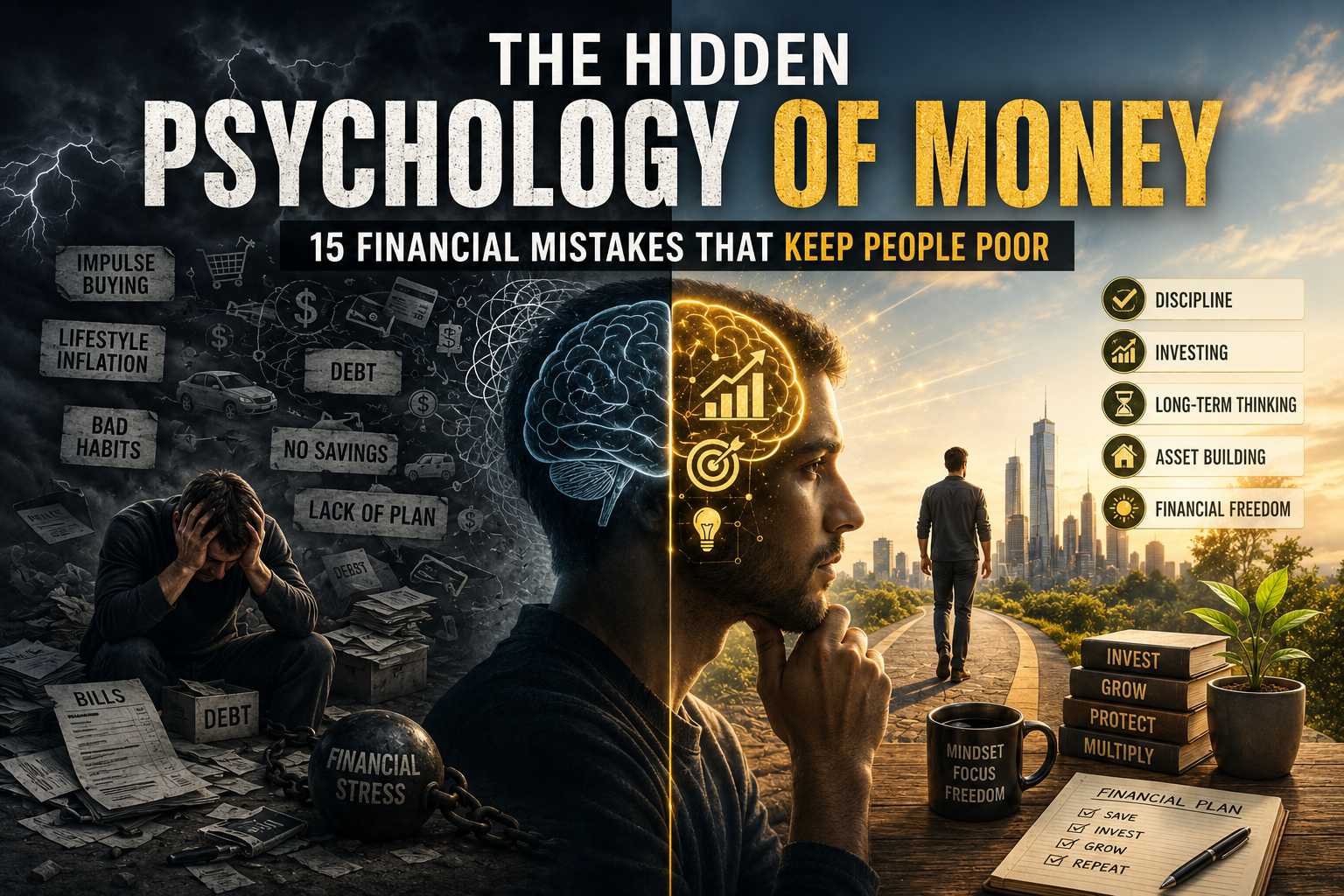
Introduction: Why Money Is More Psychological Than Mathematical
Most people believe financial success is primarily about numbers.
Income.
Budgets.
Investments.
Savings.
Interest rates.
Taxes.
While these factors matter, they are only part of the story.
The uncomfortable truth is that money is often more psychological than mathematical.
If financial success were simply about intelligence, many highly educated people would become wealthy.
If it were simply about information, almost everyone with internet access would be financially successful.
Today, people have access to more financial information than at any point in human history.
Thousands of books.
Millions of articles.
Endless videos.
Podcasts.
Courses.
Experts.
Yet financial stress remains widespread.
Why?
Because financial success is rarely determined by what people know.
It is often determined by how they behave.
The Financial Knowledge Illusion
Imagine two individuals.
The first person understands:
- Investing
- Budgeting
- Compound interest
- Risk management
The second person understands the same concepts.
However, only one consistently applies them.
Who achieves better results?
The answer is obvious.
Knowledge without action creates little value.
Execution creates outcomes.
This is why many people know what they should do financially but still struggle.
The challenge is not information.
The challenge is behavior.
Why Smart People Make Poor Financial Decisions
One of the most fascinating discoveries in behavioral economics is that intelligence does not automatically protect people from bad financial decisions.
Highly intelligent individuals regularly:
- Overspend
- Take unnecessary risks
- Accumulate debt
- Ignore investing
- Chase trends
- Panic during market downturns
Why?
Because financial decisions are often emotional.
Humans evolved to survive.
Not to manage investment portfolios.
Our brains are optimized for immediate threats.
Not long-term wealth creation.
This creates a conflict.
Wealth building rewards patience.
Human psychology often rewards immediate gratification.
The Greatest Enemy of Wealth Is Often Invisible
Many people assume poverty is caused solely by lack of income.
Income matters.
But behavior often matters more than people realize.
Two individuals can earn identical salaries.
One builds wealth.
The other remains financially stressed.
The difference frequently comes down to habits.
Financial outcomes are often the result of repeated behaviors rather than isolated decisions.
Small choices repeated for years create powerful effects.
This principle works in both directions.
Good habits compound.
Bad habits compound.
Why Humans Struggle With Long-Term Thinking
Our ancestors lived in environments where immediate survival mattered.
Food.
Shelter.
Safety.
The future was uncertain.
As a result, humans developed a tendency to prioritize immediate rewards.
This tendency still exists today.
The problem is that modern wealth building requires the opposite approach.
Investing rewards delayed gratification.
Saving rewards delayed gratification.
Business building rewards delayed gratification.
Skill development rewards delayed gratification.
Yet our brains often encourage immediate consumption.
This creates one of the most important psychological battles in personal finance.
The Cost of Instant Gratification
Imagine two versions of the same person.
One consistently chooses:
- Immediate comfort
- Immediate spending
- Immediate entertainment
- Immediate rewards
The other consistently chooses:
- Long-term investing
- Skill development
- Asset building
- Delayed gratification
The difference may appear small at first.
Five years later, it becomes noticeable.
Ten years later, it becomes dramatic.
Twenty years later, the outcomes may be completely different.
This illustrates one of the most important principles of wealth creation:
Small decisions become large outcomes when given enough time.
Why Financial Success Often Looks Boring
Social media frequently presents wealth as excitement.
Luxury cars.
Expensive watches.
Designer clothing.
Luxury vacations.
The reality is often different.
Many financially successful people spend years doing things that appear boring.
They:
- Save consistently
- Invest regularly
- Avoid unnecessary debt
- Build businesses
- Develop skills
- Purchase assets
None of these activities generate immediate excitement.
Yet they often generate long-term wealth.
The problem is that boring actions rarely go viral.
Financial success often depends on behaviors that receive little attention.
The Difference Between Looking Rich and Being Wealthy
This distinction changes everything.
Looking rich is visible.
Wealth is often invisible.
Looking rich may involve:
- Expensive purchases
- Luxury consumption
- Status signaling
Wealth often involves:
- Investments
- Businesses
- Ownership
- Cash reserves
- Assets
Many people spend years pursuing the appearance of wealth while neglecting actual wealth creation.
This mistake can become extremely expensive over time.
Why Emotions Drive Financial Decisions
Most people like to believe they make rational decisions.
Research repeatedly shows otherwise.
Fear influences investing.
Greed influences investing.
Envy influences spending.
Pride influences purchases.
Social pressure influences consumption.
These emotions affect decisions far more than many people realize.
Understanding this reality is essential.
Because the first step toward improving financial behavior is recognizing that emotions are involved.
The Hidden Mental Habits of Wealth Builders
Financially successful individuals often develop specific psychological patterns.
They tend to:
- Think long term
- Focus on ownership
- Control impulses
- Remain patient
- Learn continuously
- Avoid emotional decisions
These habits are not necessarily natural.
They are often developed intentionally.
This is encouraging.
Because habits can be learned.
Why Money Magnifies Existing Behavior
Money rarely changes people.
More often, it magnifies existing tendencies.
Someone who manages money responsibly may become more successful when income increases.
Someone who spends impulsively may continue struggling even with higher earnings.
This explains why income alone does not guarantee financial success.
Behavior remains critical.
The Most Important Financial Question
Most people ask:
“How can I make more money?”
This is a useful question.
A more powerful question may be:
“What financial behaviors are preventing me from keeping and growing the money I already earn?”
This question shifts attention from income to psychology.
And psychology often determines outcomes.
Coming Next
In the next section, we will explore the first five psychological money traps that keep millions of people financially stuck, including lifestyle inflation, social comparison, emotional spending, short-term thinking, and the illusion of affordability.
These traps are subtle, common, and far more expensive than most people realize.
The First Five Psychological Money Traps That Keep People Poor
Most financial advice focuses on external factors.
Income.
Investments.
Budgets.
Debt.
These topics matter.
However, many financial outcomes are driven by something deeper:
Psychology.
The truth is that most people do not lose financial opportunities because they lack intelligence.
They lose opportunities because they repeatedly fall into psychological traps they do not recognize.
These traps are powerful because they feel normal.
Millions of people make the same mistakes.
The behavior becomes socially accepted.
As a result, people rarely question it.
Yet over decades, these mental patterns can cost hundreds of thousands—or even millions—of dollars in lost wealth.
Money Trap #1: Lifestyle Inflation
Lifestyle inflation is one of the most destructive financial habits in the modern world.
The concept is simple.
Income increases.
Spending increases.
Nothing else changes.
Why Lifestyle Inflation Feels Harmless
Imagine someone receives:
- A promotion
- A raise
- A bonus
- A higher-paying job
Their first instinct is often to improve their lifestyle.
A better apartment.
A newer car.
More expensive vacations.
Premium subscriptions.
Luxury purchases.
Individually, these decisions seem reasonable.
After all, people want to enjoy the rewards of hard work.
The problem occurs when spending rises at the same pace as income.
The Invisible Wealth Leak
Suppose two professionals receive identical salary increases over ten years.
The first invests most of the difference.
The second spends most of the difference.
Initially, their lifestyles appear similar.
Twenty years later, their financial positions may be radically different.
One owns assets.
The other owns memories and monthly payments.
This illustrates an important principle:
Many people become richer without becoming wealthier.
Income rises.
Net worth barely changes.
Why Wealth Builders Behave Differently
Financially successful people often enjoy lifestyle improvements.
But they usually do so selectively.
A portion of every income increase goes toward:
- Investments
- Business ownership
- Asset acquisition
- Future opportunities
This creates a gap between earnings and spending.
That gap becomes wealth.
Without the gap, wealth creation becomes difficult.
The Psychology Behind Lifestyle Inflation
The issue is not mathematics.
It is adaptation.
Humans quickly become accustomed to improvements.
Psychologists call this phenomenon hedonic adaptation.
What once felt luxurious soon feels normal.
The new car becomes ordinary.
The upgraded home becomes familiar.
The higher income becomes expected.
As expectations rise, satisfaction often returns to previous levels.
This creates a cycle:
Earn more.
Spend more.
Adapt.
Want more.
Repeat.
Many people spend decades trapped in this loop.
Money Trap #2: Social Comparison
Few forces influence spending more than comparison.
Humans are social creatures.
We constantly evaluate ourselves relative to others.
Neighbors.
Friends.
Coworkers.
Family members.
Social media personalities.
The problem is that comparison rarely improves financial decision-making.
The Comparison Game Never Ends
Imagine earning $100,000 annually.
That may feel successful.
Then you meet someone earning $200,000.
Suddenly your perspective changes.
Then you meet someone earning $500,000.
Then a millionaire.
Then a billionaire.
The comparison ladder has no top.
There will always be someone with:
- More money
- A larger house
- A newer car
- A more impressive lifestyle
This makes comparison a dangerous foundation for financial decisions.
Why Social Media Makes It Worse
Historically, people compared themselves to a limited number of individuals.
Today, social media provides constant exposure to carefully curated lifestyles.
People see:
- Luxury vacations
- Expensive purchases
- Business successes
- Financial milestones
Rarely do they see:
- Debt
- Stress
- Financial mistakes
- Failed investments
- Business losses
As a result, people compare their real lives to someone else’s highlight reel.
This creates distorted perceptions.
The Hidden Cost of Comparison
Comparison often encourages:
- Overspending
- Status purchases
- Financial pressure
- Poor investment decisions
- Unnecessary risk-taking
In extreme cases, people spend money primarily to impress people they do not even know.
This is one of the least efficient uses of money imaginable.
The Wealth Builder’s Perspective
Wealth builders often ask a different question.
Instead of:
“What do other people have?”
They ask:
“What financial position am I building?”
The focus shifts from appearance to progress.
This subtle mental change can transform long-term outcomes.
Money Trap #3: Emotional Spending
Most people believe spending decisions are rational.
Research suggests otherwise.
Many purchases are emotional.
The rational explanation usually appears afterward.
Why Emotions Influence Spending
Money and emotions are deeply connected.
People spend when they feel:
- Happy
- Sad
- Stressed
- Lonely
- Bored
- Excited
- Anxious
The purchase often becomes an attempt to improve emotional state.
This is why shopping is sometimes described as retail therapy.
The problem is that emotional relief is usually temporary.
The financial consequences may last much longer.
The Dopamine Effect
Every purchase creates anticipation.
Anticipation triggers dopamine.
Dopamine creates pleasure.
The brain begins associating spending with reward.
This can become addictive.
Not necessarily in a clinical sense.
But behaviorally.
People begin chasing the emotional experience rather than the value of the purchase itself.
Why Modern Marketing Exploits Psychology
Businesses understand these mechanisms extremely well.
Marketing often emphasizes:
- Scarcity
- Urgency
- Exclusivity
- Status
- Fear of missing out
These triggers influence emotions.
And emotions influence spending.
The goal is not to avoid all purchases.
The goal is to recognize when emotions are driving decisions.
Awareness creates control.
Control improves outcomes.
Money Trap #4: Short-Term Thinking
One of the strongest predictors of financial success is time horizon.
People with short time horizons often make very different decisions than people with long time horizons.
The Immediate Reward Problem
Consider two choices:
Option A:
Spend $1,000 today.
Option B:
Invest $1,000 for the future.
The immediate reward is obvious.
The future reward is abstract.
Humans naturally gravitate toward certainty.
Especially when the future feels distant.
This tendency creates financial challenges.
Why Wealth Requires Future Thinking
Most wealth-building activities involve delayed rewards.
Investing.
Business building.
Skill development.
Content creation.
Real estate.
These activities often produce little immediate gratification.
In many cases, results take years.
This creates an advantage for patient individuals.
Because many people quit before the rewards arrive.
The Time Horizon Advantage
A person thinking five years ahead often makes different decisions than someone thinking five weeks ahead.
The longer the time horizon, the more likely decisions become aligned with wealth creation.
This is one reason wealthy individuals frequently appear patient.
Their perspective operates on a different timeline.
Money Trap #5: The Illusion of Affordability
This may be one of the most dangerous financial traps of all.
Many people evaluate purchases using a single question:
“Can I afford it?”
Unfortunately, this question is often misleading.
Why Affordability Is Not the Right Question
Imagine someone has $10,000 in savings.
They purchase a $5,000 luxury item.
Technically, they could afford it.
The money existed.
The purchase was possible.
Yet that does not automatically mean it was wise.
The Better Question
Instead of asking:
“Can I afford this?”
Wealth builders often ask:
“Is this the best use of this money?”
This question changes everything.
Now the purchase competes against alternatives:
- Investments
- Business opportunities
- Education
- Asset acquisition
- Emergency reserves
The decision becomes strategic rather than emotional.
Opportunity Cost: The Hidden Financial Force
Every dollar spent loses the ability to do something else.
Economists call this opportunity cost.
Most people ignore it.
Wealth builders constantly consider it.
This creates a powerful difference in behavior.
Because wealth is not only determined by what you buy.
It is also determined by what you choose not to buy.
The Common Thread Behind These Traps
At first glance, these five money traps appear unrelated.
Lifestyle inflation.
Comparison.
Emotional spending.
Short-term thinking.
Affordability illusions.
Yet they all share the same underlying problem:
They prioritize immediate satisfaction over long-term outcomes.
This is the central psychological battle of wealth building.
Financial success often depends less on financial knowledge and more on the ability to consistently choose long-term benefits over short-term comfort.
Coming Next
In the next section, we will explore five additional psychological money traps that are even more subtle and often affect intelligent, educated, and high-income individuals.
These include loss aversion, overconfidence, financial identity, scarcity thinking, and the fear of investing—mental patterns that quietly prevent millions of people from reaching their financial potential.
Five More Hidden Psychological Money Traps
The most dangerous financial mistakes are rarely obvious.
Obvious mistakes are easier to avoid.
Everyone knows excessive debt can be harmful.
Everyone knows saving money is important.
Everyone knows spending less than you earn is generally beneficial.
The truly dangerous mistakes are psychological.
They operate quietly.
They influence decisions without attracting attention.
And because they occur inside the mind, they are often difficult to recognize.
Many intelligent, educated, and even high-income individuals remain financially stuck because of these hidden mental patterns.
The following five traps are especially important because they affect not only beginners but also experienced professionals, business owners, and investors.
Money Trap #6: Loss Aversion
One of the most powerful discoveries in behavioral economics is that humans feel losses more intensely than gains.
Psychologists call this phenomenon loss aversion.
Simply put:
The pain of losing $1,000 is often stronger than the pleasure of gaining $1,000.
This may sound harmless.
In reality, it influences countless financial decisions.
How Loss Aversion Affects Investing
Imagine an investor buys a stock.
The investment falls by 30%.
What should happen next?
The rational response depends on:
- Fundamentals
- Valuation
- Long-term prospects
- Portfolio strategy
Unfortunately, emotions often take over.
The investor becomes obsessed with avoiding the pain of loss.
As a result, they may:
- Hold bad investments too long
- Refuse to admit mistakes
- Avoid future investing opportunities
- Make emotional decisions
The goal shifts from maximizing wealth to avoiding emotional discomfort.
Why Loss Aversion Keeps People Poor
Loss aversion does not only affect investing.
It affects life decisions.
People often avoid:
- Starting businesses
- Learning new skills
- Changing careers
- Taking calculated risks
Because potential losses feel larger than potential gains.
This creates stagnation.
The irony is that avoiding risk can sometimes be riskier than taking it.
A person who never invests may avoid market losses.
They may also miss decades of growth.
What Wealth Builders Understand
Successful wealth builders understand an important distinction:
Not all losses are failures.
Some losses are tuition.
Business mistakes teach lessons.
Investment mistakes teach lessons.
Career mistakes teach lessons.
People who learn from losses often outperform people who spend their lives trying to avoid them.
Money Trap #7: Overconfidence
At first glance, confidence seems beneficial.
And it often is.
The problem is overconfidence.
Overconfidence occurs when people overestimate:
- Their knowledge
- Their skills
- Their predictions
- Their ability to control outcomes
This trap becomes particularly dangerous in finance.
Why Overconfidence Is So Expensive
Imagine someone experiences success.
Perhaps:
- A profitable investment
- A successful business
- A winning trade
Success creates confidence.
Confidence creates optimism.
Optimism sometimes becomes overconfidence.
The person begins believing:
“I understand this better than others.”
“I can predict outcomes.”
“I know what will happen next.”
This mindset often leads to excessive risk-taking.
The Expert Illusion
One of the strangest aspects of money is that success can make people less objective.
A person who earns money during a favorable market may assume skill was responsible.
Sometimes it was.
Sometimes luck played a larger role.
The challenge is knowing the difference.
Why Humility Creates Wealth
The most successful long-term investors and business builders often share an unusual trait:
Intellectual humility.
They recognize uncertainty.
They acknowledge mistakes.
They continue learning.
This mindset reduces catastrophic errors.
And avoiding catastrophic errors is one of the most effective wealth-building strategies.
Money Trap #8: Scarcity Thinking
Scarcity thinking is one of the most destructive financial mindsets.
It occurs when people become trapped in constant fear of not having enough.
At first, this sounds reasonable.
Money is important.
Financial security matters.
The problem occurs when scarcity becomes permanent.
The Psychology of Scarcity
People operating from scarcity often focus almost entirely on immediate needs.
Their attention becomes consumed by:
- Bills
- Expenses
- Short-term problems
- Financial pressure
This creates tunnel vision.
Long-term opportunities become difficult to recognize.
Why Scarcity Reduces Performance
Research shows that financial stress can reduce cognitive performance.
When people constantly worry about survival, they often struggle to think strategically.
Decision-making quality declines.
Planning declines.
Creativity declines.
Risk assessment declines.
This creates a vicious cycle.
Financial stress leads to poorer decisions.
Poorer decisions increase financial stress.
The Difference Between Scarcity and Prudence
Some people confuse scarcity thinking with responsibility.
They are not the same.
Prudence says:
“Let’s make smart decisions.”
Scarcity says:
“There will never be enough.”
Prudence creates discipline.
Scarcity creates fear.
The distinction matters enormously.
How Wealth Builders Think Differently
Wealth builders often focus on expansion.
Not merely preservation.
They ask:
How can I create more value?
How can I increase income?
How can I build assets?
How can I improve my skills?
This growth-oriented perspective creates opportunities that scarcity thinking often overlooks.
Money Trap #9: Financial Identity
One of the least discussed aspects of wealth building is identity.
People often behave in ways that reinforce how they see themselves.
This psychological force is surprisingly powerful.
The Invisible Ceiling
Imagine someone subconsciously believes:
“I’m bad with money.”
“I’ll never be wealthy.”
“People like me don’t become financially successful.”
These beliefs influence behavior.
Often without awareness.
The individual may:
- Avoid investing
- Avoid opportunities
- Undervalue their skills
- Accept poor financial situations
The result reinforces the original belief.
This creates a self-fulfilling cycle.
Why Identity Drives Behavior
Most people focus on goals.
Psychologists increasingly recognize that identity often matters more.
A person trying to save money behaves differently from a person who sees themselves as financially disciplined.
A person trying to build wealth behaves differently from a person who identifies as an investor or business owner.
Identity influences actions.
Actions influence outcomes.
Outcomes reinforce identity.
The Wealth Identity Shift
One of the most powerful changes occurs when people stop asking:
“Can I become wealthy?”
and start asking:
“What would a financially successful person do in this situation?”
This subtle shift can dramatically improve decision-making.
Money Trap #10: Fear of Investing
Perhaps no psychological barrier has prevented more wealth creation than fear of investing.
Millions of people understand investing is important.
Yet they delay.
Sometimes for years.
Sometimes for decades.
Why Investing Feels Dangerous
Investing contains uncertainty.
Markets rise.
Markets fall.
Businesses succeed.
Businesses fail.
The future remains unknown.
Humans naturally dislike uncertainty.
As a result, many people choose inaction.
The Hidden Risk of Safety
Ironically, avoiding investing does not eliminate risk.
It simply changes the type of risk.
A person who never invests may avoid market volatility.
But they still face:
- Inflation
- Rising costs
- Lost opportunities
- Reduced purchasing power
These risks are often less visible.
Yet they can be equally damaging over long periods.
The Cost of Waiting
Imagine two individuals.
One starts investing at 25.
The other waits until 40.
The second person may have more knowledge.
More experience.
More confidence.
Yet they have lost something impossible to recover:
Time.
Time is the most powerful ingredient in compounding.
And compounding is one of the most powerful forces in wealth creation.
Why Action Matters More Than Perfection
Many people wait for:
- Perfect knowledge
- Perfect timing
- Perfect confidence
None of these conditions ever arrive.
Financially successful individuals often begin before they feel completely ready.
They learn while moving.
Not while waiting.
The Deep Connection Between These Traps
At first glance, loss aversion, overconfidence, scarcity thinking, financial identity, and fear of investing seem unrelated.
In reality, they stem from the same source:
The human brain evolved for survival.
Not wealth building.
Our instincts often prioritize:
- Safety
- Certainty
- Immediate rewards
- Social approval
Wealth building frequently requires the opposite:
- Calculated risk
- Delayed gratification
- Independent thinking
- Long-term perspective
This creates an ongoing psychological conflict.
Understanding this conflict is one of the most valuable financial skills a person can develop.
Why Wealth Building Is Ultimately a Psychological Game
Many people spend years searching for better investments.
Better strategies.
Better opportunities.
Sometimes the greatest improvement comes from improving decision-making itself.
Because wealth creation often depends less on finding extraordinary opportunities and more on consistently avoiding destructive behaviors.
The investor who controls emotions.
The entrepreneur who remains adaptable.
The saver who thinks long term.
The professional who continuously develops skills.
These individuals often achieve remarkable outcomes not because they are dramatically smarter than everyone else, but because they consistently make slightly better decisions.
And over decades, slightly better decisions become extraordinary results.
Coming Next
In the next section, we will explore the final five psychological money traps, including status addiction, financial procrastination, the lottery mindset, herd behavior, and the illusion of future discipline.
These traps are especially dangerous because they often affect ambitious, hardworking people who genuinely want financial success but unknowingly sabotage themselves along the way.
The Final Five Psychological Money Traps
By now, a pattern should be becoming clear.
Most financial struggles are not caused by a lack of information.
They are caused by behaviors.
The modern world provides almost unlimited access to financial knowledge.
People know they should:
- Save more
- Invest regularly
- Avoid destructive debt
- Think long term
- Build assets
Yet millions still struggle financially.
Why?
Because knowledge and behavior are not the same thing.
The final five money traps are particularly dangerous because they often affect ambitious, hardworking, and intelligent individuals.
In fact, some of these traps become stronger as income increases.
This is why many high earners remain financially stressed despite earning far more than average.
Money Trap #11: Status Addiction
Humans care deeply about status.
This tendency is ancient.
For thousands of years, social standing influenced:
- Safety
- Opportunity
- Relationships
- Survival
Today, status still matters.
But it often expresses itself through money.
Why Status Spending Is So Powerful
People rarely purchase products solely for utility.
They often purchase identity.
The car is not only transportation.
The watch is not only a timepiece.
The house is not only shelter.
These purchases frequently communicate:
- Success
- Achievement
- Belonging
- Social position
The problem arises when financial decisions become driven primarily by appearance.
The Invisible Competition
Many people spend years competing in financial games they never consciously chose to play.
Bigger houses.
Newer cars.
More expensive vacations.
Luxury brands.
Premium lifestyles.
The finish line keeps moving.
Because status is relative.
No matter how much someone acquires, there is always another level.
Another comparison.
Another standard.
Why Status Rarely Creates Satisfaction
Research consistently shows that material upgrades provide temporary happiness.
People adapt.
The excitement fades.
The new purchase becomes normal.
Then the cycle begins again.
This is one reason many wealthy individuals remain surprisingly unhappy.
Money solved financial problems.
It did not solve psychological ones.
The Wealth Builder’s Alternative
Financially successful people often focus less on visible wealth and more on invisible wealth.
Investments.
Businesses.
Ownership.
Cash reserves.
Assets.
These things may not impress strangers.
But they create freedom.
And freedom is often more valuable than status.
Money Trap #12: Financial Procrastination
Few financial mistakes are more expensive than waiting.
Not because waiting feels dangerous.
Because it feels harmless.
Why Procrastination Is So Costly
Consider how often people say:
“I’ll start investing next year.”
“I’ll build a budget later.”
“I’ll learn about money someday.”
“I’ll launch that business eventually.”
“I’ll save when I earn more.”
Years pass.
Nothing changes.
The tragedy is that financial opportunities often depend on time.
And time cannot be recovered.
The Compound Cost of Delay
Imagine delaying investing for ten years.
The money lost is not simply ten years of contributions.
It is ten years of compound growth.
Ten years of learning.
Ten years of experience.
Ten years of momentum.
This hidden cost becomes enormous over decades.
Why Humans Delay Important Things
Financial procrastination often occurs because:
- The task feels complex
- The reward feels distant
- The outcome feels uncertain
Meanwhile, immediate activities feel easier.
Entertainment wins.
Distraction wins.
Comfort wins.
The future loses.
What Successful People Understand
Progress rarely requires perfect action.
It requires consistent action.
A small step today often creates more value than a perfect plan delayed indefinitely.
Money Trap #13: The Lottery Mindset
One of the most common financial fantasies is the belief that wealth arrives suddenly.
Many people unconsciously search for:
- The perfect stock
- The perfect crypto investment
- The perfect business idea
- The perfect side hustle
- The perfect opportunity
They hope one decision will transform their lives.
This is the lottery mindset.
Why This Thinking Is Dangerous
The lottery mindset encourages people to focus on unlikely outcomes.
Instead of:
- Skill development
- Consistency
- Investing
- Asset building
- Long-term growth
they chase breakthroughs.
The problem is that breakthroughs are unpredictable.
Systems are reliable.
How Wealth Is Usually Built
Most wealth is not created by one extraordinary event.
It is created by:
- Thousands of small decisions
- Consistent investing
- Skill development
- Business growth
- Long-term ownership
This process appears slow.
But it is far more dependable.
Why People Love Financial Shortcuts
Shortcuts are attractive because they promise maximum reward with minimal effort.
Unfortunately, shortcuts often create maximum disappointment.
The most reliable path to wealth remains remarkably boring.
And that is precisely why so few people follow it.
Money Trap #14: Herd Behavior
Humans are social creatures.
When uncertainty increases, we often look to others for guidance.
This tendency influences financial decisions more than many people realize.
The Psychology of Following Crowds
Imagine an investment becomes popular.
Everyone is discussing it.
Friends are buying.
News coverage increases.
Social media becomes obsessed.
At this moment, many people feel pressure to participate.
Not because they understand the investment.
Because everyone else appears confident.
Why Crowds Can Be Dangerous
Crowds are not always wrong.
But crowds often become emotional.
Excitement spreads.
Fear spreads.
Optimism spreads.
Panic spreads.
As a result, people frequently buy near peaks and sell near bottoms.
The exact opposite of what creates wealth.
Historical Examples
History repeatedly shows examples of speculative manias.
Different assets.
Different decades.
Same psychology.
The details change.
Human behavior remains remarkably similar.
Independent Thinking as an Asset
Financially successful individuals often develop the ability to think independently.
They gather information.
Evaluate evidence.
Make decisions.
Without relying entirely on crowd behavior.
This skill becomes increasingly valuable in a world overflowing with opinions.
Money Trap #15: The Illusion of Future Discipline
This may be the most deceptive trap of all.
Many people believe their future selves will be more disciplined than they are today.
The Future Self Fantasy
People often assume:
“I’ll save more later.”
“I’ll invest later.”
“I’ll become disciplined later.”
“I’ll start taking money seriously later.”
The assumption is that future circumstances will create better behavior.
Unfortunately, behavior rarely changes automatically.
Why More Income Does Not Solve Everything
A common belief is:
“When I earn more, I’ll finally start building wealth.”
Sometimes this happens.
Often it does not.
Because spending habits usually scale with income.
Without behavioral change, higher income may simply create higher expenses.
The Real Secret
The habits that build wealth at lower income levels are usually the same habits that build wealth at higher income levels.
Discipline does not suddenly appear.
It is developed.
Why Today Matters More Than Tomorrow
Financial success is rarely determined by future intentions.
It is determined by present actions.
The future is shaped by today’s decisions.
Not tomorrow’s promises.
The Hidden Pattern Behind All Fifteen Money Traps
After examining all fifteen psychological traps, a fascinating pattern emerges.
Most financial mistakes are not mathematical.
They are emotional.
People struggle because of:
- Fear
- Ego
- Comparison
- Impatience
- Overconfidence
- Procrastination
- Social pressure
The numbers are often simple.
The psychology is difficult.
Why Wealth Building Is an Internal Game
Many people spend years searching for external solutions.
Better investments.
Better jobs.
Better opportunities.
These things matter.
But sustainable wealth often begins internally.
With:
- Better habits
- Better decisions
- Better emotional control
- Better long-term thinking
The person who masters these skills gains an enormous advantage.
Because they stop fighting against their own psychology.
The Wealth Mindset Framework
If we simplify everything discussed throughout this article, long-term financial success often comes down to five principles:
Think Long Term
Most wealth requires time.
Control Emotions
Emotional decisions are expensive.
Build Assets
Ownership creates freedom.
Ignore Comparison
Focus on progress rather than appearances.
Stay Consistent
Consistency compounds.
These principles sound simple.
Yet they separate people who build wealth from people who merely earn income.
Coming Next
In the final section, we will bring everything together.
We will compare the psychology of wealthy and financially struggling individuals, explore practical ways to improve money habits, answer the most important financial psychology questions, and create a step-by-step framework readers can apply immediately to improve their financial future.
Wealthy Minds vs Poor Minds: The Psychology Behind Financial Outcomes
After examining fifteen psychological money traps, an important question remains:
What separates people who consistently build wealth from those who remain financially stressed?
The answer is often less about intelligence and more about mindset.
This does not mean wealthy people are inherently smarter.
Nor does it mean financially struggling individuals are less capable.
Rather, different financial outcomes frequently emerge from different patterns of thinking.
The goal of this section is not to judge people.
The goal is to understand behaviors.
Because behaviors can be changed.
And changing behavior can change financial outcomes.
The Difference Between Income and Financial Thinking
One of the biggest misconceptions about money is that income automatically creates wealth.
Reality suggests otherwise.
Many high-income earners struggle financially.
Many moderate-income earners build substantial wealth.
This occurs because wealth and income are not the same thing.
Income creates opportunity.
Behavior determines what happens next.
The key question is:
What do people do with the opportunities available to them?
Wealthy Minds Focus on Assets
Financially successful people often think differently about money.
When they receive income, they frequently ask:
“How can this money create more money?”
This mindset naturally directs attention toward:
- Investments
- Businesses
- Real estate
- Intellectual property
- Skills
- Ownership
Assets become the focus.
Why Assets Matter
Assets can continue generating value long after the original effort ends.
A stock portfolio.
A rental property.
A successful website.
A software product.
A business.
A book.
These assets can continue producing results.
The goal becomes building systems rather than simply earning income.
The Consumption Trap
Financially struggling individuals are not necessarily irresponsible.
However, they often receive the same income and direct more of it toward consumption.
Consumption provides immediate satisfaction.
Assets often provide delayed rewards.
This difference compounds over time.
Wealthy Minds Ask Better Questions
Questions influence decisions.
Decisions influence outcomes.
Financially successful people often ask questions such as:
- What is the opportunity cost?
- Is this purchase creating value?
- How can I increase my earning power?
- How can I make this money productive?
- What skills should I develop?
These questions create different behaviors.
Different behaviors create different results.
The Power of Opportunity Cost
Every financial decision closes other possibilities.
A dollar spent cannot be invested.
A dollar invested cannot be spent.
Understanding this trade-off is one of the most valuable financial skills.
Wealth builders frequently evaluate decisions through this lens.
Not because they never spend money.
But because they understand alternatives.
Wealthy Minds Think in Decades
One of the clearest differences between financial outcomes is time horizon.
Many people think in:
- Days
- Weeks
- Months
Wealth builders often think in:
- Years
- Decades
This perspective changes behavior dramatically.
The Long-Term Advantage
Consider two individuals.
One focuses on immediate comfort.
The other focuses on future freedom.
Their daily decisions may appear similar.
Five years later, the difference becomes noticeable.
Twenty years later, the gap can become extraordinary.
Time magnifies behavior.
This is why small habits matter so much.
Wealthy Minds Prioritize Ownership
Ownership is a recurring theme in wealth creation.
Owners benefit differently than consumers.
Consumers purchase products.
Owners participate in value creation.
This distinction appears repeatedly among financially successful individuals.
They often seek ownership in:
- Companies
- Investments
- Intellectual property
- Businesses
- Real estate
Ownership creates leverage.
Leverage accelerates wealth creation.
Why Ownership Changes Everything
Most people exchange time for money.
Owners create systems that generate value beyond their personal labor.
This does not happen overnight.
However, ownership is often where significant wealth originates.
Financially Successful People Understand Delayed Gratification
Delayed gratification may be the most important wealth-building skill.
The ability to sacrifice a smaller reward today for a larger reward tomorrow creates powerful advantages.
The Compounding Effect of Discipline
A single disciplined decision may seem insignificant.
One investment.
One saved dollar.
One avoided purchase.
One additional skill.
One productive habit.
Individually, these actions appear small.
Repeated consistently, they become transformative.
Why Most People Struggle
The challenge is psychological.
Immediate rewards feel real.
Future rewards feel abstract.
The human brain naturally prefers certainty.
This is why delayed gratification is so valuable.
It is difficult.
And difficult behaviors often create competitive advantages.
The Practical Psychology of Building Wealth
Many readers may now wonder:
How can these ideas actually be applied?
The answer is simpler than most people expect.
Financial improvement usually begins with awareness.
Step 1: Identify Your Financial Triggers
Pay attention to:
- Emotional spending
- Comparison behavior
- Impulsive purchases
- Fear-based decisions
Awareness creates control.
Step 2: Create Automatic Systems
Humans are imperfect.
Systems reduce reliance on willpower.
Examples include:
- Automatic investing
- Automatic saving
- Automatic bill payments
Automation improves consistency.
Step 3: Increase Financial Education
Knowledge alone is not enough.
But it remains important.
Learn about:
- Investing
- Taxes
- Business
- Assets
- Cash flow
Financial literacy improves decision quality.
Step 4: Build Skills
Skills increase earning potential.
Increased earning potential creates opportunities.
The most valuable asset often sits between your ears.
Step 5: Focus on Net Worth
Many people track income.
Fewer track net worth.
Wealth is ultimately reflected by what you own minus what you owe.
Monitoring this metric provides a clearer picture of progress.
The Most Powerful Financial Habit
If one habit appears repeatedly among successful individuals, it is consistency.
Not brilliance.
Not luck.
Not perfection.
Consistency.
Small positive actions repeated for years create extraordinary outcomes.
This principle applies to:
- Investing
- Business building
- Skill development
- Saving
- Health
- Relationships
Consistency compounds.
And compounding is one of the most powerful forces in life.
Related Articles
Continue exploring:
- How to Build Wealth in Your 20s
- Best High-Income Careers for the Future
- Best Skills to Learn in 2026
- Best Online Businesses to Start in 2026
- Best Side Hustles That Can Make $1,000+ Per Month in 2026
- Best Passive Income Ideas for 2026
- Why Most Small Businesses Fail
- How Small Businesses Are Using AI in 2026
Frequently Asked Questions
Is wealth mostly about mindset?
Mindset alone is not enough. However, mindset strongly influences behavior, and behavior significantly influences financial outcomes.
Can someone become wealthy on an average income?
Yes. Higher income helps, but saving, investing, skill development, and asset ownership play major roles in wealth creation.
What is the biggest psychological obstacle to wealth?
Many experts would argue that short-term thinking is among the most damaging obstacles because wealth creation often requires delayed gratification.
Why do some high-income people remain financially stressed?
Income does not automatically create wealth. Spending habits, debt, lifestyle inflation, and financial behavior influence outcomes.
Can financial habits be changed?
Absolutely. Financial habits are learned behaviors, which means they can also be improved through awareness, systems, and consistent practice.
Final Thoughts
The greatest financial battle is rarely fought in the stock market.
It is rarely fought in boardrooms.
It is rarely fought in economic reports.
It is fought inside the human mind.
Every day, people make choices between:
Consumption and ownership.
Comfort and growth.
Impulse and discipline.
Short-term rewards and long-term freedom.
These choices often appear insignificant.
Yet over years and decades, they shape financial outcomes.
The people who build wealth are not necessarily the smartest.
They are often the people who consistently make decisions aligned with their future rather than their present emotions.
They understand that wealth is not simply a financial achievement.
It is a behavioral achievement.
Because money tends to flow toward habits.
And habits, when repeated long enough, become destiny.
The hidden psychology of money ultimately teaches a powerful lesson:
Financial success is not merely about earning more.
It is about thinking differently, behaving differently, and making better decisions long enough for compounding to do its work.