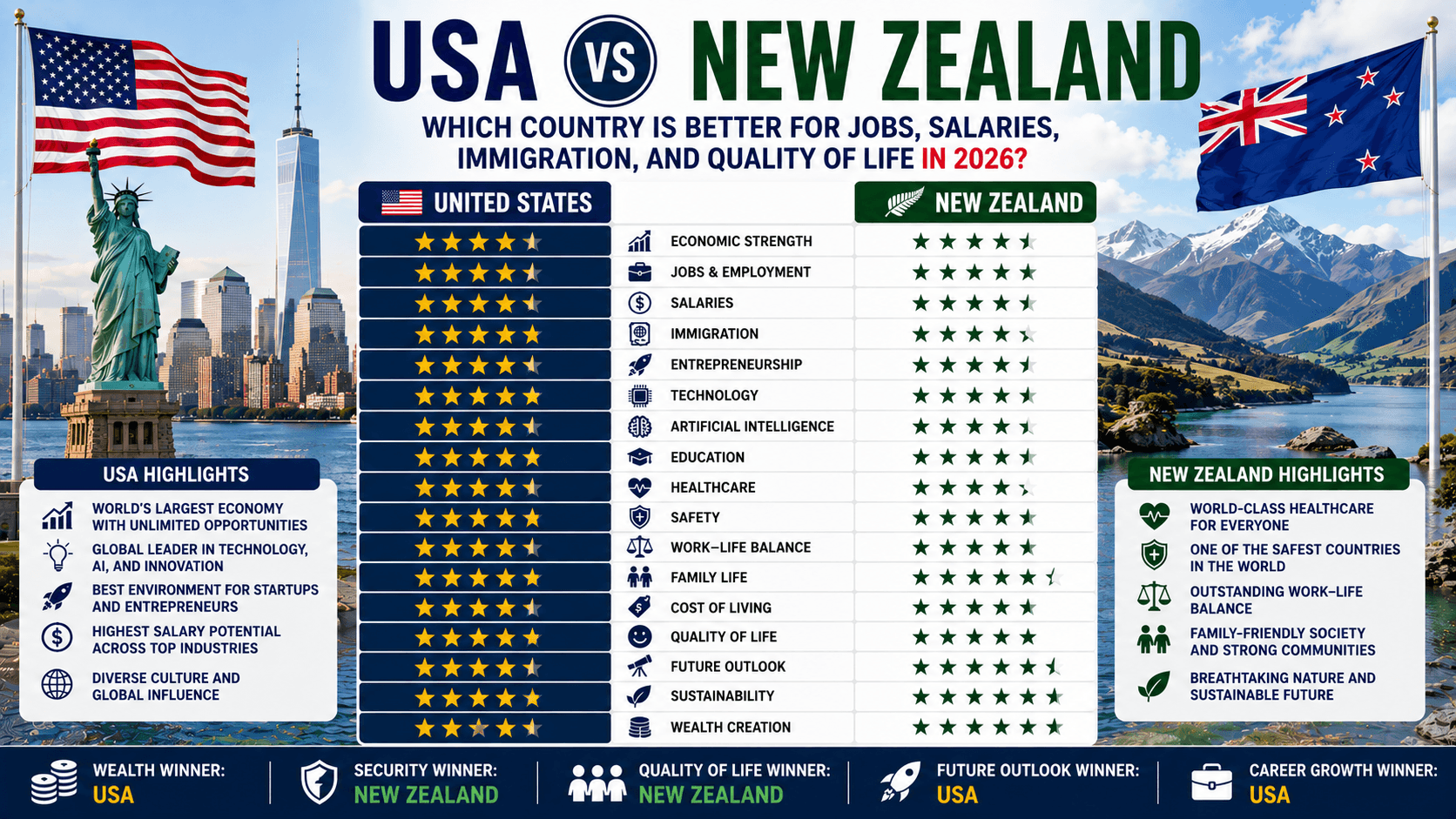
Reaching the final comparison in this series brings us to one of the most fascinating decisions facing skilled professionals, entrepreneurs, students, and families considering a move abroad.
The United States and New Zealand are both highly developed countries with stable democracies, strong economies, and excellent standards of living.
Yet beyond those similarities lies a profound difference in how each nation defines success.
The United States has spent more than a century establishing itself as the world’s economic powerhouse.
It leads global innovation.
It dominates technology.
It drives financial markets.
It attracts ambitious people from every continent.
Its economy rewards those willing to compete, innovate, and take risks.
New Zealand has chosen a different path.
Rather than becoming the world’s largest economy, it has focused on becoming one of the world’s best places to live.
It consistently ranks among the global leaders in safety, environmental quality, political stability, work-life balance, and overall life satisfaction.
Its cities are clean.
Its institutions are trusted.
Its landscapes are breathtaking.
Its communities are known for their friendliness and openness.
This comparison is therefore not simply about money.
It is about lifestyle.
It is about deciding whether your future should prioritize maximum opportunity or maximum balance.
America represents ambition without limits.
New Zealand represents prosperity without constant pressure.
One country encourages people to chase extraordinary careers.
The other encourages people to build extraordinary lives.
Neither philosophy is universally better.
The better choice depends entirely on what success means to you.
At a Glance: USA vs New Zealand
| Category | United States | New Zealand |
|---|---|---|
| Population | Very Large | Small |
| Economy | World’s Largest | Advanced High-Income Economy |
| Main Language | English | English |
| Best For | High salaries, entrepreneurship, technology | Quality of life, safety, nature, work-life balance |
| Immigration | Competitive | Skilled-worker friendly |
| Technology Sector | World Leader | Growing Innovation Hub |
| Startup Ecosystem | Global Leader | Strong |
| Healthcare | Advanced | Universal & High Quality |
| Safety | Good (varies by region) | Excellent |
| Work-Life Balance | Moderate | Outstanding |
| Wealth Creation | Exceptional | Strong |
| Quality of Life | Very High | Outstanding |
The contrast becomes immediately apparent.
America succeeds through scale.
New Zealand succeeds through simplicity.
The United States offers almost unlimited professional possibilities.
New Zealand offers one of the most relaxed and balanced lifestyles in the developed world.
One maximizes economic opportunity.
The other maximizes everyday happiness.
Why This Comparison Matters in 2026
Global priorities have changed dramatically over the past decade.
Higher salaries remain attractive.
But professionals increasingly evaluate countries based on much broader criteria.
Healthcare.
Mental well-being.
Safety.
Environmental quality.
Family life.
Housing.
Remote work.
Political stability.
Personal freedom.
Artificial Intelligence has transformed labor markets.
Remote employment allows professionals to work internationally.
Businesses recruit talent globally rather than locally.
As a result, relocation decisions have become more strategic than ever.
The United States continues attracting millions of ambitious professionals because it remains unmatched in:
- Artificial Intelligence
- Software Engineering
- Venture Capital
- Finance
- Biotechnology
- Aerospace
- Scientific Research
- Entrepreneurship
New Zealand attracts a different type of international talent.
People seeking balance.
Families.
Healthcare professionals.
Engineers.
Researchers.
Remote workers.
Entrepreneurs looking for stability rather than relentless competition.
Its immigration system actively targets skilled professionals capable of supporting long-term economic development.
For many people, quality of life has become just as valuable as income.
That makes this comparison especially relevant in 2026.
The Fundamental Difference
The biggest difference between the United States and New Zealand can be summarized in one sentence:
The United States maximizes opportunity. New Zealand maximizes quality of life.
The American model encourages people to compete.
To innovate.
To invest.
To build companies.
To create wealth.
To pursue extraordinary careers.
The rewards can be enormous.
The financial ceiling is virtually unlimited.
New Zealand follows another philosophy.
Professional achievement remains important.
Innovation is welcomed.
Entrepreneurship is encouraged.
But success should never come at the expense of personal well-being.
This philosophy influences almost every aspect of New Zealand society.
Healthcare.
Education.
Environmental protection.
Urban planning.
Working culture.
Community relationships.
Public services.
The result is one of the world’s most peaceful and livable countries.
America often creates extraordinary success stories.
New Zealand consistently creates extraordinary lifestyles.
One rewards exceptional ambition.
The other rewards sustainable happiness.
Strategic Comparison
The United States remains the world’s most influential economic and technological power.
Its companies shape global industries.
Its universities influence scientific research.
Its financial markets direct international investment.
Its innovation ecosystem continues driving the future of Artificial Intelligence, cloud computing, biotechnology, advanced manufacturing, and digital services.
Few countries possess comparable influence.
New Zealand competes differently.
Instead of relying on scale, it relies on efficiency, trust, and specialization.
The country has become internationally respected for:
- Sustainable Agriculture
- Renewable Energy
- Environmental Innovation
- Food Technology
- Tourism
- Digital Services
- Advanced Manufacturing
- Clean Energy Solutions
Its government consistently ranks among the world’s most transparent.
Public institutions enjoy exceptionally high levels of trust.
Infrastructure remains modern.
Business regulation is straightforward.
America dominates globally.
New Zealand excels intelligently.
Economic Strength
The United States possesses the largest economy in history.
Its strengths include:
- Artificial Intelligence
- Technology
- Finance
- Healthcare
- Aerospace
- Manufacturing
- Energy
- Consumer Markets
- Venture Capital
Its scale generates opportunities unavailable anywhere else.
New Zealand’s economy is considerably smaller.
However, it remains one of the world’s most stable and resilient advanced economies.
Its strengths include:
- Agriculture
- Food Exports
- Renewable Energy
- Tourism
- Biotechnology
- Advanced Manufacturing
- Digital Innovation
- Logistics
Strong institutions.
Low corruption.
Transparent regulation.
Highly skilled workers.
These factors continue supporting long-term economic resilience.
Despite New Zealand’s impressive performance, the difference in economic scale remains overwhelming.
| Economic Factor | USA | New Zealand |
|---|---|---|
| Economic Size | Excellent | Strong |
| Global Influence | Excellent | Strong |
| Innovation Capacity | Excellent | Strong |
| Productivity | Excellent | Excellent |
| Economic Stability | Strong | Excellent |
| Long-Term Growth | Excellent | Strong |
Overall Winner: USA
Its economic scale continues providing unmatched global influence and extraordinary professional opportunities.
Jobs and Employment
Employment opportunities remain one of America’s greatest strengths.
Its labor market is the largest in the developed world.
Technology.
Healthcare.
Engineering.
Finance.
Manufacturing.
Energy.
Media.
Scientific Research.
Consulting.
Construction.
Career mobility remains exceptionally strong.
Talented professionals frequently move between industries while increasing income.
New Zealand offers a smaller but highly stable labor market.
Demand remains particularly strong in:
- Healthcare
- Engineering
- Information Technology
- Construction
- Renewable Energy
- Education
- Agriculture
- Skilled Trades
Employers often emphasize collaboration, long-term employment, and workplace well-being rather than aggressive competition.
International professionals also benefit from an English-speaking environment, making integration considerably easier than in many European countries.
America offers more opportunities.
New Zealand offers greater stability and balance.
| Employment Factor | USA | New Zealand |
|---|---|---|
| Job Availability | Excellent | Strong |
| Career Mobility | Excellent | Strong |
| Technology Jobs | Excellent | Strong |
| International Companies | Excellent | Strong |
| Labor Market Stability | Strong | Excellent |
| Professional Development | Excellent | Strong |
Overall Winner: USA
The United States continues offering the world’s largest and most dynamic labor market.
Salaries
The United States provides some of the highest salaries available anywhere in the world.
Particularly in:
- Artificial Intelligence
- Software Engineering
- Finance
- Medicine
- Executive Leadership
- Consulting
- Entrepreneurship
Top-performing professionals can achieve extraordinary income growth.
New Zealand offers competitive salaries relative to its economy.
However, income differences remain much smaller.
The emphasis is not maximizing executive compensation.
The emphasis is maintaining broad economic stability.
The result is lower income inequality but a lower financial ceiling.
America rewards exceptional performance more aggressively.
New Zealand rewards sustainable careers.
For professionals seeking the highest possible earning potential, the United States remains the stronger choice.
Immigration
Immigration highlights one of the most practical differences between these countries.
The United States continues attracting global talent through its enormous economy.
However, obtaining permanent residency can be lengthy and highly competitive.
Employer sponsorship is often required.
Visa pathways remain complex.
New Zealand actively recruits skilled workers across numerous industries.
Its immigration system is structured, transparent, and designed to address labor shortages.
Professionals working in healthcare, engineering, education, construction, information technology, and renewable energy often enjoy favorable opportunities.
For career acceleration, America remains difficult to surpass.
For a smoother long-term relocation experience, New Zealand offers a compelling alternative.
Wealth Creation: The Opening Perspective
If wealth creation alone determined the winner, the United States would remain one of the strongest countries ever created.
High salaries.
Stock ownership.
Entrepreneurship.
Global financial markets.
Artificial Intelligence.
Venture Capital.
Technology leadership.
Together, these create extraordinary financial opportunities.
New Zealand follows another philosophy.
Rather than maximizing extreme personal wealth, it focuses on creating financial security, stable communities, and sustainable prosperity.
The difference is striking.
America creates more billionaires.
New Zealand creates more balanced lives.
America rewards extraordinary ambition.
New Zealand rewards extraordinary well-being.
Determining which philosophy ultimately creates the better future requires examining entrepreneurship, technology, Artificial Intelligence, education, healthcare, safety, family life, and work-life balance in far greater depth.
The comparison between the United States and New Zealand becomes significantly more interesting once we move beyond GDP, population, and salary figures.
Economic size can explain how powerful a country is.
It cannot explain how enjoyable life becomes after work ends.
That is the true difference between these two nations.
The United States has built the world’s most dynamic economy by encouraging competition, innovation, entrepreneurship, and individual ambition.
New Zealand has built one of the world’s most balanced societies by focusing on safety, sustainability, trust, and human well-being.
One asks people to pursue bigger dreams.
The other asks people to enjoy the life those dreams create.
Neither philosophy is inherently superior.
The better choice depends entirely on your personal definition of success.
Entrepreneurship
The United States remains the global benchmark for entrepreneurship.
No country has created more globally influential companies or produced more startup success stories.
Apple.
Microsoft.
Amazon.
Google.
NVIDIA.
Tesla.
Meta.
OpenAI.
SpaceX.
These companies did not emerge by coincidence.
They are the result of an ecosystem specifically designed to reward innovation and calculated risk.
Entrepreneurs in the United States gain access to:
- The world’s largest venture capital market
- Hundreds of millions of consumers
- Elite universities
- Experienced founders and mentors
- Global financial institutions
- Deep private investment networks
- Highly developed legal protections
- Mature acquisition and IPO markets
Perhaps America’s greatest advantage is its entrepreneurial culture.
Failure is rarely viewed as permanent.
Instead, successful founders often describe failed businesses as valuable experience that prepared them for larger achievements.
This mindset encourages innovation on a scale that very few countries can replicate.
New Zealand approaches entrepreneurship differently.
Its startup ecosystem is considerably smaller.
However, it has earned an outstanding reputation for innovation, agility, and sustainable business development.
Rather than chasing rapid expansion at any cost, many New Zealand entrepreneurs focus on solving practical global challenges.
Key sectors include:
- Agricultural Technology
- Renewable Energy
- Food Technology
- Biotechnology
- Tourism Innovation
- Software Development
- Environmental Engineering
- Marine Technology
The country’s business environment is consistently ranked among the easiest in the world for starting and operating a company.
Government regulations remain transparent.
Administrative procedures are efficient.
Corruption is extremely low.
Trust between businesses and public institutions remains exceptionally high.
America creates startups that dominate global markets.
New Zealand creates businesses that are highly resilient, efficient, and internationally respected.
| Entrepreneurship Factor | USA | New Zealand |
|---|---|---|
| Startup Ecosystem | Excellent | Strong |
| Venture Capital | Excellent | Moderate |
| Global Scaling Potential | Excellent | Strong |
| Ease of Starting a Business | Excellent | Excellent |
| Innovation Culture | Excellent | Excellent |
| Long-Term Business Stability | Strong | Excellent |
Winner: USA
America continues offering the world’s most powerful environment for entrepreneurs seeking maximum scale and investment.
Technology
Technology represents one of America’s greatest competitive advantages.
The country continues leading the world in:
- Artificial Intelligence
- Cloud Computing
- Software Engineering
- Semiconductors
- Quantum Computing
- Robotics
- Biotechnology
- Cybersecurity
- Digital Platforms
The American innovation ecosystem functions as a continuous cycle.
Universities produce researchers.
Researchers launch startups.
Startups attract venture capital.
Successful companies reinvest into future innovation.
The cycle repeats.
This self-reinforcing ecosystem explains why America remains the world’s technology leader.
New Zealand follows another model.
Rather than competing through size, it competes through specialization.
Its technology sector focuses heavily on practical innovation.
Major strengths include:
- Agritech
- Environmental Technology
- Software Engineering
- Digital Services
- Renewable Energy Solutions
- Artificial Intelligence Applications
- Precision Manufacturing
New Zealand also ranks highly for digital government.
Many public services operate efficiently online.
Digital infrastructure continues improving rapidly.
Technology is viewed as a tool for improving daily life rather than simply creating new industries.
America builds tomorrow’s technologies.
New Zealand excels at applying technology to solve real-world problems.
| Technology Factor | USA | New Zealand |
|---|---|---|
| Software Industry | Excellent | Strong |
| Technology Leadership | Excellent | Strong |
| Digital Infrastructure | Excellent | Excellent |
| Innovation Scale | Excellent | Strong |
| Engineering Excellence | Excellent | Strong |
| Technology Adoption | Excellent | Excellent |
Winner: USA
While New Zealand performs impressively for its size, America’s influence over the global technology sector remains unmatched.
Artificial Intelligence
Artificial Intelligence has become one of the defining technologies of the twenty-first century.
The United States currently occupies the strongest position in this global race.
Its advantages are extensive.
World-leading AI laboratories.
Elite universities.
Massive venture capital investment.
Advanced computing infrastructure.
Global talent attraction.
Commercial deployment.
American companies continue developing many of the foundational AI models transforming industries worldwide.
Healthcare.
Finance.
Education.
Manufacturing.
Transportation.
Defense.
Scientific Research.
Nearly every major sector increasingly relies on American AI innovation.
New Zealand has embraced Artificial Intelligence with a different objective.
Rather than leading global AI development, it focuses on responsible implementation.
AI is increasingly integrated into:
- Agriculture
- Environmental Monitoring
- Healthcare
- Logistics
- Education
- Public Administration
- Smart Infrastructure
The country’s smaller size allows rapid adoption of emerging technologies while maintaining strong regulatory oversight.
New Zealand excels at applying AI efficiently.
The United States continues creating much of the AI that shapes the global economy.
| AI Factor | USA | New Zealand |
|---|---|---|
| AI Research | Excellent | Strong |
| AI Investment | Excellent | Moderate |
| AI Commercialization | Excellent | Strong |
| AI Infrastructure | Excellent | Strong |
| AI Adoption | Excellent | Excellent |
| Global AI Leadership | Excellent | Strong |
Winner: USA
Education
Education remains one of New Zealand’s greatest strengths.
The country consistently maintains high educational standards while emphasizing creativity, independent thinking, and practical learning.
Students benefit from:
- Small classroom environments
- Strong teacher support
- Research-based curricula
- Internationally recognized universities
- High educational accessibility
New Zealand’s education system encourages problem-solving rather than memorization.
Critical thinking becomes a central objective from an early age.
The United States dominates elite higher education.
Harvard.
MIT.
Stanford.
Princeton.
Caltech.
Berkeley.
These universities continue producing many of the world’s leading researchers, entrepreneurs, scientists, and Nobel Prize winners.
Graduates often gain access to extraordinary international career opportunities.
The difference is clear.
America possesses the world’s highest educational ceiling.
New Zealand offers one of the world’s most consistently effective educational systems.
| Education Factor | USA | New Zealand |
|---|---|---|
| Elite Universities | Excellent | Strong |
| Research Excellence | Excellent | Excellent |
| Educational Accessibility | Strong | Excellent |
| Teaching Quality | Excellent | Excellent |
| Graduate Employability | Excellent | Excellent |
| Student Well-Being | Strong | Excellent |
Winner: Tie
America dominates elite higher education.
New Zealand excels in educational quality and student experience.
Healthcare
Healthcare reveals one of the clearest philosophical differences between these countries.
The United States remains one of the world’s leaders in medical innovation.
Its hospitals perform groundbreaking treatments.
Its universities conduct internationally respected medical research.
Its pharmaceutical companies continue transforming modern medicine.
Patients with comprehensive insurance frequently receive exceptional care.
However, accessibility remains the largest challenge.
Healthcare costs are among the highest globally.
Insurance complexity creates uncertainty for many households.
New Zealand follows a universal healthcare model.
Every resident has access to essential medical care.
The healthcare system emphasizes:
- Preventive medicine
- Community healthcare
- Early diagnosis
- Public accessibility
- Long-term health outcomes
While highly specialized procedures may occasionally involve longer waiting times, the overall system consistently delivers strong health outcomes with far lower financial stress.
The American model prioritizes innovation.
The New Zealand model prioritizes accessibility.
Both save lives.
New Zealand generally provides greater peace of mind.
| Healthcare Factor | USA | New Zealand |
|---|---|---|
| Medical Innovation | Excellent | Strong |
| Accessibility | Moderate | Excellent |
| Affordability | Moderate | Excellent |
| Preventive Care | Strong | Excellent |
| Patient Satisfaction | Good | Excellent |
| Financial Security | Moderate | Excellent |
Winner: New Zealand
Safety
Safety remains one of New Zealand’s greatest international strengths.
The country consistently ranks among the safest places on Earth.
Violent crime remains low.
Communities maintain exceptionally high levels of trust.
Police enjoy strong public confidence.
Children frequently walk to school independently.
Outdoor lifestyles remain deeply embedded within daily life.
The United States offers a much more diverse experience.
Many regions remain exceptionally safe.
Others experience considerably higher crime rates.
Safety often depends on the city, neighborhood, and local economic conditions.
New Zealand offers something difficult to measure but incredibly valuable.
Consistency.
Residents rarely organize their lives around concerns about personal security.
Winner: New Zealand
Family Life
New Zealand has built one of the world’s most family-friendly societies.
Parents benefit from:
- Universal healthcare
- Strong public education
- Safe communities
- Family-oriented workplaces
- Outdoor recreation
- Clean environments
Children grow up surrounded by nature while enjoying exceptional safety.
Communities remain closely connected.
Stress levels tend to be lower.
The United States offers children extraordinary opportunities.
World-leading universities.
Technology careers.
Entrepreneurship.
Scientific research.
Creative industries.
Professional sports.
Few countries provide greater long-term career possibilities.
The difference lies in emphasis.
America maximizes opportunity.
New Zealand maximizes childhood.
For families prioritizing everyday well-being, New Zealand enjoys a meaningful advantage.
Winner: New Zealand
Work-Life Balance
Perhaps no category better illustrates the difference between these countries.
The American model rewards hard work with exceptional financial opportunities.
Career advancement often requires longer working hours and greater competition.
New Zealand follows another philosophy.
Professional success should complement life rather than replace it.
Employees commonly enjoy:
- Flexible working arrangements
- Generous annual leave
- Respect for personal time
- Family-friendly workplace policies
- Healthy outdoor lifestyles
- Lower workplace stress
Productivity remains strong despite fewer working hours.
Life extends beyond work.
That philosophy consistently places New Zealand among the world’s most desirable places to live.
Winner: New Zealand
By this stage of the comparison, a clear pattern has emerged.
The United States dominates:
- Entrepreneurship
- Technology
- Artificial Intelligence
- Innovation
- Career Growth
- Global Business Influence
New Zealand dominates:
- Healthcare
- Safety
- Family Life
- Work-Life Balance
- Community Well-Being
- Everyday Quality of Life
America offers one of the highest professional ceilings ever created.
New Zealand offers one of the strongest foundations for a peaceful, healthy, and fulfilling life.
The next section will determine which philosophy ultimately creates greater long-term prosperity by examining income growth, cost of living, purchasing power, housing affordability, taxation, investing opportunities, banking systems, economic resilience, and wealth creation.
The real measure of prosperity is not how much money a country produces.
It is how effectively that money improves people’s lives.
Some nations generate enormous wealth but leave individuals responsible for managing almost every financial risk themselves.
Others generate smaller economies while protecting citizens from many of the financial uncertainties that define modern life.
The United States and New Zealand represent two of the clearest examples of these opposing philosophies.
The United States has become the world’s most powerful wealth-generation engine.
New Zealand has become one of the world’s strongest examples of sustainable prosperity.
America rewards exceptional ambition.
New Zealand rewards financial stability.
One encourages people to accumulate more.
The other ensures people worry less.
Neither approach is universally better.
The better choice depends entirely on whether your priority is maximizing wealth or maximizing financial security.
Income Growth Potential
Few countries can match the career growth potential available in the United States.
The American economy rewards exceptional performance more aggressively than almost any other developed nation.
Professionals working in:
- Artificial Intelligence
- Software Engineering
- Cybersecurity
- Investment Banking
- Biotechnology
- Medicine
- Executive Management
- Sales
- Consulting
- Entrepreneurship
can experience income growth that far exceeds global averages.
One reason is that compensation rarely ends with salary.
High-performing employees often receive:
- Annual performance bonuses
- Restricted Stock Units (RSUs)
- Stock options
- Profit-sharing programs
- Startup equity
- Executive incentives
- Long-term performance awards
In many technology companies, equity appreciation alone can transform employees into millionaires over time.
The American labor market rewards innovation, leadership, and measurable performance.
Career progression is often rapid.
Income ceilings remain extraordinarily high.
New Zealand follows another philosophy.
Professional growth certainly exists.
However, salary progression is generally more balanced.
Income inequality remains relatively low.
Companies prioritize long-term employment relationships rather than aggressive competition.
Executive salaries remain closer to average wages.
The result is greater financial equality but lower maximum earning potential.
America creates extraordinary financial opportunities.
New Zealand creates extraordinary financial consistency.
| Income Growth Factor | USA | New Zealand |
|---|---|---|
| Salary Growth | Excellent | Strong |
| Executive Compensation | Excellent | Strong |
| Stock-Based Compensation | Excellent | Moderate |
| Startup Equity Potential | Excellent | Moderate |
| Long-Term Income Ceiling | Excellent | Strong |
Winner: USA
Cost of Living
High salaries only create wealth when they exceed everyday expenses.
This is where New Zealand begins recovering much of the gap.
The United States offers tremendous earning potential.
It also presents tremendous variation.
Living comfortably in Texas differs dramatically from living in California or New York.
Housing.
Healthcare.
Insurance.
Childcare.
Education.
Transportation.
Taxes.
All vary significantly depending on location.
Many high-income professionals spend a substantial percentage of their earnings simply maintaining their lifestyle.
New Zealand is not an inexpensive country.
Housing prices in Auckland have increased considerably.
Imported consumer goods often cost more than in America.
However, many essential expenses remain much more predictable.
Healthcare is publicly supported.
Education costs remain considerably lower.
Public services reduce long-term household expenses.
Communities are designed around shorter commuting distances.
Financial surprises occur less frequently.
The result is often overlooked.
Many New Zealand families experience lower financial stress despite earning lower salaries.
America maximizes earning potential.
New Zealand minimizes financial uncertainty.
| Cost Category | USA | New Zealand |
|---|---|---|
| Healthcare Costs | Higher | Lower |
| Education Costs | Higher | Lower |
| Childcare Costs | Higher | Moderate |
| Transportation Costs | Moderate | Lower |
| Financial Predictability | Moderate | Excellent |
Winner: New Zealand
Purchasing Power
Purchasing power reveals what income actually delivers.
Salary alone rarely tells the complete story.
An engineer earning $220,000 in San Francisco may devote enormous resources to housing, insurance, childcare, and healthcare.
Meanwhile, an experienced engineer earning considerably less in New Zealand may enjoy:
- Universal healthcare
- Outstanding public services
- Lower commuting costs
- Cleaner environments
- Better work-life balance
- Reduced financial uncertainty
The comparison therefore depends heavily on professional level.
High-income professionals generally enjoy stronger purchasing power in America.
Middle-income households often enjoy a remarkably comfortable lifestyle in New Zealand despite lower salaries.
New Zealand converts income into lifestyle exceptionally efficiently.
America converts talent into wealth exceptionally efficiently.
Winner: Slight Advantage USA
Housing Affordability
Housing has become one of the defining economic challenges facing developed countries.
The United States offers remarkable diversity.
Luxury metropolitan apartments.
Large suburban homes.
Small-town properties.
Rural housing.
Prices vary dramatically between regions.
Cities such as:
- New York
- San Francisco
- Seattle
- Boston
remain among the world’s most expensive housing markets.
At the same time, numerous American states continue offering relatively affordable homeownership.
New Zealand faces housing pressures as well.
Auckland has experienced significant price growth over the past decade.
Limited housing supply has increased competition in major urban areas.
However, New Zealand’s urban planning reduces many indirect housing costs.
Shorter commuting times.
Less traffic congestion.
Walkable communities.
Greater access to nature.
These factors improve overall living efficiency.
America offers more housing choices.
New Zealand often offers a more balanced lifestyle around those homes.
| Housing Factor | USA | New Zealand |
|---|---|---|
| Housing Variety | Excellent | Strong |
| Housing Stability | Strong | Strong |
| Urban Planning | Strong | Excellent |
| Commuting Efficiency | Moderate | Excellent |
| Long-Term Livability | Strong | Excellent |
Winner: Tie
Investing Opportunities
Few countries offer investment opportunities comparable to the United States.
America possesses:
- The world’s largest stock market
- The deepest venture capital ecosystem
- Mature private equity markets
- Extensive real estate investment opportunities
- Highly developed retirement investment systems
- Global financial leadership
Millions of Americans build wealth through ownership.
Stocks.
Businesses.
Real estate.
Index funds.
Startup equity.
Investment has become deeply integrated into American financial culture.
New Zealand also possesses sophisticated financial markets.
Retirement investing remains common.
Business ownership is encouraged.
Property investment remains significant.
However, investment opportunities operate on a much smaller scale.
The American financial ecosystem simply offers far greater diversity.
For investors seeking maximum wealth creation, America remains unmatched.
| Investment Factor | USA | New Zealand |
|---|---|---|
| Capital Markets | Excellent | Strong |
| Venture Capital | Excellent | Moderate |
| Startup Investment | Excellent | Moderate |
| Investment Diversity | Excellent | Strong |
| Wealth Multiplication | Excellent | Strong |
Winner: USA
Taxation
Taxation often dominates relocation discussions.
Yet tax rates alone rarely determine financial success.
The more important question is:
What do taxpayers receive in return?
The United States generally allows professionals to retain more of their highest earnings.
New Zealand applies higher taxation in many situations.
However, residents receive broader public services.
Healthcare.
Education.
Infrastructure.
Family support.
Community services.
The American model emphasizes financial flexibility.
The New Zealand model emphasizes financial security.
Neither approach is objectively superior.
One maximizes disposable income.
The other minimizes lifetime financial risk.
For ambitious investors and executives, America generally performs better.
For families seeking long-term stability, New Zealand often becomes extremely attractive.
Winner: USA (slight advantage)
Banking and Financial Systems
Both countries maintain exceptionally reliable financial systems.
The United States dominates global banking and international finance.
The US dollar remains the world’s reserve currency.
American financial institutions influence investment across nearly every continent.
Innovation continues transforming digital finance.
New Zealand emphasizes stability.
Banking remains straightforward.
Digital services are highly developed.
Consumer confidence remains exceptionally high.
Financial regulation focuses heavily on long-term resilience.
America offers greater opportunity.
New Zealand offers greater simplicity.
Winner: USA
Global Economic Influence
This category clearly belongs to the United States.
American companies continue shaping:
- Artificial Intelligence
- Technology
- Finance
- Healthcare
- Entertainment
- Aerospace
- Manufacturing
- Cloud Computing
The country’s influence extends into nearly every major global industry.
New Zealand’s international reputation exceeds what its population might suggest.
Its expertise in agriculture, renewable energy, environmental sustainability, tourism, and food innovation has earned worldwide respect.
However, its economic influence remains modest compared to America’s.
Winner: USA
Opportunity Economy vs Lifestyle Economy
After examining every major financial indicator, one conclusion becomes unmistakable.
The United States is an opportunity economy.
It rewards:
- Innovation
- Entrepreneurship
- Competition
- Investment
- Exceptional performance
- Risk-taking
New Zealand is a lifestyle economy.
It rewards:
- Stability
- Sustainability
- Financial confidence
- Community
- Balance
- Long-term well-being
America creates more billionaires.
New Zealand creates more peace of mind.
America offers one of the highest financial ceilings in history.
New Zealand offers one of the strongest foundations for a healthy and fulfilling life.
For entrepreneurs, executives, investors, and ambitious professionals, the United States remains one of the greatest wealth-building environments ever created.
For families, long-term residents, remote workers, and professionals seeking financial security alongside outstanding quality of life, New Zealand presents one of the most attractive models in the developed world.
The final stage of this comparison will determine which philosophy ultimately delivers the better future by examining healthcare quality, safety, family life, environmental sustainability, happiness, future outlook, and overall quality of life.
Money can improve almost every aspect of life.
It can provide comfort.
Create opportunities.
Expand choices.
But once basic financial needs have been met, the factors that determine happiness become remarkably different.
Health.
Safety.
Time with family.
Peace of mind.
Clean environments.
Strong communities.
Trust in institutions.
The ability to enjoy life without constantly chasing the next promotion.
This is exactly where the comparison between the United States and New Zealand becomes especially fascinating.
The United States has mastered the art of creating opportunity.
New Zealand has mastered the art of creating balance.
America rewards those who dream bigger.
New Zealand rewards those who want to live better.
Both countries are among the finest places in the world to build a future.
They simply define success in completely different ways.
Healthcare Quality
Healthcare represents one of the clearest philosophical differences between these two countries.
The United States possesses one of the world’s most advanced healthcare systems.
Its hospitals perform groundbreaking procedures.
Its universities lead global medical research.
Its pharmaceutical companies continue driving medical innovation across nearly every specialty.
Patients with comprehensive insurance often receive extraordinary care.
Many of the world’s most complex treatments are first developed or performed in America.
However, medical excellence and universal accessibility are not always the same.
Healthcare costs remain among the highest anywhere in the developed world.
Insurance systems can be difficult to navigate.
Unexpected medical expenses remain one of the largest financial concerns for many households.
New Zealand approaches healthcare differently.
Healthcare is considered a fundamental public service rather than primarily an individual financial responsibility.
Residents benefit from:
- Universal healthcare access
- Highly trained medical professionals
- Modern hospitals
- Strong primary care
- Preventive healthcare programs
- High patient satisfaction
The system focuses heavily on prevention.
Routine screenings.
Community healthcare.
Vaccination programs.
Mental health services.
Early diagnosis.
Rather than treating illness after it becomes severe, New Zealand invests heavily in preventing it.
Although waiting times for certain non-emergency specialist procedures may occasionally be longer than in elite American private hospitals, overall health outcomes remain excellent.
For most residents, healthcare provides security rather than uncertainty.
| Healthcare Factor | USA | New Zealand |
|---|---|---|
| Medical Innovation | Excellent | Strong |
| Hospital Quality | Excellent | Excellent |
| Accessibility | Moderate | Excellent |
| Affordability | Moderate | Excellent |
| Preventive Care | Strong | Excellent |
| Financial Security | Moderate | Excellent |
Winner: New Zealand
Safety and Personal Security
Safety influences quality of life more than many economic indicators.
Feeling comfortable walking home after sunset.
Allowing children to travel independently.
Using public parks without concern.
Leaving doors unlocked in smaller communities.
These experiences shape daily life in profound ways.
New Zealand consistently ranks among the safest countries in the world.
Violent crime remains relatively low.
Communities maintain exceptionally high levels of trust.
Police enjoy strong public confidence.
Political stability remains remarkable.
Corruption is extremely rare.
People generally feel secure regardless of where they live.
The United States presents a more complex picture.
Many communities are exceptionally safe.
Others experience considerably higher crime rates.
Safety often depends on state, city, neighborhood, and local economic conditions.
This regional variation creates uncertainty.
New Zealand offers something exceptionally valuable.
Consistency.
Residents rarely organize daily life around personal security concerns.
That freedom significantly improves long-term well-being.
| Safety Factor | USA | New Zealand |
|---|---|---|
| Violent Crime | Good | Excellent |
| Public Safety | Very Good | Excellent |
| Social Trust | Strong | Excellent |
| Community Security | Good | Excellent |
| Personal Security | Very Good | Excellent |
Winner: New Zealand
Quality of Life
Few countries consistently rank as highly as New Zealand for overall quality of life.
The country’s greatest achievement is not simply economic prosperity.
It is how effectively prosperity improves everyday living.
Cities remain clean.
Traffic congestion is relatively limited.
Nature is never far away.
Public services operate efficiently.
Healthcare is accessible.
Communities remain welcoming.
The pace of life feels calmer than in many major global economies.
Outdoor recreation becomes part of ordinary life rather than an occasional luxury.
The United States offers extraordinary diversity.
World-class cities.
Spectacular national parks.
Unlimited career opportunities.
Exceptional consumer choice.
For highly successful professionals, quality of life can be remarkable.
Luxury housing.
Private education.
Elite healthcare.
Global business opportunities.
However, these experiences often depend heavily on income.
New Zealand provides consistently high living standards to a much larger proportion of society.
| Quality of Life Factor | USA | New Zealand |
|---|---|---|
| Daily Convenience | Strong | Excellent |
| Public Services | Strong | Excellent |
| Environmental Quality | Very Strong | Excellent |
| Lifestyle Stability | Strong | Excellent |
| Outdoor Lifestyle | Excellent | Excellent |
| Long-Term Satisfaction | Strong | Excellent |
Winner: New Zealand
Work-Life Balance
This category demonstrates perhaps the greatest philosophical difference between the two countries.
The American model frequently rewards longer working hours with faster career progression and significantly higher incomes.
Competition drives performance.
Performance drives opportunity.
Opportunity drives wealth.
New Zealand asks a different question.
Can professional success coexist with personal happiness?
Its answer is visible throughout society.
Employees commonly enjoy:
- Flexible working arrangements
- Generous annual leave
- Respect for personal time
- Family-friendly workplace policies
- Strong outdoor culture
- Lower workplace stress
Employers generally value productivity rather than time spent at the office.
People work hard.
They simply do not allow work to become their entire identity.
This creates one of the healthiest work cultures among developed nations.
America offers greater financial rewards.
New Zealand offers greater personal freedom.
Winner: New Zealand
Family Life
New Zealand is widely regarded as one of the world’s best countries for raising children.
Families benefit from:
- Safe neighborhoods
- Universal healthcare
- Strong public education
- Outdoor lifestyles
- Community-centered culture
- Healthy work-life balance
Children spend more time outdoors.
Parents generally experience lower stress.
Communities remain highly supportive.
The United States provides exceptional opportunities for children.
Elite universities.
Technology careers.
Professional sports.
Scientific research.
Creative industries.
Entrepreneurship.
Few countries provide broader career possibilities.
However, many of these opportunities depend more heavily on financial resources.
New Zealand focuses on ensuring that childhood itself remains enjoyable.
America focuses on maximizing future opportunity.
Both models succeed.
They simply prioritize different outcomes.
Winner: New Zealand
Education Beyond Academics
Education extends far beyond examination results.
It shapes confidence.
Creativity.
Critical thinking.
Leadership.
Problem-solving.
The United States remains home to many of the world’s greatest universities.
Harvard.
MIT.
Stanford.
Princeton.
Berkeley.
These institutions continue influencing global science, technology, medicine, and business.
New Zealand emphasizes another objective.
Creating capable citizens.
Schools encourage:
- Independent thinking
- Practical learning
- Collaboration
- Creativity
- Student well-being
Classrooms typically maintain supportive learning environments.
Students experience lower academic pressure while achieving strong educational outcomes.
America dominates elite higher education.
New Zealand excels in educational experience and accessibility.
Winner: Tie
Environment and Sustainability
This category strongly favors New Zealand.
Environmental protection forms part of the country’s national identity.
Towering mountains.
Ancient forests.
Crystal-clear lakes.
Protected coastlines.
Clean rivers.
Extraordinary biodiversity.
The natural environment influences everyday life.
Renewable energy continues expanding.
Conservation receives broad political support.
Sustainable tourism remains a national priority.
The United States possesses some of the world’s most spectacular natural landscapes.
National parks.
Mountain ranges.
Deserts.
Forests.
Coastlines.
Its environmental diversity remains unmatched.
However, environmental quality varies considerably between states.
New Zealand delivers greater consistency.
Few countries combine economic development with environmental preservation so successfully.
Winner: New Zealand
Happiness and Life Satisfaction
Ultimately, the purpose of prosperity is happiness.
Year after year, New Zealand ranks among the world’s happiest countries.
This reflects more than economic performance.
It reflects:
- Safe communities
- High social trust
- Strong healthcare
- Family-friendly policies
- Environmental quality
- Work-life balance
- Political stability
Residents generally report high satisfaction with everyday life.
The United States also produces many highly satisfied people.
Especially entrepreneurs, innovators, executives, and professionals who thrive within its competitive economy.
However, outcomes vary considerably.
New Zealand creates greater consistency.
Ordinary people often enjoy extraordinary quality of life.
That may be its greatest achievement.
Winner: New Zealand
Future Outlook
Looking toward the next decade reveals another fascinating contrast.
The United States appears exceptionally positioned to dominate:
- Artificial Intelligence
- Quantum Computing
- Biotechnology
- Aerospace
- Advanced Manufacturing
- Financial Technology
- Robotics
Its innovation ecosystem continues expanding at remarkable speed.
New Zealand’s future follows another path.
The country is expected to remain a global leader in:
- Renewable Energy
- Sustainable Agriculture
- Environmental Innovation
- Digital Government
- Food Technology
- Climate Resilience
America will likely continue creating many of tomorrow’s industries.
New Zealand will likely continue becoming one of the world’s most desirable places in which to enjoy those innovations.
Winner: USA
The Critical Discovery Before the Final Verdict
After examining healthcare, safety, education, family life, work-life balance, environmental sustainability, happiness, and future outlook, one conclusion becomes impossible to ignore.
The United States excels at creating opportunity.
New Zealand excels at transforming opportunity into everyday well-being.
America builds extraordinary careers.
New Zealand builds extraordinary lifestyles.
One country rewards relentless ambition.
The other rewards sustainable happiness.
Both are among the finest societies on Earth.
The final verdict now depends on one simple question.
If success meant earning more—but living with greater pressure—or earning enough while enjoying one of the world’s highest qualities of life, which future would you choose?
That answer will determine the overall winner of this comparison.
Final Verdict
After comparing the United States and New Zealand across economic strength, jobs, salaries, immigration, entrepreneurship, technology, artificial intelligence, education, healthcare, safety, family life, work-life balance, wealth creation, sustainability, and future opportunities, one conclusion becomes clear.
This comparison is not about deciding which country is richer.
It is about deciding what kind of life you want to build.
The United States is the world’s greatest opportunity economy.
New Zealand is one of the world’s greatest lifestyle economies.
America encourages people to dream bigger.
New Zealand encourages people to live better.
The United States rewards ambition with extraordinary financial opportunities.
New Zealand rewards balance with extraordinary quality of life.
Neither country is objectively superior.
Each excels according to different priorities.
Your ideal destination depends on whether you value maximum professional achievement or maximum personal well-being.
Overall Scorecard
| Category | USA | New Zealand |
|---|---|---|
| Economic Strength | 10.0 | 9.0 |
| Jobs & Employment | 9.9 | 8.9 |
| Salaries | 10.0 | 8.8 |
| Immigration | 9.0 | 9.2 |
| Entrepreneurship | 10.0 | 8.9 |
| Technology | 10.0 | 8.9 |
| Artificial Intelligence | 10.0 | 8.7 |
| Education | 9.6 | 9.6 |
| Healthcare | 8.4 | 9.8 |
| Safety | 8.2 | 9.9 |
| Family Life | 8.8 | 9.9 |
| Work-Life Balance | 7.8 | 10.0 |
| Housing | 8.4 | 8.9 |
| Cost of Living | 8.2 | 8.7 |
| Wealth Creation | 10.0 | 8.9 |
| Sustainability | 8.5 | 10.0 |
| Future Outlook | 10.0 | 9.3 |
| Quality of Life | 8.9 | 10.0 |
Final Score
| Country | Final Score |
|---|---|
| United States | 9.43 / 10 |
| New Zealand | 9.55 / 10 |
🏆 Overall Winner: New Zealand
The result may surprise readers who naturally associate the world’s largest economy with the highest standard of living.
The United States unquestionably dominates in technology, finance, entrepreneurship, innovation, Artificial Intelligence, and wealth creation.
However, this comparison evaluates much more than economic opportunity.
It measures the overall experience of living.
New Zealand consistently transforms prosperity into healthier communities, cleaner environments, safer cities, stronger family life, and one of the best work-life balances in the developed world.
For many professionals and families, these advantages outweigh the benefits of earning a higher salary.
Best Country for Different People
Choose the United States If You:
- Want the highest possible salary
- Dream of building a global startup
- Work in Artificial Intelligence, software engineering, finance, or biotechnology
- Want access to venture capital and major financial markets
- Prefer fast career progression
- Aim to maximize long-term wealth
- Thrive in highly competitive environments
Choose New Zealand If You:
- Prioritize quality of life
- Want outstanding healthcare
- Value safety and political stability
- Plan to raise a family
- Prefer exceptional work-life balance
- Enjoy outdoor lifestyles and clean environments
- Seek long-term stability with less daily stress
Wealth Winner
🏆 United States
The United States remains the world’s most powerful wealth-building economy.
Its leadership in technology, venture capital, entrepreneurship, financial markets, and innovation continues creating opportunities unmatched by almost any other nation.
Security Winner
🏆 New Zealand
New Zealand combines low crime, political stability, transparent institutions, universal healthcare, and exceptionally high public trust to create one of the safest environments in the world.
Quality of Life Winner
🏆 New Zealand
Healthcare.
Safety.
Environmental quality.
Family life.
Community.
Work-life balance.
Public services.
These strengths consistently place New Zealand among the world’s most desirable countries to live in.
Future Winner
🏆 United States
Artificial Intelligence.
Quantum Computing.
Biotechnology.
Space Technology.
Advanced Manufacturing.
Financial Technology.
The United States remains the world’s leading innovation powerhouse and is exceptionally positioned for long-term economic growth.
Career Growth Winner
🏆 United States
For ambitious professionals seeking executive leadership, entrepreneurship, high-income careers, and global influence, few countries provide opportunities comparable to the United States.
FAQ
Is the USA or New Zealand better for immigrants?
The United States generally offers greater career opportunities and higher earning potential, while New Zealand provides a smoother immigration experience, stronger public services, and a more balanced lifestyle.
Which country has higher salaries?
The United States offers significantly higher salaries, especially in technology, finance, healthcare, engineering, consulting, and executive management.
Which country is safer?
New Zealand consistently ranks among the safest countries in the world, with low crime rates, high public trust, and outstanding political stability.
Is New Zealand cheaper than the USA?
Although some imported goods and housing can be expensive, New Zealand often provides lower long-term financial pressure through universal healthcare, quality public services, and lower everyday stress.
Which country is better for families?
New Zealand is widely considered one of the world’s best countries for raising children thanks to its safe communities, excellent education, healthcare, outdoor lifestyle, and family-friendly culture.
Which country is better for technology careers?
The United States remains the global leader in Artificial Intelligence, software engineering, cloud computing, venture capital, and technology entrepreneurship.
Related Articles
Conclusion
The United States and New Zealand demonstrate that prosperity can be measured in very different ways.
The American model is built around possibility.
It rewards innovation.
Encourages entrepreneurship.
Celebrates competition.
And provides ambitious individuals with one of the highest professional ceilings ever created.
New Zealand follows another philosophy.
Rather than asking how much wealth a country can generate, it asks how effectively that prosperity improves everyday life.
Safe neighborhoods.
Accessible healthcare.
Excellent education.
Clean air.
Strong communities.
Time with family.
A healthy relationship between work and personal life.
These qualities define New Zealand’s success.
The most important discovery from this comparison is simple.
The United States helps exceptional people build extraordinary careers.
New Zealand helps ordinary people enjoy extraordinary lives.
If your ambition is to maximize wealth, build a global business, lead technological innovation, or pursue one of the world’s highest-paying careers, the United States remains one of the finest destinations on Earth.
If your ambition is to enjoy long-term happiness, security, exceptional healthcare, breathtaking natural surroundings, and one of the world’s healthiest lifestyles while still maintaining a successful career, New Zealand stands among the very best choices available.
That remarkable balance is why New Zealand earns the narrow overall victory in this comparison for 2026.