Introduction: The Next Big Shift After ChatGPT
For the past few years, artificial intelligence has been mostly associated with chatbots, writing tools, image generators, coding assistants, and productivity apps. Millions of people learned how to ask AI questions, write prompts, summarize documents, create content, and speed up daily tasks.
But in 2026, the AI conversation is moving into a new phase.
The next major shift is not just about asking AI to answer questions. It is about giving AI a goal, connecting it to tools, and allowing it to complete multi-step tasks with less human input.
This is where AI agents come in.
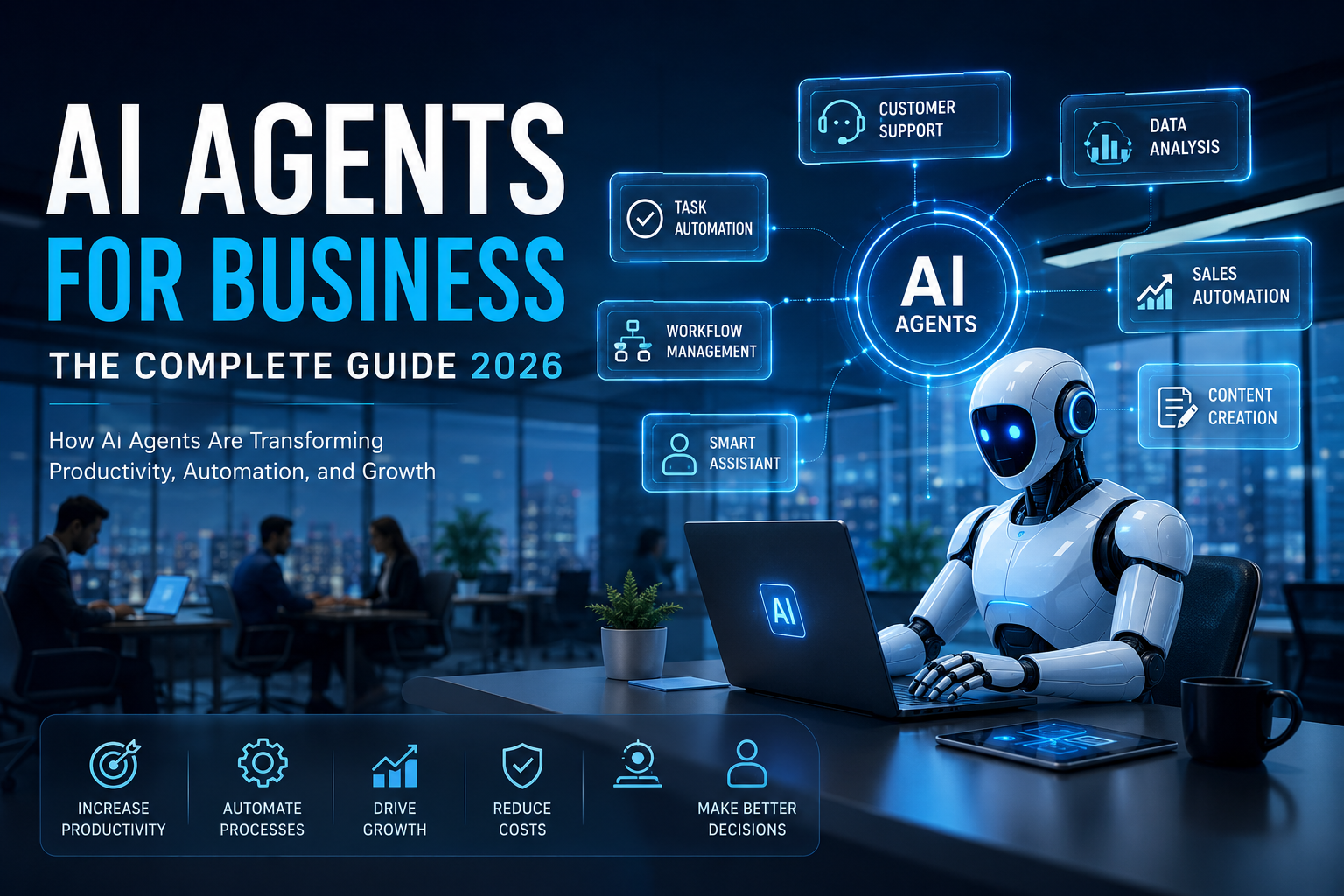
AI agents are quickly becoming one of the most important trends in business, online work, software, marketing, customer service, and digital entrepreneurship. Instead of only generating text, an AI agent can help plan, decide, act, check results, and continue working through a process.
For businesses, this could mean faster customer support, smarter sales follow-ups, automated research, better lead qualification, content workflows, data analysis, appointment booking, email handling, and even internal operations that run with less manual work.
For individuals, freelancers, creators, and online business owners, AI agents may open a new wave of income opportunities. People who understand how to use them early can build better services, create stronger businesses, reduce repetitive work, and compete with larger teams.
This does not mean AI agents are magic. They are not perfect, and they still need human supervision. But they represent a serious change in how work is organized.
In simple terms, 2026 may be the year when AI moves from being a tool you “talk to” into a system you “work with.”
What Are AI Agents?
An AI agent is a software system powered by artificial intelligence that can work toward a goal by taking actions, using tools, and making decisions across multiple steps.
A normal chatbot waits for your message and gives you a response.
An AI agent can go further.
For example, instead of asking an AI tool:
“Write me an email to a potential customer.”
You may give an AI agent a broader task:
“Find potential customers in this industry, organize them in a list, draft personalized emails, schedule follow-ups, and alert me when someone replies.”
That is a very different level of automation.
The key difference is that an AI agent is not only generating information. It is helping manage a workflow.
A basic AI assistant may help you think. An AI agent may help you execute.
AI Agents vs Chatbots: The Important Difference
Many people still confuse AI agents with chatbots. The difference matters because businesses do not only want answers. They want results.
A chatbot is usually reactive. You ask something, it responds.
An AI agent is more goal-oriented. You give it an objective, and it may break that objective into steps.
For example, a chatbot can explain how to improve a website.
An AI agent could analyze pages, detect weak titles, suggest internal links, prepare meta descriptions, organize content updates, and create a task list for the site owner.
A chatbot can write a customer service reply.
An AI agent could read the customer’s message, check order details, classify the issue, suggest a solution, escalate complex cases, and record the result inside a support system.
A chatbot can help brainstorm content ideas.
An AI agent could research competitors, find keyword gaps, prepare article outlines, generate briefs, organize publishing calendars, and track what has already been published.
This is why AI agents are becoming important. They are closer to digital workers than simple answer machines.
Why AI Agents Matter in 2026
AI agents matter because most businesses are not struggling because they lack ideas. They are struggling because they have too many repetitive tasks, too much manual coordination, too many disconnected tools, and not enough time.
Small businesses lose time answering the same questions, following up with leads, creating reports, updating spreadsheets, replying to emails, preparing content, checking orders, and managing customer communication.
Large companies face the same problem at a bigger scale. They have departments, tools, teams, data, and workflows that often move slower than they should.
AI agents are attractive because they can sit between people, data, and software tools.
They can help connect the work.
This is especially powerful in areas like:
- Customer support
- Sales operations
- Marketing automation
- Content production
- Research
- Data analysis
- Human resources
- E-commerce
- Finance administration
- Project management
- Software development
- Personal productivity
The real value is not that AI agents can replace every worker. The real value is that they can remove large parts of repetitive work and allow people to focus on higher-value decisions.
The Business Problem AI Agents Are Solving
Most companies have hidden operational waste.
A sales team may spend hours researching leads before making contact.
A support team may answer the same basic questions hundreds of times.
A marketing team may waste time moving content between documents, calendars, design tools, and publishing platforms.
A manager may spend too much time collecting updates instead of making decisions.
A freelancer may spend more time on admin work than paid client work.
AI agents target this problem directly.
They reduce the gap between intention and execution.
Instead of manually moving from tool to tool, the user can increasingly create a workflow where the AI agent helps handle the process.
This can make businesses faster, leaner, and more responsive.
For small business owners, this may be especially important. A company that cannot afford a large team may still use AI agents to handle parts of marketing, customer service, lead management, and operations.
That means AI agents are not only a technology trend. They are a business leverage trend.
How AI Agents Can Help Companies Make More Money
AI agents are not valuable only because they save time. They are valuable because time savings can become revenue growth.
A business that responds to customers faster can close more sales.
A business that follows up with leads consistently can reduce missed opportunities.
A business that creates better content faster can attract more traffic.
A business that analyzes customer behavior can improve offers.
A business that automates repetitive support can reduce costs.
A business that uses AI agents for research can make smarter decisions sooner.
In many cases, AI agents may improve both sides of the business equation:
They can help increase revenue.
They can also help reduce operational costs.
This combination is why many companies are taking agentic AI seriously.
For online entrepreneurs, the opportunity is also clear. People who understand AI agents can build services around them, such as workflow automation, AI customer support setup, AI content systems, AI lead generation systems, AI research dashboards, and AI-powered operations consulting.
In other words, AI agents do not only create tools. They create new service businesses.
Practical Example: AI Agents for Customer Support
Customer support is one of the clearest use cases for AI agents.
Traditional support chatbots often fail because they give generic answers. They may not understand context, and they often frustrate customers when the issue is specific.
AI agents can be more useful when connected to business systems.
For example, an AI support agent could:
- Understand the customer’s question
- Check order status
- Review previous messages
- Suggest a solution
- Answer common questions
- Escalate difficult cases to a human
- Summarize the issue for the support team
- Update the customer record
This does not remove the need for human support. Instead, it can reduce the number of simple repetitive tickets and make human agents more effective.
For small online stores, service companies, software businesses, and agencies, this can be a major advantage.
A faster support experience can improve customer satisfaction, protect brand reputation, and increase repeat purchases.
Practical Example: AI Agents for Sales
Sales is another area where AI agents can create real value.
Many businesses lose money not because their product is bad, but because their follow-up system is weak.
Leads are forgotten.
Emails are delayed.
Customer questions are not answered quickly.
Salespeople spend too much time researching instead of selling.
An AI sales agent can help by organizing the sales process.
It could research prospects, qualify leads, prepare personalized outreach, suggest follow-up messages, summarize calls, and remind the sales team when action is needed.
For B2B companies, this can be powerful. Selling to businesses often requires research, timing, personalization, and persistence.
AI agents can support that process without replacing the human relationship.
The human still builds trust, negotiates, understands emotions, and closes important deals.
The AI agent handles preparation, organization, and repetitive steps.
That combination can make a small sales team perform like a much larger one.
Practical Example: AI Agents for Content Websites
For content websites, AI agents may become one of the most important productivity tools.
A serious content website does not only need articles. It needs strategy, topic planning, SEO structure, internal linking, image consistency, updates, keyword research, analytics review, and quality control.
This is where AI agents can help.
An AI content agent could:
- Track published articles
- Avoid duplicate topics
- Suggest new article ideas
- Build content clusters
- Prepare article outlines
- Recommend internal links
- Generate meta descriptions
- Identify outdated content
- Create update plans
- Organize content calendars
- Analyze which categories need more articles
This is especially useful for large websites that publish frequently.
The biggest risk in high-volume publishing is not only low quality. It is chaos.
Without a system, the website may become repetitive, poorly organized, and difficult for users to browse.
AI agents can help keep the publishing system structured.
For website owners, bloggers, affiliate marketers, and digital publishers, this may become a major competitive advantage in 2026.
Practical Example: AI Agents for Freelancers
Freelancers often work alone, which means they must handle everything: client communication, proposals, invoices, research, delivery, revisions, marketing, and administration.
AI agents can help freelancers operate more professionally.
A freelance writer could use an AI agent to manage briefs, research topics, prepare outlines, check deadlines, and organize revisions.
A web designer could use an AI agent to collect client requirements, prepare project timelines, write website copy drafts, and summarize feedback.
A digital marketer could use an AI agent to monitor campaigns, prepare reports, suggest improvements, and organize client updates.
A consultant could use an AI agent to research industries, summarize documents, prepare meeting notes, and build action plans.
This does not remove the freelancer’s skill. It increases their capacity.
The freelancers who benefit most will not be the ones who blindly automate everything. They will be the ones who combine expertise with AI-powered workflows.
The Real Opportunity: Human Skill Plus AI Execution
The biggest mistake people make with AI is thinking the tool alone is the business.
It is not.
AI agents are powerful, but they still need direction, judgment, strategy, and quality control.
The real opportunity belongs to people who understand a valuable problem and use AI agents to solve it faster.
For example, a person who understands SEO can use AI agents to build better content systems.
A person who understands sales can use AI agents to build better outreach workflows.
A person who understands customer service can use AI agents to design better support systems.
A person who understands operations can use AI agents to reduce waste inside a company.
This means human skill becomes more important, not less.
AI agents reward people who can think clearly, design processes, evaluate output, and make smart decisions.
In 2026, the winners will not simply be the people who use AI.
The winners will be the people who know what to automate, what to keep human, and how to turn AI into measurable value.
How AI Agents Actually Work
To understand why AI agents are different from normal AI tools, it is useful to look at how they work behind the scenes.
An AI agent usually combines several core elements:
First, it needs a goal. This is the outcome the user wants to achieve. The goal may be simple, like “summarize these customer messages,” or more complex, like “prepare a weekly sales report, identify weak leads, and suggest follow-up actions.”
Second, it needs access to information. This may include documents, emails, customer records, website data, product catalogs, spreadsheets, analytics dashboards, or business systems.
Third, it needs tools. A useful AI agent is often connected to apps and platforms, such as email, calendars, CRM systems, help desks, e-commerce platforms, project management tools, databases, or marketing software.
Fourth, it needs reasoning. The agent must decide what step should happen next. It may need to classify a customer request, choose the right template, check missing information, compare options, or decide whether a human should review the result.
Fifth, it needs memory or context. A strong agent should understand what happened before, what the customer asked previously, what the business rules are, and what the current task requires.
Sixth, it needs guardrails. This is one of the most important parts. A business should not allow an AI agent to take unlimited actions without rules. The agent must know what it can do, what it cannot do, when to ask for approval, and when to send the task to a human.
This is why high-quality AI agent systems are not just “AI connected to apps.” They are structured workflows with clear permissions, business logic, and review points.
The Workflow Layer: Why AI Agents Are More Than Prompts
Many people think AI success depends only on writing better prompts. Prompts are still important, but AI agents require something deeper: workflow design.
A workflow is the full process from the beginning of a task to the final result.
For example, “write a sales email” is not a full workflow.
A real sales workflow may include:
Identifying the target customer, researching the company, finding the decision maker, checking whether the lead matches the business offer, writing a personalized message, sending the email, waiting for a reply, sending a follow-up, updating the CRM, and notifying the sales manager.
This is where AI agents become powerful.
They can help manage the chain, not only one step.
A weak AI workflow simply says: “Generate an email.”
A strong AI workflow says: “Research the lead, understand the customer’s possible pain points, prepare a message based on our offer, check it against brand rules, ask for human approval, send it, record the activity, and schedule a follow-up.”
That is the difference between random AI usage and business automation.
Businesses that understand workflow design will get more value from AI agents than businesses that only chase new tools.
The Best Tasks to Automate With AI Agents
Not every task should be automated. The best tasks for AI agents usually have three characteristics.
They are repetitive.
They follow a predictable process.
They involve information handling.
This is why AI agents are useful for tasks like customer support classification, lead qualification, meeting summaries, content planning, reporting, document review, email drafting, follow-up reminders, inventory checks, and internal knowledge search.
These tasks often take time but do not always require deep human creativity.
For example, a business owner does not need to manually answer the same question about shipping policy fifty times per week. An AI agent can handle the first response and escalate unusual cases.
A sales employee does not need to manually research every basic company detail before outreach. An AI agent can prepare a prospect summary.
A content website owner does not need to manually check every article category one by one to identify weak clusters. An AI agent can help organize the content map.
The best automation opportunities are not always the most exciting tasks. They are often the boring tasks that quietly consume hours every week.
Tasks That Should Not Be Fully Automated
AI agents should not be used blindly.
Some tasks still require human judgment, emotional intelligence, legal awareness, ethical thinking, or brand sensitivity.
For example, an AI agent should not make final hiring decisions alone.
It should not approve sensitive financial transactions without human review.
It should not provide medical, legal, or investment advice without proper professional control.
It should not handle angry customers in a way that damages the company’s reputation.
It should not publish important content automatically without quality checks.
It should not change pricing, contracts, refunds, or policies without clear approval rules.
This is one of the most important lessons for businesses in 2026: the goal is not to remove humans from every process. The goal is to place humans at the right points in the process.
AI agents should handle speed, structure, organization, first drafts, data movement, and repetitive decisions.
Humans should handle strategy, final approval, sensitive communication, creativity, accountability, and complex judgment.
The best model is not “AI instead of humans.”
The best model is “AI before humans, AI beside humans, and humans above AI.”
The Human-in-the-Loop Model
A human-in-the-loop system means the AI agent can work, but a human remains involved at important decision points.
This is the safest and most realistic way to use AI agents in business.
For example, an AI agent may draft customer replies, but a human approves replies for refund disputes.
An AI agent may prepare a sales proposal, but a sales manager reviews the final offer.
An AI agent may suggest article topics, but an editor chooses which topics match the website strategy.
An AI agent may summarize financial data, but an accountant verifies the final report.
This model gives businesses the benefits of AI without losing control.
It also improves trust. Employees are more likely to accept AI when it helps them work better instead of replacing their role completely.
For small businesses, this is especially useful because it allows the owner to move faster while still controlling important decisions.
AI Agents and Small Businesses
Small businesses may benefit from AI agents even more than large companies.
A large company may already have departments for sales, support, marketing, operations, finance, and data analysis.
A small business owner often has to do everything.
This creates pressure.
The owner answers customers, posts on social media, manages invoices, follows up with leads, updates the website, handles suppliers, checks orders, and tries to grow the business at the same time.
AI agents can act like a support layer.
They can help a small business appear more organized, more responsive, and more professional.
For example, a small HVAC company could use an AI agent to collect customer inquiries, ask for project details, organize leads by urgency, prepare quotations for review, and remind the team to follow up.
A small online store could use an AI agent to answer product questions, track common complaints, suggest new FAQ content, and summarize customer feedback.
A small consulting firm could use an AI agent to prepare client notes, build proposal drafts, research industries, and organize weekly tasks.
This is not about replacing the business owner. It is about giving the business owner more leverage.
In 2026, the small companies that learn to use AI agents wisely may compete more effectively with larger competitors.
AI Agents and Enterprise Companies
Large companies face a different challenge.
They do not only need productivity. They need scale, security, governance, compliance, and integration.
An enterprise company cannot simply connect an AI agent to sensitive business systems without rules. It must manage permissions, audit logs, data privacy, user access, approval workflows, and risk controls.
This is why enterprise AI agents are becoming a serious technology category.
Large organizations want agents that can connect with internal data, respect company policies, support employees, and improve workflows without creating security problems.
For example, an enterprise AI agent may help employees search internal knowledge bases, prepare reports, summarize meetings, assist customer service teams, analyze sales pipelines, or support IT help desk requests.
But the most successful enterprise use cases usually start with a specific workflow.
Instead of saying, “We want AI everywhere,” a smart company may say:
“We want to reduce customer support response time.”
“We want to shorten sales proposal preparation.”
“We want to automate first-level IT support.”
“We want to improve employee access to internal knowledge.”
“We want to reduce manual reporting work.”
Specific use cases are easier to measure, easier to control, and easier to improve.
The Data Problem: Why Many AI Agents Fail
AI agents are only as strong as the data and systems around them.
If a company has messy data, outdated documents, unclear policies, duplicate customer records, badly organized files, and disconnected tools, an AI agent will struggle.
This is a major reason many AI projects fail.
The problem is not always the AI model.
Sometimes the problem is the business environment.
An AI agent cannot create reliable results from unreliable information.
For example, if the product catalog is outdated, the agent may give wrong product details.
If customer records are incomplete, the agent may misunderstand the customer history.
If company policies are unclear, the agent may give inconsistent answers.
If the website structure is messy, the agent may suggest weak internal links.
If the sales pipeline is not updated, the agent may follow up with the wrong lead at the wrong time.
Before using AI agents seriously, businesses should clean their information systems.
This may include organizing documents, updating FAQs, improving CRM data, removing duplicate records, creating clear SOPs, and defining approval rules.
The cleaner the business system, the smarter the AI agent appears.
The Role of SOPs in AI Agent Success
SOPs, or Standard Operating Procedures, are extremely important for AI agents.
An SOP explains how a task should be done.
Many companies try to automate work before they have clearly defined the work.
This creates poor results.
If a human team does not know the correct process, an AI agent will not magically fix it.
For example, before building an AI customer support agent, a business should define:
What questions can the agent answer?
Which cases require human escalation?
What tone should the agent use?
What refund rules must it follow?
What information should it collect before escalation?
What should it never say?
What languages should it support?
How should it update customer records?
The same applies to sales, marketing, content, finance, HR, and operations.
AI agents perform better when the business has clear rules.
A good SOP turns AI from a random assistant into a reliable system.
This is why one of the best opportunities in 2026 is not only “using AI agents,” but helping businesses prepare their workflows for AI agents.
AI Agent Opportunities for Online Entrepreneurs
AI agents create several opportunities for online entrepreneurs.
The first opportunity is AI workflow consulting. Many small businesses want to use AI but do not know where to start. A consultant can help them identify repetitive tasks, choose tools, build workflows, and train employees.
The second opportunity is AI customer support setup. Many businesses need better customer response systems. An entrepreneur can help set up AI agents for FAQs, ticket classification, live chat, and escalation.
The third opportunity is AI sales automation. Businesses need lead research, outreach preparation, follow-up systems, and CRM organization.
The fourth opportunity is AI content operations. Website owners, agencies, and creators need help with topic planning, SEO briefs, internal linking, content updates, and publishing systems.
The fifth opportunity is AI admin automation. Many professionals need help organizing emails, meetings, documents, reports, and task management.
The sixth opportunity is AI training. Companies need employees who understand how to work with AI agents safely and effectively.
The seventh opportunity is niche-specific AI automation. This may include real estate, clinics, law firms, e-commerce stores, restaurants, education businesses, construction companies, travel agencies, and local service providers.
The most profitable opportunities will not come from selling generic AI promises.
They will come from solving specific business problems.
Why Niche Knowledge Matters
Niche knowledge is one of the biggest advantages in the AI agent economy.
A person who understands a specific industry can build better AI workflows than someone who only understands AI tools.
For example, someone who understands real estate can build better lead qualification agents for property agencies.
Someone who understands e-commerce can build better agents for product support, abandoned cart follow-ups, and customer complaints.
Someone who understands industrial sales can build better agents for technical lead qualification, quotation preparation, and customer follow-up.
Someone who understands SEO can build better agents for content planning, internal linking, and article updates.
This is important because AI tools are becoming easier to access. The difference will not only be tool access.
The difference will be problem understanding.
In 2026, knowing the customer’s pain point may be more valuable than knowing the newest AI platform.
Building an AI Agent Strategy
A good AI agent strategy should not start with the question: “Which AI tool should we use?”
It should start with a better question:
“What business process is wasting time, losing money, or slowing growth?”
After identifying the process, the business should ask:
Can this process be clearly described?
Does it happen often?
Does it use structured information?
Can mistakes be reviewed?
Is there a clear success metric?
Can a human approve sensitive steps?
If the answer is yes, the process may be a good candidate for an AI agent.
For example, a business may choose to start with customer support because response time is slow.
Another business may start with sales follow-up because leads are being lost.
A content website may start with internal linking because articles are increasing and organization is becoming harder.
A consulting firm may start with proposal drafts because they take too much time.
The key is to begin with a workflow that has measurable value.
Do not automate randomly.
Automate where it matters.
A Simple AI Agent Implementation Framework
Businesses can use a simple five-step framework to start with AI agents.
Step one: identify the repetitive workflow.
Choose one process that happens frequently and creates real pressure.
Step two: map the current process.
Write down every step from beginning to end. Include who does what, which tools are used, what information is needed, and where delays happen.
Step three: decide what the AI agent can handle.
Separate tasks into three groups: tasks AI can do alone, tasks AI can draft but humans approve, and tasks humans should always handle.
Step four: connect the right data and tools.
The agent should have access only to the information it needs. More access is not always better. Controlled access is safer.
Step five: test, measure, and improve.
The first version will not be perfect. Businesses should test outputs, track errors, collect feedback, and improve the workflow over time.
This framework is simple, but it prevents one of the biggest mistakes in AI adoption: buying tools without changing the process.
Measuring the Success of AI Agents
AI agents should be judged by business results, not excitement.
A company should measure whether the agent actually improves performance.
Useful metrics may include:
Response time reduced.
Number of tickets handled.
Sales follow-up completion rate.
Lead qualification accuracy.
Hours saved per week.
Content production speed.
Error rate.
Customer satisfaction.
Employee satisfaction.
Cost per task.
Revenue generated from improved follow-up.
Time saved in reporting.
If an AI agent does not improve a meaningful metric, it may not be worth keeping.
This is important because many businesses will adopt AI tools because they sound impressive. But impressive technology does not always create business value.
The best AI agents are not the ones with the most features.
The best AI agents are the ones that solve expensive problems clearly.
The Risk of Over-Automation
One of the biggest risks in 2026 is over-automation.
Some businesses will try to automate too much too quickly.
This can create poor customer experiences, wrong decisions, security problems, brand damage, and employee resistance.
Over-automation happens when companies trust AI agents before the workflow is mature.
For example, a company may allow an AI agent to send sales emails automatically without checking quality. This can lead to spam-like outreach.
A website owner may allow AI to publish articles without editing. This can damage content quality and SEO trust.
A support team may allow AI to answer complex complaints without human review. This can make customers angry.
A business may connect AI to sensitive data without proper permissions. This can create privacy and security risks.
The solution is not to avoid AI agents.
The solution is to design them carefully.
Automation should increase trust, not reduce it.
The Future of Work With AI Agents
AI agents will not affect every job in the same way.
Some roles will become more automated.
Some roles will become more strategic.
Some roles will require new skills.
Employees may spend less time on repetitive tasks and more time reviewing, improving, coordinating, and making decisions.
Managers may need to design better workflows.
Freelancers may need to offer more complete solutions instead of simple task delivery.
Business owners may need to understand automation, data, and AI-assisted operations.
Content creators may need to focus more on originality, expertise, and editorial judgment.
Salespeople may spend less time on research and more time on relationships.
Customer support teams may handle fewer basic questions and more complex cases.
In this new environment, the most valuable people will be those who can combine domain knowledge, communication, process thinking, and AI literacy.
AI agents will reward people who understand systems.
The Skills People Need in the AI Agent Era
To benefit from AI agents, people do not need to become advanced programmers.
But they do need new practical skills.
The first skill is process thinking. You must understand how work moves from step one to the final outcome.
The second skill is prompt and instruction design. You must know how to explain goals, rules, tone, and constraints clearly.
The third skill is quality control. You must be able to review AI output and detect mistakes.
The fourth skill is data organization. AI agents work better when information is clean and accessible.
The fifth skill is tool integration. You should understand how different apps connect, even at a basic level.
The sixth skill is business judgment. You must know which tasks are worth automating and which tasks should stay human.
The seventh skill is ethical awareness. You must think about privacy, bias, accuracy, and accountability.
These skills are practical and valuable. They can help employees, freelancers, entrepreneurs, and business owners stay competitive.
Why AI Agents Are a Bigger Opportunity Than Simple AI Content
AI-generated content became popular quickly, but it also became crowded quickly.
Many people used the same tools, produced similar articles, repeated the same ideas, and created low-value content.
AI agents are different because they are tied to operations.
They are not only about producing more words.
They are about improving how work gets done.
This makes the opportunity deeper.
A business will not pay much for generic AI text if thousands of people can produce it.
But a business may pay for an AI workflow that saves ten hours per week, improves lead follow-up, reduces customer support pressure, or organizes internal operations.
This is why AI agents may create stronger business opportunities than basic AI content services.
The value is closer to the money.
When AI solves operational problems, it becomes easier to justify payment.
Conclusion of Part Two: AI Agents Are About Systems, Not Hype
AI agents are one of the most important business technology trends of 2026, but their real value is often misunderstood.
They are not magic employees.
They are not perfect decision makers.
They are not a replacement for strategy, trust, or human judgment.
Their real power comes from systems.
A strong AI agent needs a clear goal, clean data, connected tools, business rules, human review, and measurable outcomes.
For businesses, AI agents can reduce repetitive work, improve customer support, strengthen sales follow-up, organize content operations, and help teams move faster.
For individuals and entrepreneurs, they create new opportunities in consulting, automation services, workflow design, AI training, and niche business solutions.
The most important lesson is simple:
AI agents are not valuable because they are “AI.”
They are valuable when they solve a real problem better, faster, and more consistently than the old way.
The Major AI Agent Platforms in 2026
One of the biggest mistakes businesses make is assuming that all AI agent platforms are the same.
In reality, the AI agent ecosystem is becoming increasingly specialized.
Some platforms are designed for enterprise companies.
Some focus on small businesses.
Some are built for software developers.
Others target non-technical users.
Understanding the landscape is important because choosing the wrong platform can create unnecessary complexity, higher costs, and poor adoption.
In 2026, most AI agent solutions fall into five broad categories:
1. Enterprise AI Agent Platforms
These platforms are designed for large organizations that require security, governance, compliance, role-based permissions, and integration with existing systems.
Enterprise companies often need AI agents connected to:
- CRM systems
- ERP platforms
- Internal databases
- Knowledge management systems
- Customer support software
- Analytics platforms
- HR systems
- Financial systems
The biggest challenge for enterprises is not generating AI responses.
The challenge is controlling how AI interacts with sensitive business data.
This is why enterprise AI adoption tends to focus heavily on security, auditing, approval workflows, and risk management.
2. Small Business Automation Platforms
Small businesses usually care about different priorities.
They want solutions that are:
- Fast to deploy
- Affordable
- Easy to understand
- Easy to maintain
- Flexible
A small company often cannot afford a dedicated AI team.
Instead, the owner wants an agent that helps save time immediately.
Examples include:
- Lead capture agents
- Customer support agents
- Appointment booking agents
- Email management agents
- Marketing assistants
- Proposal generation agents
For many small businesses, simplicity is more valuable than advanced features.
3. Developer-Oriented Agent Platforms
These platforms are built for customization.
They allow developers to build sophisticated workflows and highly specialized agents.
The advantage is flexibility.
The disadvantage is complexity.
A custom-built AI agent can often do far more than a generic off-the-shelf solution.
However, it usually requires technical expertise to create, maintain, improve, and secure.
Large technology companies frequently use this approach because they need solutions tailored to unique business requirements.
4. Industry-Specific AI Agents
One of the fastest-growing segments is vertical AI.
Instead of building a general-purpose agent, companies build agents designed specifically for a single industry.
Examples include:
- Real estate agents
- Healthcare support agents
- Legal research agents
- Accounting assistants
- Construction project agents
- Manufacturing support agents
- Travel planning agents
Industry-specific solutions often outperform generic tools because they understand the workflows, terminology, and challenges of a particular market.
5. Personal Productivity Agents
These agents focus on helping individuals rather than businesses.
They assist with:
- Scheduling
- Research
- Email organization
- Task management
- Meeting preparation
- Document summarization
- Personal learning
Many professionals will likely interact with personal AI agents daily by the end of the decade.
Why Most Companies Start With the Wrong AI Project
Many organizations approach AI backwards.
They begin with excitement rather than business problems.
Management hears about AI.
A new tool becomes popular.
Competitors announce AI initiatives.
Employees begin experimenting with chatbots.
Suddenly the company decides:
“We need AI.”
But nobody clearly defines what success looks like.
This often leads to disappointing results.
The strongest AI projects begin with a business problem.
Examples include:
“Our support team is overwhelmed.”
“Our sales team is missing follow-ups.”
“Our reporting process takes too long.”
“Our content production is inefficient.”
“Our employees cannot find internal information.”
These are concrete problems.
AI agents should be viewed as solutions to business bottlenecks, not as technology experiments.
Organizations that focus on solving a specific operational challenge generally see better returns than organizations that pursue AI simply because it is trending.
The Economics of AI Agents
One reason AI agents are attracting so much attention is their potential economic impact.
Historically, increasing productivity required one of three things:
- Hiring more people
- Purchasing more equipment
- Increasing employee workload
AI introduces a fourth option.
Increasing output without proportionally increasing headcount.
This does not mean businesses no longer need employees.
Rather, it means each employee may become capable of producing more value.
Consider a marketing manager.
Without AI support, the manager might spend:
- 5 hours on research
- 4 hours on reporting
- 6 hours on content planning
- 3 hours on administrative work
That is 18 hours spent on tasks that are not directly creating strategy.
If AI agents reduce those tasks by 50%, the manager suddenly gains approximately 9 additional productive hours.
Across a team, that effect compounds significantly.
The result is not necessarily workforce reduction.
In many cases, it is capacity expansion.
The company can pursue more opportunities using the same team.
The Rise of the One-Person Business
One of the most interesting trends emerging from AI is the growth of highly productive solo businesses.
Historically, scaling a business required hiring employees.
More clients meant more staff.
More projects meant more management.
More revenue meant more complexity.
AI agents are beginning to challenge that assumption.
A single entrepreneur can now access capabilities that previously required multiple specialists.
For example:
A solo creator can use AI agents for:
- Research
- Content planning
- SEO organization
- Email marketing
- Customer support
- Analytics monitoring
A consultant can use AI agents for:
- Proposal creation
- Meeting preparation
- Industry research
- Client onboarding
- Documentation
An e-commerce operator can use AI agents for:
- Product descriptions
- Customer support
- Inventory monitoring
- Marketing campaigns
- Reporting
This does not eliminate the need for human expertise.
It amplifies it.
The result is a growing category of businesses where a small team can operate at a scale previously reserved for much larger organizations.
AI Agents and the Future of Management
Management itself may change significantly over the next decade.
Traditional managers often spend large portions of their time:
- Collecting information
- Following up on tasks
- Checking progress
- Coordinating communication
- Preparing reports
AI agents can assist with all of these activities.
This means future managers may spend less time gathering information and more time making decisions.
The role may become increasingly strategic.
The best managers will likely be those who know how to:
- Design systems
- Define objectives
- Interpret information
- Coach people
- Evaluate outcomes
In other words, management may shift from process supervision toward decision leadership.
AI Agents in Sales: A Deeper Look
Sales is often one of the highest-return areas for AI implementation.
Most companies do not lose opportunities because they lack prospects.
They lose opportunities because follow-up is inconsistent.
Research is incomplete.
Communication is delayed.
Information is scattered.
AI agents can support nearly every stage of the sales cycle.
Prospect Research
Before a salesperson even contacts a company, an AI agent can gather information about:
- Industry
- Company size
- Recent news
- Decision makers
- Potential challenges
This creates a stronger starting point for outreach.
Lead Qualification
Not every lead deserves equal attention.
AI agents can help score prospects based on criteria such as:
- Budget
- Industry fit
- Company size
- Urgency
- Previous engagement
This allows sales teams to focus their energy where it matters most.
Follow-Up Management
Many deals are lost simply because follow-up stops.
AI agents can:
- Schedule reminders
- Suggest next actions
- Draft follow-up messages
- Track engagement
Consistency often wins more deals than brilliance.
Sales Intelligence
Over time, AI agents may identify patterns humans miss.
For example:
- Which industries convert best
- Which messaging performs best
- Which products generate the highest margins
- Which prospects are most likely to close
These insights can significantly improve decision-making.
AI Agents and Customer Experience
Customer expectations continue to rise.
People increasingly expect:
- Fast responses
- Personalized service
- Accurate information
- Consistent experiences
Businesses that fail to meet these expectations risk losing customers.
AI agents can help bridge this gap.
The best implementations combine:
- Speed from AI
- Judgment from humans
For example:
An AI agent can immediately acknowledge a customer request.
Gather relevant information.
Search internal knowledge.
Suggest solutions.
Escalate when necessary.
The customer receives faster service while still benefiting from human expertise when required.
This hybrid model is becoming increasingly common.
Why Trust Will Become a Competitive Advantage
As AI-generated content, communication, and automation become widespread, trust may become more valuable than ever.
Customers do not simply want automation.
They want reliability.
Businesses that use AI responsibly can strengthen trust.
Businesses that misuse automation can damage it.
For example:
A company that uses AI to answer simple questions quickly while escalating complex issues appropriately improves customer experience.
A company that hides behind poor automation and frustrates customers may lose credibility.
This means future winners will not necessarily be the companies with the most AI.
They may be the companies that use AI in the most trustworthy way.
The Next Phase of AI Competition
The first phase of AI competition focused on access.
Who has access to AI?
The second phase focused on capability.
Which model is smarter?
The third phase is increasingly focused on implementation.
Who can integrate AI into real-world operations most effectively?
This is where the biggest opportunities are emerging.
Many businesses now have access to powerful AI tools.
Far fewer know how to transform those tools into measurable business value.
That gap represents one of the largest opportunities of the AI agent era.
AI Agents Are Becoming Infrastructure
Perhaps the most important trend is that AI agents are gradually moving from novelty to infrastructure.
A decade ago, businesses debated whether they needed cloud computing.
Today cloud services are normal.
A decade ago, businesses debated whether they needed social media.
Today social media is standard.
A decade ago, many organizations questioned the importance of analytics.
Today analytics are essential.
AI agents may follow a similar path.
Today they feel innovative.
Tomorrow they may simply become part of how business operates.
Companies that learn how to work effectively with AI agents now may gain a significant advantage before widespread adoption makes the technology commonplace.
The opportunity is not merely to use AI.
The opportunity is to build better systems, better decisions, better customer experiences, and better businesses with AI as a force multiplier.
Real-World AI Agent Use Cases Across Industries
One reason AI agents are attracting so much attention is that they are no longer limited to technology companies.
Nearly every industry contains workflows that involve information, communication, decision support, and repetitive processes.
These are exactly the environments where AI agents can create value.
The most successful implementations are often not the most complicated ones.
Instead, they focus on solving specific operational problems that cost time, money, or customer satisfaction.
Let’s examine how AI agents are transforming different industries.
Manufacturing and Industrial Companies
Manufacturing is one of the sectors that could benefit significantly from AI agents over the next decade.
Industrial operations generate enormous amounts of information:
- Production reports
- Maintenance records
- Equipment data
- Supplier communications
- Quality inspections
- Safety documentation
- Inventory tracking
- Procurement workflows
Much of this information is valuable but difficult to manage efficiently.
AI agents can help organize and analyze these processes.
For example, a maintenance agent could:
- Monitor equipment performance data
- Identify abnormal patterns
- Recommend inspection schedules
- Alert maintenance teams before failures occur
- Generate maintenance summaries
This approach moves companies closer to predictive maintenance rather than reactive maintenance.
Instead of fixing equipment after breakdowns occur, organizations can intervene earlier and reduce downtime.
Similarly, procurement teams can use AI agents to:
- Compare supplier quotes
- Track delivery timelines
- Monitor inventory levels
- Identify purchasing risks
- Prepare procurement recommendations
In large industrial environments, even small efficiency improvements can produce substantial financial savings.
Renewable Energy and Sustainability
The renewable energy sector is becoming increasingly data-driven.
Solar systems, battery storage projects, heat pumps, smart grids, electric vehicle charging infrastructure, and energy management systems generate large volumes of operational information.
AI agents can help organizations manage this complexity.
A renewable energy company could deploy AI agents to:
- Monitor system performance
- Analyze energy production
- Detect abnormal behavior
- Generate customer reports
- Predict maintenance requirements
- Track project development progress
- Assist engineering teams
For example, a commercial PV-to-Heat project may generate performance data from:
- Solar panels
- Inverters
- Thermal systems
- Energy meters
- Weather sources
An AI agent could consolidate this information into understandable business insights.
Instead of manually reviewing multiple dashboards, decision-makers receive summarized recommendations.
As energy systems become smarter, AI agents may increasingly function as operational coordinators between equipment, software, and human teams.
Healthcare
Healthcare contains enormous administrative workloads.
Doctors, nurses, administrators, and support teams spend significant time managing documentation, appointments, records, communications, and compliance requirements.
AI agents may help reduce this burden.
Potential applications include:
- Appointment scheduling
- Patient communication
- Documentation assistance
- Insurance workflow support
- Internal knowledge search
- Medical record organization
Importantly, AI agents should support healthcare professionals rather than replace medical judgment.
A doctor remains responsible for diagnosis and treatment decisions.
However, reducing administrative workload can allow healthcare professionals to spend more time focusing on patient care.
This is one of the most valuable forms of AI adoption: increasing human effectiveness rather than attempting to replace expertise.
Financial Services
Banks, insurance companies, investment firms, and financial institutions process massive quantities of information every day.
Common activities include:
- Customer onboarding
- Document verification
- Risk assessment
- Compliance checks
- Reporting
- Customer support
AI agents can assist by automating information-heavy processes.
For example, a financial agent could:
- Review submitted documents
- Identify missing information
- Flag inconsistencies
- Prepare summaries for analysts
- Monitor workflow progress
However, financial services also require strong governance.
This means AI agents often operate within carefully controlled environments where human approval remains mandatory for sensitive decisions.
The goal is efficiency, not unchecked automation.
E-Commerce
E-commerce is one of the most obvious applications for AI agents.
Online stores face numerous operational challenges:
- Product management
- Customer support
- Marketing campaigns
- Inventory monitoring
- Order tracking
- Customer retention
AI agents can support each of these areas.
For example, an e-commerce support agent could:
- Answer product questions
- Track order status
- Process common requests
- Escalate unusual issues
Meanwhile, a marketing-focused agent could:
- Analyze campaign performance
- Identify top-selling products
- Recommend promotional opportunities
- Generate performance summaries
The result is a more responsive business with lower operational overhead.
Education
Education is another sector undergoing rapid transformation.
Teachers and educational institutions face increasing demands related to administration, grading, communication, planning, and content delivery.
AI agents can assist with:
- Student support
- Administrative workflows
- Learning recommendations
- Course organization
- Scheduling
- Knowledge retrieval
A university could deploy AI agents to answer common student questions about admissions, deadlines, policies, and campus services.
This reduces administrative pressure while improving accessibility.
Meanwhile, instructors can use AI agents to help organize materials, summarize learning data, and prepare educational resources.
Again, the objective is support rather than replacement.
Human educators remain central to learning outcomes.
Real Estate
Real estate professionals spend significant time handling repetitive communication.
Examples include:
- Property inquiries
- Appointment scheduling
- Lead qualification
- Follow-up communication
- Market research
AI agents can assist throughout the process.
A real estate agent may receive hundreds of inquiries each month.
An AI agent can:
- Collect buyer requirements
- Categorize prospects
- Schedule viewings
- Prepare property information
- Organize lead pipelines
This allows human agents to spend more time building relationships and negotiating transactions.
The technology becomes an efficiency layer rather than a replacement.
Travel and Tourism
Travel is another industry that naturally aligns with AI agents.
Travel decisions often involve:
- Research
- Comparisons
- Booking coordination
- Customer support
- Itinerary planning
AI agents can help travelers:
- Compare destinations
- Organize itineraries
- Manage bookings
- Track travel requirements
- Recommend activities
For travel businesses, agents can assist with customer inquiries, reservation management, and personalized recommendations.
As personalization improves, travel experiences may become increasingly tailored to individual preferences.
Construction and Engineering
Construction projects generate large volumes of documentation and coordination requirements.
Common challenges include:
- Project timelines
- Contractor communication
- Change orders
- Safety documentation
- Procurement coordination
- Progress tracking
AI agents can help manage information flow across stakeholders.
For example, a project management agent could:
- Summarize project updates
- Track deadlines
- Monitor document approvals
- Flag delays
- Generate management reports
The result is improved visibility across complex projects.
As projects become larger and more interconnected, information management becomes increasingly valuable.
AI Agents and Content Businesses
Content businesses are entering a period of significant transformation.
Historically, publishing success depended largely on content production capacity.
Today, content operations are becoming more complex.
Website owners must manage:
- Topic selection
- Keyword research
- Internal linking
- Content updates
- Analytics
- User experience
- Search visibility
AI agents can help organize these systems.
For example, a content operations agent could:
- Identify content gaps
- Recommend article clusters
- Suggest internal links
- Monitor outdated content
- Analyze category performance
- Track publishing consistency
For large websites, these organizational functions may become increasingly important.
The challenge is no longer simply creating content.
The challenge is managing content at scale while maintaining quality.
The Emergence of AI-Native Companies
A fascinating trend is the emergence of AI-native businesses.
These companies are designed around AI workflows from the beginning.
Unlike traditional organizations that retrofit AI into existing processes, AI-native companies build processes assuming AI support is available.
This creates advantages such as:
- Lower operational costs
- Faster execution
- Leaner teams
- Greater scalability
A startup founded in 2026 may operate very differently from a company founded in 2016.
The newer company may automate many administrative functions from day one.
This allows founders to focus more resources on growth, innovation, and customer acquisition.
The result is increasing competitive pressure across industries.
What Businesses Should Do Right Now
Many leaders understand AI is important.
Fewer understand how to start.
The best approach is often surprisingly simple.
Do not begin with a large transformation project.
Start with one workflow.
Identify:
- A repetitive process
- A measurable problem
- A clear success metric
Then build a small pilot project.
Examples include:
- Customer support triage
- Sales follow-up automation
- Internal knowledge search
- Reporting assistance
- Content planning
Successful pilots create confidence.
Confidence creates adoption.
Adoption creates transformation.
Most successful AI journeys begin with small wins rather than massive implementations.
The Biggest Misconception About AI Agents
Perhaps the biggest misconception is that AI agents are primarily technology projects.
They are not.
They are business projects.
The technology itself is increasingly accessible.
The real challenge is understanding:
- Workflows
- Processes
- Customer needs
- Operational bottlenecks
- Business priorities
Organizations that focus only on technology often struggle.
Organizations that focus on business outcomes tend to succeed.
The question should never be:
“How can we use AI?”
The better question is:
“What business problem should we solve first?”
That shift in thinking often determines whether an AI initiative delivers measurable value or becomes another abandoned experiment.
The Companies That Will Win
Over the next several years, the biggest winners may not be the companies with the most advanced AI.
They may be the companies that combine:
- Strong processes
- High-quality data
- Clear leadership
- Skilled employees
- Responsible AI adoption
Technology alone rarely creates lasting advantages.
Execution does.
The organizations that learn how to integrate AI agents into everyday operations while maintaining quality, trust, and human oversight will likely gain substantial competitive advantages.
In many industries, AI agents are not replacing strategy.
They are amplifying it.
And that distinction may define the next generation of successful businesses.
The Biggest AI Agent Opportunities of the Next Five Years
Every major technology wave creates winners and losers.
The internet created entirely new industries.
Smartphones created entirely new business models.
Cloud computing transformed how companies operate.
Artificial intelligence is now creating another shift.
But many people are asking the wrong question.
They ask:
“What AI tool should I use?”
The better question is:
“Where is value being created?”
The biggest opportunities rarely come from simply using a new technology.
They come from understanding how that technology changes behavior, markets, customer expectations, and business operations.
The AI agent revolution is not primarily about software.
It is about leverage.
For the first time in history, individuals and small organizations can access capabilities that previously required entire departments.
This changes the economics of business.
A freelancer can operate more efficiently.
A consultant can serve more clients.
A startup can scale faster.
A content publisher can manage larger content operations.
A sales team can pursue more opportunities.
A customer support department can handle more requests.
The question is no longer whether AI agents will become important.
The question is who will learn to use them effectively before they become standard.
The New Competitive Advantage
For decades, companies competed using:
- Capital
- Employees
- Equipment
- Physical infrastructure
Those factors remain important.
But another layer is emerging.
Operational intelligence.
The ability to make better decisions faster.
The ability to move information efficiently.
The ability to eliminate unnecessary friction.
The ability to identify opportunities before competitors.
AI agents directly influence all of these areas.
This means future competitive advantages may increasingly come from workflow design rather than workforce size.
A company with excellent systems may outperform a much larger competitor with inefficient processes.
This is especially important for entrepreneurs.
Historically, small businesses often lost because they lacked resources.
Today, a small business equipped with effective AI systems can operate at a level that was previously impossible.
This is one of the most significant business shifts of the modern era.
Why Most People Will Miss the Opportunity
History shows that most people focus on visible technology rather than underlying transformation.
During the early internet era, many people saw websites.
Few saw e-commerce.
During the smartphone revolution, many people saw apps.
Few saw entire industries being reshaped.
The same pattern is happening with AI.
Many people see chatbots.
Many people see image generation.
Many people see content creation.
But the deeper shift is operational transformation.
The biggest value may not come from asking AI questions.
It may come from redesigning how work itself gets done.
This distinction matters.
Because the largest opportunities are often hidden behind process improvement rather than flashy demonstrations.
The people who understand this early may benefit disproportionately.
The Future Workforce
There is significant debate about whether AI will replace jobs.
The reality is more complex.
Some tasks will disappear.
Some roles will evolve.
Some entirely new professions will emerge.
This pattern has occurred throughout history.
When spreadsheets became common, accountants did not disappear.
When email became common, business communication did not disappear.
When search engines became common, research did not disappear.
Instead, work changed.
The same is likely to happen with AI agents.
Routine administrative work may become increasingly automated.
Information gathering may become faster.
Basic analysis may become more accessible.
However, skills such as:
- Judgment
- Leadership
- Strategy
- Creativity
- Communication
- Trust building
- Problem solving
may become even more valuable.
AI agents can process information.
Humans remain responsible for deciding what matters.
The future workforce will likely consist of people who know how to collaborate effectively with intelligent systems.
The Rise of the AI-Augmented Professional
One of the most important concepts emerging in 2026 is the AI-augmented professional.
This is not someone replaced by AI.
It is someone enhanced by AI.
Consider two professionals with equal experience.
The first works entirely manually.
The second uses AI agents strategically.
The second professional may:
- Research faster
- Respond faster
- Analyze faster
- Organize information better
- Handle more projects
- Deliver work more consistently
Over time, this productivity gap compounds.
The difference may become significant.
This applies across industries.
Engineers.
Consultants.
Marketers.
Sales professionals.
Writers.
Business owners.
Managers.
Analysts.
Educators.
The future may belong to professionals who understand how to multiply their capabilities through intelligent systems.
AI Agents and Entrepreneurship
Entrepreneurship may experience one of the largest transformations.
Historically, starting a business required overcoming numerous operational barriers.
Founders needed help with:
- Administration
- Marketing
- Customer support
- Sales
- Research
- Documentation
- Reporting
These functions consumed time and resources.
AI agents reduce many of these barriers.
This does not guarantee success.
Products still matter.
Customers still matter.
Execution still matters.
However, founders can increasingly focus their energy on value creation rather than administrative overhead.
This lowers the cost of experimentation.
More people can test ideas.
More businesses can launch.
More innovation becomes possible.
The result may be an unprecedented wave of entrepreneurial activity throughout the next decade.
The Next Billion-Dollar Companies
Every technological shift creates new categories of companies.
The internet created search engines, social networks, e-commerce platforms, and digital advertising giants.
Mobile technology created ride-sharing, food delivery, and app-based ecosystems.
AI agents are likely to create entirely new categories as well.
Future billion-dollar companies may emerge around:
- AI workflow infrastructure
- Vertical AI solutions
- Agent marketplaces
- AI security systems
- Business automation platforms
- Industry-specific AI ecosystems
- Autonomous service businesses
Many of these companies may not even exist today.
That is what makes technological transitions so powerful.
The future is rarely obvious at the beginning.
The Ethical Challenge
With great capability comes responsibility.
AI agents raise important questions.
How should businesses handle privacy?
Who is accountable for mistakes?
How should decisions be reviewed?
How should bias be addressed?
How should customer data be protected?
Organizations that ignore these questions may face significant risks.
Responsible AI adoption is not only an ethical requirement.
It is becoming a business requirement.
Trust is increasingly valuable.
Customers, employees, and regulators all expect transparency and accountability.
The companies that combine innovation with responsibility may ultimately build the strongest brands.
What This Means for Small Business Owners
If you own a small business, the AI revolution should not be viewed with fear.
It should be viewed with curiosity.
The goal is not to automate everything.
The goal is to remove unnecessary friction.
Ask simple questions:
What tasks consume too much time?
What information is difficult to find?
What processes are repetitive?
What delays hurt customer experience?
What activities create little value?
These questions often reveal the best opportunities.
Small improvements repeated across dozens of workflows can produce substantial results.
In many cases, the businesses that benefit most are not the largest.
They are the most adaptable.
What This Means for Content Creators
Content creators face a different challenge.
The internet is becoming flooded with AI-generated material.
This creates a paradox.
Creating content is becoming easier.
Standing out is becoming harder.
As a result, originality becomes more important.
Expertise becomes more important.
Experience becomes more important.
Trust becomes more important.
AI agents can help creators operate more efficiently.
But efficiency alone is not enough.
The creators who thrive will combine AI-powered productivity with genuine insight and unique perspectives.
The future belongs to creators who provide value, not simply volume.
What This Means for Website Owners
For website owners and publishers, AI agents represent both an opportunity and a warning.
The opportunity is operational efficiency.
Better planning.
Better organization.
Better research.
Better content systems.
Better internal linking.
Better analytics.
Better updates.
The warning is that low-quality content strategies are becoming increasingly vulnerable.
Search engines continue moving toward rewarding expertise, usefulness, authority, trust, and user satisfaction.
AI can help create systems.
It cannot replace quality.
The websites that succeed long term will be the ones that use AI to improve value rather than mass-produce mediocrity.
This distinction will become increasingly important.
The Long-Term Outlook
Most technological revolutions follow a predictable pattern.
First comes excitement.
Then comes unrealistic expectations.
Then comes disappointment.
Then comes practical adoption.
Eventually, the technology becomes normal.
AI agents appear to be moving through this cycle right now.
The hype is significant.
Some expectations are unrealistic.
Some projects will fail.
Some investments will disappoint.
But beneath the noise, something important is happening.
Organizations are learning how intelligent systems can support real work.
That learning process may reshape industries for decades.
The companies, professionals, and entrepreneurs who focus on practical value rather than hype are likely to benefit most.
Related Articles
If you enjoyed this guide, continue exploring:
- Best AI Tools for Students 2026
- Best AI Tools to Make Money Online in 2026
- How to Make Passive Income With AI in 2026
- How Small Businesses Are Using AI in 2026
- ChatGPT vs Claude vs Gemini vs Perplexity (2026)
- ChatGPT vs Claude vs Gemini: Which AI Assistant Is Best in 2026?
- Best Online Businesses to Start in 2026
- Best Skills to Learn in 2026
- Best Remote Jobs That Pay Well in 2026
Frequently Asked Questions
What is the difference between an AI agent and a chatbot?
A chatbot typically responds to questions. An AI agent can pursue goals, interact with tools, complete multi-step workflows, make decisions within defined rules, and assist with business operations.
Can AI agents replace employees?
In most cases, AI agents are better suited for automating repetitive tasks rather than replacing entire roles. Human judgment, creativity, leadership, communication, and decision-making remain essential.
Are AI agents only useful for large companies?
No. Small businesses may benefit significantly because AI agents can help owners manage customer support, marketing, sales, scheduling, administration, and reporting without hiring large teams.
What industries benefit most from AI agents?
Industries with repetitive workflows and large amounts of information often benefit the most, including manufacturing, healthcare, finance, e-commerce, education, real estate, engineering, energy, consulting, and digital publishing.
Do AI agents require programming skills?
Not always. Many modern platforms allow non-technical users to build basic workflows. However, advanced implementations often benefit from technical expertise and process design knowledge.
Will AI agents become standard in business?
Most analysts believe AI agents will become increasingly common across industries as costs decrease, tools improve, and businesses identify practical use cases that deliver measurable results.
Final Thoughts
Artificial intelligence is no longer simply a tool for generating text, images, or code.
It is evolving into a new operating layer for business.
AI agents represent one of the earliest glimpses of that future.
Their true significance is not that they can answer questions.
Their significance is that they can help organizations coordinate information, streamline operations, improve decision-making, and unlock new levels of productivity.
The winners of the next decade will not necessarily be the organizations with the biggest budgets or the largest teams.
They may be the organizations that learn how to combine human intelligence, strong processes, and AI-powered systems more effectively than everyone else.
The future will not belong to AI alone.
The future will belong to those who learn how to work with it.