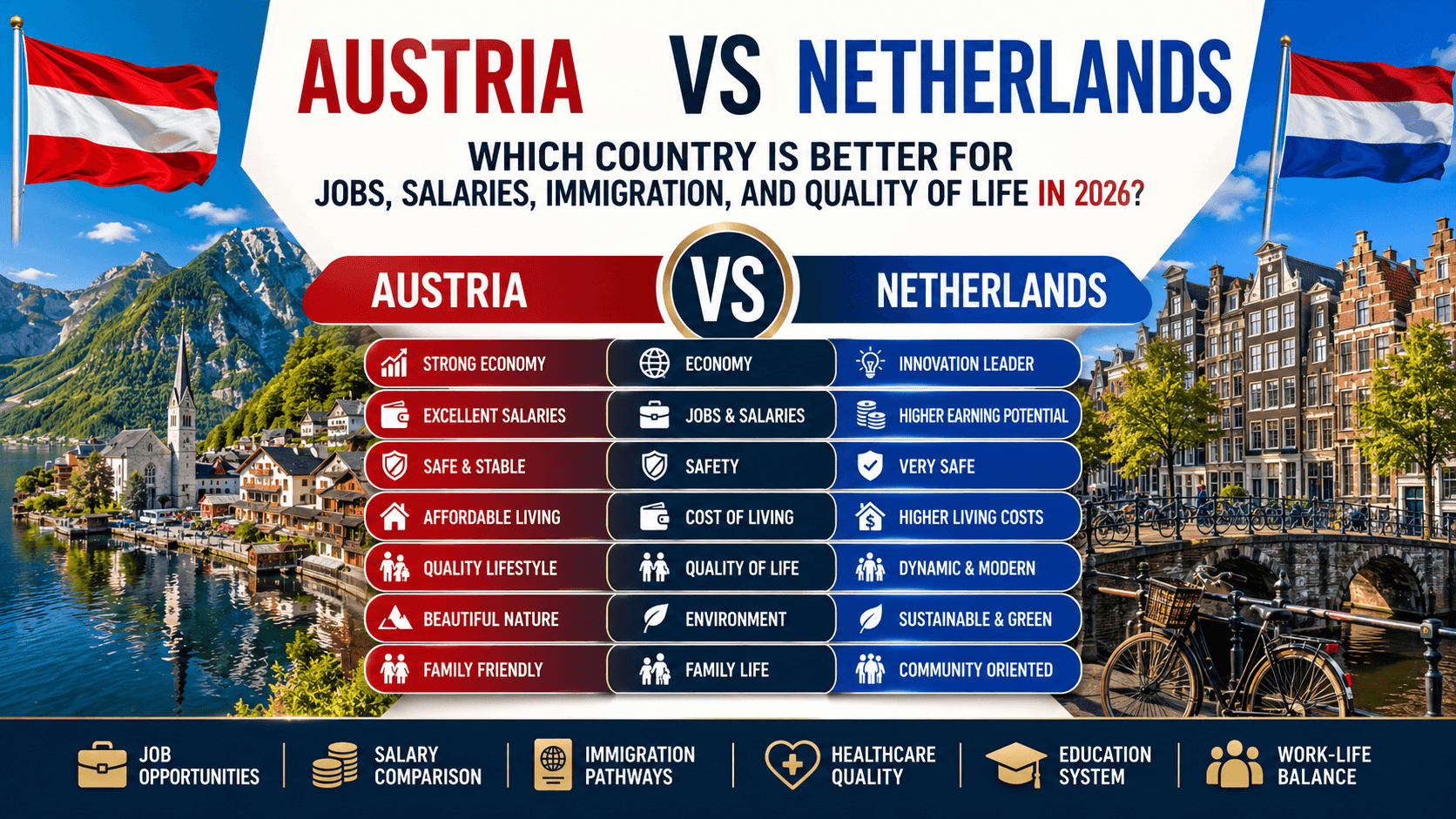
Jobs, Salaries, Immigration, Economic Strength, and the Real Difference Between Austria and the Netherlands
Choosing between Austria and the Netherlands in 2026 is not a simple decision between two rich European countries. Both are safe, developed, organized, and attractive for skilled workers, students, entrepreneurs, and families. Both offer high living standards, strong healthcare systems, efficient public services, and access to the European Union. However, the experience of living, working, earning, integrating, and building long-term wealth in each country can feel completely different.
Austria is a country of stability, structure, industrial strength, high social protection, and calm quality of life. It is deeply connected to Central Europe, especially Germany, Switzerland, Italy, Czechia, Slovakia, and Hungary. Its economy is built around engineering, manufacturing, tourism, healthcare, logistics, public services, and high-quality industrial production. For people who value safety, order, mountains, clean cities, strong public services, and a slower lifestyle, Austria can be one of the most comfortable countries in Europe.
The Netherlands is a country of trade, global business, English-speaking workplaces, technology, logistics, finance, startups, agriculture innovation, energy transition, and international talent. It is one of Europe’s most connected economies, with Amsterdam, Rotterdam, The Hague, Utrecht, Eindhoven, and Leiden forming a powerful network of business, technology, research, and logistics hubs. For people who want international job opportunities, English-friendly workplaces, global company exposure, and faster career mobility, the Netherlands is often more open and easier to enter professionally.
This comparison matters because Austria and the Netherlands are both excellent countries, but they serve different types of people.
Austria may be better for someone who wants long-term security, family stability, strong social systems, affordable access to nature, and a lifestyle that feels less intense than the Netherlands. The Netherlands may be better for someone who wants a more international career, stronger English-speaking job access, better exposure to multinational companies, and a faster path into global industries.
So the real question is not only: Which country is richer?
The better question is:
Which country gives you the best balance between income, immigration access, career growth, living costs, security, family life, and long-term opportunity in 2026?
That is exactly what this comparison will answer.
At a Glance: Austria vs Netherlands in 2026
| Category | Austria | Netherlands |
|---|---|---|
| Best For | Stability, families, engineering, healthcare, skilled trades, calm lifestyle | International careers, tech, logistics, finance, startups, English-speaking jobs |
| Economic Style | Stable industrial and service economy | Highly globalized trade, tech, finance, and logistics economy |
| Job Market | Strong but more German-language dependent | Very international and English-friendly in major cities |
| Salary Level | High by European standards | High by European standards, especially in international sectors |
| Immigration Path | Red-White-Red Card, shortage occupations, points-based routes | Highly Skilled Migrant route, recognized sponsors, EU Blue Card, startup options |
| Language Barrier | German is very important | Dutch helps, but English is widely used in professional sectors |
| Cost of Living | High but often more balanced outside Vienna | Very high, especially housing in Amsterdam, Utrecht, Rotterdam, and Eindhoven |
| Housing Pressure | Difficult in Vienna and major cities, but less extreme than the Netherlands | One of the biggest challenges in Europe |
| Quality of Life | Excellent, calm, safe, nature-focused | Excellent, efficient, modern, international, but often more crowded |
| Long-Term Wealth Potential | Good for stable careers and family life | Stronger for international career growth and high-skill sectors |
| Overall Advantage | Lifestyle stability | Career opportunity |
At first glance, Austria and the Netherlands look similar. Both are wealthy European countries with strong institutions, high wages, good healthcare, advanced infrastructure, and high living standards. But once you look deeper, the difference becomes clear.
Austria is more conservative, traditional, structured, and lifestyle-oriented. The Netherlands is more international, business-driven, flexible, and career-oriented.
Austria gives you comfort.
The Netherlands gives you movement.
Austria helps you build a secure life.
The Netherlands helps you build a more internationally connected career.
That difference will shape almost every part of this comparison.
Why This Comparison Matters in 2026
In 2026, people are not comparing countries only for tourism or lifestyle. They are comparing countries for survival, income growth, safety, family planning, immigration opportunities, career mobility, and financial future.
For skilled workers from outside Europe, the choice between Austria and the Netherlands can determine how easy it is to get hired, how much salary is required for a work permit, how quickly they can integrate, whether their family can adapt, and whether they can save money after rent, taxes, insurance, and daily costs.
For people from the United States, Canada, the United Kingdom, Australia, India, the Middle East, Africa, and Asia, Austria and the Netherlands both look attractive. They offer European security, good healthcare, public transport, strong education, and a better work-life balance than many high-pressure countries. But the practical experience can be very different.
The Netherlands is usually easier for English-speaking professionals. Many companies operate in English, especially in technology, engineering, logistics, finance, life sciences, research, consulting, and international business. A skilled person can sometimes enter the Dutch job market without fluent Dutch, especially in cities such as Amsterdam, Rotterdam, Utrecht, The Hague, and Eindhoven.
Austria is different. English can help in international companies, tourism, academia, and some technology roles, but German remains much more important for everyday life and many jobs. If you want to work in healthcare, public administration, education, skilled trades, customer-facing roles, or local companies, German is often essential.
This makes the Netherlands more accessible in the short term for international professionals, while Austria may reward people who are willing to integrate more deeply over time.
The comparison also matters because both countries are dealing with labour shortages, ageing populations, housing pressure, rising costs, and competition for skilled workers. In simple terms, both countries need talent, but they do not attract or absorb talent in the same way.
The Netherlands often attracts people through international companies and English-speaking jobs.
Austria often attracts people through stability, shortage occupations, family life, and long-term security.
That is why choosing between them requires more than looking at salary numbers. You have to understand the whole model.
The Fundamental Difference Between Austria and the Netherlands
The fundamental difference is this:
Austria is a stability-first country. The Netherlands is an opportunity-first country.
Austria is built around security, order, social protection, high-quality public services, and a strong but relatively traditional economy. It is a country where people value long-term employment, predictable systems, clean cities, good public transport, safe neighborhoods, and a balanced life. Vienna, Graz, Linz, Salzburg, and Innsbruck offer strong living standards, but the rhythm is generally calmer than in the Netherlands.
The Netherlands is built around trade, movement, openness, innovation, and international business. It has one of the most globally connected economies in Europe. Rotterdam is one of the most important ports in the world. Amsterdam is a major financial and technology hub. Eindhoven is a major center for high-tech engineering and semiconductors. The country is small, dense, efficient, and highly connected to global markets.
This creates a very different feeling for workers and immigrants.
In Austria, you may find a more peaceful lifestyle, stronger connection to nature, beautiful cities, mountains, cultural depth, and a stronger sense of traditional European life. But you may also face more language barriers, a less flexible job market, and slower access to international career paths if you do not speak German.
In the Netherlands, you may find more English-speaking jobs, faster hiring in international sectors, stronger networking opportunities, and more exposure to global companies. But you may also face intense housing competition, expensive rent, crowded cities, and a lifestyle that can feel fast, direct, and highly competitive.
Austria is better if you want to settle into a secure life.
The Netherlands is better if you want to push your career into a bigger international market.
Austria feels more protective.
The Netherlands feels more dynamic.
Austria may give you a softer life.
The Netherlands may give you a stronger professional launchpad.
Strategic Comparison: Which Country Gives You the Better Long-Term Position?
Strategically, the Netherlands has a stronger international position. It is one of Europe’s most important gateways for trade, logistics, finance, technology, agriculture innovation, and global business. Its location between Germany, Belgium, the UK, and the North Sea gives it major economic importance. For ambitious professionals, this matters because international companies often build regional headquarters, logistics operations, finance teams, engineering offices, and technology centers in the Netherlands.
Austria’s strategic position is different. It is a Central European hub with strong connections to Germany, Switzerland, Italy, Eastern Europe, and the Balkans. It is especially important for manufacturing, engineering, machinery, industrial services, tourism, energy, transport, and regional business. Austria is not as globally exposed as the Netherlands, but it is extremely well placed for people who want a stable European base with strong access to Central and Eastern Europe.
For career growth, the Netherlands usually has the advantage because it offers more international roles, more English-speaking work environments, and stronger access to multinational companies. It is particularly attractive for professionals in technology, software, data, logistics, finance, digital marketing, life sciences, engineering, and corporate operations.
For long-term lifestyle security, Austria has a strong argument. It offers a calmer environment, excellent public transport, high safety, strong healthcare, and one of the best lifestyle combinations in Europe. Vienna repeatedly attracts global attention for livability, and Austria’s smaller cities offer a high quality of life without the same level of pressure found in Amsterdam or other Dutch urban centers.
The strategic decision therefore depends on your personal goal.
Choose Austria if your priority is long-term stability, family comfort, safety, and a balanced European life.
Choose the Netherlands if your priority is international career growth, English-friendly jobs, business networking, and stronger access to global industries.
In 2026, the Netherlands is more strategic for career acceleration.
Austria is more strategic for lifestyle consolidation.
Economic Strength: Which Economy Is Stronger?
Both Austria and the Netherlands are wealthy, developed, high-income economies. Neither country is weak. Both have strong institutions, skilled workers, advanced infrastructure, efficient public systems, and high productivity. However, the Netherlands has a larger and more globally connected economy, while Austria has a smaller but very stable and high-quality economy.
The Netherlands has a major advantage in trade, logistics, finance, technology, and international business. Its economy is deeply connected to global supply chains. Rotterdam gives the Netherlands huge logistics power, while Amsterdam provides financial, technology, creative, and corporate strength. Eindhoven and the surrounding Brainport region are important for high-tech manufacturing, semiconductors, engineering, and innovation.
Austria’s economy is strong in a different way. It is known for industrial quality, machinery, engineering, tourism, construction, healthcare, public services, and manufacturing. Austrian companies are often highly specialized, reliable, and connected to German-speaking markets. The country may not feel as internationally aggressive as the Netherlands, but it is stable, skilled, and productive.
Here is the practical difference:
| Economic Factor | Austria | Netherlands | Advantage |
|---|---|---|---|
| Economic Size | Smaller economy | Larger economy | Netherlands |
| Global Trade Role | Strong regional role | Major global trade hub | Netherlands |
| Industrial Quality | Very strong | Strong | Austria slightly |
| Finance & Corporate Jobs | Moderate | Strong | Netherlands |
| Technology Ecosystem | Growing | Stronger and more international | Netherlands |
| Tourism Economy | Very strong | Important but less central | Austria |
| Logistics | Strong regional logistics | World-class logistics | Netherlands |
| Economic Stability | Very stable | Very stable but more exposed to global trade | Tie |
| International Career Access | More limited by German language | Stronger and more English-friendly | Netherlands |
The Netherlands has the stronger economic engine for international professionals. Its economy is more open, more globally connected, and more aligned with sectors that attract foreign talent.
Austria has the stronger lifestyle economy. It offers high-quality jobs, strong public systems, and long-term security, but it is less open to people who do not speak German.
So, if the question is “Which country has the bigger international opportunity market?” the answer is the Netherlands.
If the question is “Which country gives a stable, high-quality European life with strong social security?” Austria becomes much more competitive.
Jobs and Employment: Where Is It Easier to Find Work?
For most international job seekers in 2026, the Netherlands is easier than Austria.
This does not mean Austria has no jobs. Austria has real shortages in several sectors, especially healthcare, engineering, skilled trades, tourism, construction, IT, and technical roles. However, Austria’s job market is more language-dependent. German is not just useful; in many roles, it is the difference between being employable and being ignored.
The Netherlands is much more accessible for English-speaking professionals. In major cities and international companies, English is widely used in business, technology, finance, logistics, research, and consulting. Dutch is still important for full integration, public-sector roles, healthcare, education, and long-term career depth, but it is often not required at the beginning for many professional jobs.
This gives the Netherlands a major advantage for newcomers.
A software engineer, data analyst, supply chain specialist, product manager, finance analyst, marketing manager, UX designer, or international sales professional may find more English-speaking openings in the Netherlands than in Austria. The Netherlands also has a larger ecosystem of international recruiters, multinational companies, startups, scaleups, and recognized sponsors for skilled migrants.
Austria is stronger for people who speak German or are willing to learn it seriously. Once you have German ability, Austria becomes much more attractive. Healthcare workers, engineers, technicians, electricians, mechanics, hospitality workers, construction specialists, manufacturing professionals, and skilled tradespeople may find strong opportunities, especially if their occupation appears on shortage lists.
The job-market comparison looks like this:
| Job Category | Austria | Netherlands | Better Option |
|---|---|---|---|
| English-speaking tech jobs | Available but fewer | Strong and international | Netherlands |
| Engineering | Strong | Strong | Tie |
| Manufacturing | Strong | Strong but more specialized by region | Austria slightly |
| Logistics | Good | Excellent | Netherlands |
| Finance | Moderate | Strong | Netherlands |
| Healthcare | Strong demand, German needed | Strong demand, Dutch often needed | Tie |
| Tourism & Hospitality | Very strong | Good | Austria |
| Startups | Growing | Stronger | Netherlands |
| Public Sector | German required | Dutch required | Tie |
| Skilled Trades | Strong demand | Strong demand | Tie |
If you are fluent in German, Austria becomes much more competitive. If you only speak English, the Netherlands is usually the safer choice.
For international professionals, the Netherlands is better for job access.
For German-speaking professionals, Austria can be better for stability and lifestyle.
Salaries: Which Country Pays More?
Salary comparison between Austria and the Netherlands is more complicated than it looks.
On paper, both countries offer high average wages by European standards. In some broad wage datasets, Austria and the Netherlands appear very close. That means neither country is a low-salary destination. However, the real difference appears when you look at sectors, taxes, cost of living, bonuses, housing costs, and international career paths.
The Netherlands often has stronger salary potential in international sectors. Technology, finance, consulting, logistics, data, product management, engineering, and corporate roles can offer attractive salaries, especially in Amsterdam, Rotterdam, Utrecht, The Hague, and Eindhoven. Multinational companies and fast-growing firms can create better upward mobility for ambitious professionals.
Austria also pays well, especially in engineering, manufacturing, healthcare, public-sector-related roles, and technical industries. However, Austria’s salary growth can feel more structured and less aggressive. Career progression may be steadier but slower, especially outside Vienna or in companies where German is essential.
The key salary difference is not only gross salary. It is net life.
A higher salary in the Netherlands can be reduced by extreme housing costs, especially if you live in Amsterdam or another high-demand city. A good income may not feel as strong after rent, utilities, insurance, taxes, transport, and childcare. Austria also has high costs, especially in Vienna, Salzburg, and Innsbruck, but the housing pressure can feel less extreme in many areas compared with the Netherlands.
Here is the practical salary picture:
| Salary Factor | Austria | Netherlands |
|---|---|---|
| Average Wage Level | High | High |
| Tech Salary Potential | Good | Stronger |
| Finance Salary Potential | Moderate | Stronger |
| Engineering Salary Potential | Strong | Strong |
| Healthcare Pay | Solid, but language-dependent | Solid, but language-dependent |
| Salary Growth Speed | More stable and structured | Faster in international sectors |
| Net Income Pressure | Taxes and costs matter | Taxes, rent, and housing pressure matter heavily |
| Best Salary Cities | Vienna, Linz, Graz, Salzburg | Amsterdam, Rotterdam, Utrecht, Eindhoven, The Hague |
| Best For High Earners | Stable professionals | International professionals and specialists |
If your goal is maximum salary growth, the Netherlands has the advantage.
If your goal is a stable salary with strong quality of life, Austria remains highly attractive.
A person earning slightly less in Austria may still enjoy a more comfortable lifestyle than someone earning more in the Netherlands but spending heavily on rent. On the other hand, a skilled professional in the Netherlands who secures a strong job outside the most expensive housing areas may build wealth faster.
So the answer is not simply “the Netherlands pays more” or “Austria is cheaper.”
The better answer is:
The Netherlands offers stronger salary upside. Austria offers stronger salary stability.
Immigration: Which Country Is Easier to Move To?
Immigration is one of the most important differences between Austria and the Netherlands.
The Netherlands is often easier for highly skilled international professionals because its system is built around recognized employers and salary thresholds. If a recognized sponsor wants to hire you and your salary meets the required threshold, the process can be relatively clear. This makes the Dutch route attractive for professionals in technology, engineering, finance, science, data, logistics, and corporate roles.
The Dutch Highly Skilled Migrant route is especially important because it is directly connected to employer sponsorship. For many international workers, the main challenge is not proving points or passing complex criteria. The main challenge is getting a job offer from a recognized sponsor that meets the salary requirement.
Austria uses the Red-White-Red Card system, which includes different categories such as very highly qualified workers, skilled workers in shortage occupations, other key workers, graduates, self-employed key workers, and startup founders. This system can be attractive, especially if your occupation is in demand. However, it can feel more complex because it often depends on points, qualifications, job offers, salary levels, occupation lists, and in some cases labour-market checks.
For skilled workers in shortage occupations, Austria can be a strong option. If your profession is officially listed as a shortage occupation and you meet the requirements, the process may become easier. This is especially relevant for technical, healthcare, engineering, and skilled trade roles.
However, for an English-speaking professional comparing both countries, the Netherlands usually feels more accessible because the job market itself is more international. Even if the visa rules are strict, the number of English-speaking companies and recognized sponsors gives the Netherlands a practical advantage.
The immigration comparison looks like this:
| Immigration Factor | Austria | Netherlands | Advantage |
|---|---|---|---|
| Main Skilled Route | Red-White-Red Card | Highly Skilled Migrant / EU Blue Card | Depends on profile |
| English-Friendly Job Access | Limited compared with Netherlands | Strong | Netherlands |
| Shortage Occupation Advantage | Strong | Available but less central | Austria |
| Employer Sponsorship | Important | Very important | Tie |
| Points System | More important | Less central for HSM route | Netherlands |
| Language Barrier | German often important | Dutch useful but English widely used in skilled sectors | Netherlands |
| Best For | German-speaking skilled workers, shortage occupations | International professionals with sponsor job offer | Netherlands |
| Long-Term Integration | Requires German seriously | Dutch helps but English can carry career further | Netherlands initially |
For someone outside the EU, the Netherlands may be easier if they are highly skilled, English-speaking, and able to secure an employer sponsor.
Austria may be easier if they work in a shortage occupation, have strong qualifications, and are ready to learn German.
In short:
The Netherlands is easier for international professionals. Austria is better for people whose skills match official shortage needs and who are serious about integration.
Wealth Creation: The Opening Section
When comparing Austria and the Netherlands for wealth creation, the first mistake is to focus only on salary.
Salary matters, but wealth is created through the relationship between income, expenses, taxes, housing, savings, investments, career growth, and long-term stability.
The Netherlands may offer better wealth creation potential for ambitious professionals because it has stronger international salary growth, more multinational companies, more English-speaking high-skill jobs, and stronger business networks. A person who enters the Dutch market in technology, finance, logistics, engineering, or consulting may have more chances to move between companies, increase salary, build international experience, and later use that experience globally.
Austria may offer better wealth protection. It is not always the place where salaries grow fastest, but it can be an excellent place to build a secure life. If you have a stable job, controlled housing costs, access to public services, and a good family environment, Austria can help you preserve quality of life even without chasing the highest salary.
The wealth model is different:
| Wealth Factor | Austria | Netherlands |
|---|---|---|
| Income Growth | Stable, slower | Faster in international sectors |
| Housing Pressure | High but more manageable in many areas | Very high and often the biggest obstacle |
| Career Mobility | Good if German-speaking | Stronger for international professionals |
| Business Exposure | Regional and Central European | Global and highly international |
| Saving Potential | Good if rent is controlled | Good only if salary is strong enough to beat housing costs |
| Investment Culture | Conservative and stable | More business-oriented and internationally connected |
| Long-Term Security | Very strong | Strong but more expensive and competitive |
| Best Wealth Strategy | Stable career + controlled costs | High salary + career growth + smart housing choices |
This means Austria may be better for a person who wants financial calm, while the Netherlands may be better for someone who wants financial acceleration.
A family with children may find Austria more comfortable if they value safety, space, nature, public services, and calm routines. A young professional may find the Netherlands more exciting if they want to build a strong CV, work in English, meet international people, and move fast in a global job market.
For wealth creation, the Netherlands has the higher ceiling.
For wealth protection, Austria has the smoother floor.
That distinction will become even more important in Part 3, where we will compare income growth, cost of living, purchasing power, housing, taxes, banking, investing, and economic resilience in much deeper detail.
Early Verdict After Part 1
After comparing the first major factors — economic strength, jobs, salaries, immigration, and the opening wealth-creation picture — the Netherlands has the advantage for international career opportunity, while Austria remains stronger for stability and lifestyle security.
The Netherlands is better if your main goal is:
- Finding an English-speaking job
- Working in international business
- Growing faster in tech, finance, logistics, data, or corporate roles
- Building a globally useful career
- Accessing a more open labour market as a foreign professional
Austria is better if your main goal is:
- Living in a calm, safe, beautiful European country
- Building a stable family life
- Working in engineering, healthcare, tourism, skilled trades, or manufacturing
- Integrating into a German-speaking environment
- Prioritizing comfort and security over fast career movement
So far, the Netherlands leads for opportunity.
Austria leads for lifestyle stability.
But this comparison is not finished. Jobs and salaries are only the first layer. A country can offer high income but still be difficult if healthcare, safety, education, family life, and work-life balance are weak. A country can also offer a beautiful lifestyle but limit your professional future if the job market is too narrow.
In Part 2, we will compare Austria and the Netherlands across entrepreneurship, technology, artificial intelligence, education, healthcare, safety, family life, and work-life balance — the areas that reveal whether each country is only good for work, or truly good for building a complete life.
Entrepreneurship, Technology, Artificial Intelligence, Education, Healthcare, Safety, Family Life, and Work-Life Balance
At this point in the comparison, the Netherlands appears stronger for international careers, while Austria appears stronger for stability and long-term lifestyle security.
However, choosing a country is not only about getting a job.
Many people move abroad with bigger goals:
- Building a business
- Creating long-term wealth
- Raising children
- Accessing world-class education
- Living in a safe environment
- Achieving a healthier work-life balance
- Positioning themselves for future industries such as Artificial Intelligence
This is where the comparison becomes much more interesting.
A country may offer excellent salaries but create stress, housing pressure, and burnout.
Another country may offer slightly lower earning potential but provide a better overall life experience.
To understand which country truly wins in 2026, we need to examine the deeper foundations of long-term success.
Entrepreneurship: Which Country Is Better for Building a Business?
Entrepreneurship is one of the clearest areas where the Netherlands and Austria follow completely different philosophies.
The Netherlands was built around trade, commerce, international business, shipping, and global connectivity. For centuries, Dutch economic culture has rewarded innovation, risk-taking, international expansion, and commercial thinking.
Austria, by contrast, is more conservative and stability-oriented. Austrian businesses often focus on long-term sustainability, engineering excellence, manufacturing quality, craftsmanship, and gradual growth rather than aggressive expansion.
This difference becomes immediately visible when launching a business.
A startup founder arriving in Amsterdam, Rotterdam, Utrecht, or Eindhoven enters one of Europe’s most connected business ecosystems. Investors, accelerators, multinational corporations, venture capital firms, research institutions, and technology hubs are concentrated within a relatively small geographic area.
A founder arriving in Vienna enters a different environment. Vienna offers excellent quality of life, lower startup competition, strong government support programs, and access to Central and Eastern Europe. However, the scale of startup activity remains smaller than the Dutch ecosystem.
Startup Ecosystem Comparison
| Factor | Austria | Netherlands |
|---|---|---|
| Startup Activity | Strong | Excellent |
| Venture Capital Access | Moderate | High |
| International Investors | Moderate | Strong |
| English-Friendly Business Environment | Moderate | Excellent |
| Access to Global Markets | Good | Excellent |
| Ease of Networking | Good | Excellent |
| Innovation Culture | Strong | Very Strong |
| Startup Scaling Potential | Good | Excellent |
The Netherlands wins clearly for ambitious entrepreneurs targeting global markets.
Austria remains attractive for founders who value stability, lower pressure, engineering-focused businesses, industrial innovation, manufacturing, tourism, healthcare solutions, or regional expansion into Central Europe.
Entrepreneur Verdict
Winner: Netherlands
The Dutch ecosystem offers more capital, stronger networking opportunities, better international exposure, and faster scaling potential.
Technology: Which Country Is More Advanced?
Both countries are technologically advanced.
Neither Austria nor the Netherlands can be considered behind in digital infrastructure, innovation, engineering capability, or technological adoption.
However, their strengths differ significantly.
Austria excels in industrial technology.
The Netherlands excels in digital technology.
Austria’s technology strengths include:
- Industrial automation
- Mechanical engineering
- Energy systems
- Manufacturing technology
- Transportation infrastructure
- Environmental engineering
- Smart industrial production
The Netherlands dominates areas such as:
- Software development
- Semiconductors
- Fintech
- Digital platforms
- Cloud computing
- Data science
- Smart logistics
- Agricultural technology
- Smart cities
The Dutch technology sector is particularly impressive because it combines global talent with strong university research and world-class private industry.
The Eindhoven region alone has become one of Europe’s most important high-tech ecosystems.
Many international technology professionals view the Netherlands as one of the most attractive destinations in Europe outside Germany and the United Kingdom.
Technology Ecosystem Comparison
| Category | Austria | Netherlands |
|---|---|---|
| Software Industry | Strong | Excellent |
| Semiconductor Industry | Moderate | Excellent |
| Industrial Technology | Excellent | Strong |
| Fintech | Moderate | Excellent |
| Digital Innovation | Strong | Excellent |
| International Tech Companies | Good | Excellent |
| Research Commercialization | Strong | Excellent |
| Startup Technology Scene | Good | Excellent |
Technology Verdict
Winner: Netherlands
Austria is highly capable technologically, but the Netherlands operates on a larger international scale.
Artificial Intelligence: Which Country Is Better Positioned for the AI Era?
Artificial Intelligence is becoming one of the most important economic forces of the decade.
Countries that successfully attract AI talent, AI startups, AI investment, and AI research will likely enjoy stronger economic growth through 2030 and beyond.
When examining AI readiness, the Netherlands has established itself as one of Europe’s strongest performers.
Several factors contribute to this:
- Strong AI research universities
- International talent attraction
- English-speaking work environments
- Startup-friendly ecosystem
- Availability of venture capital
- Strong digital infrastructure
- High technology adoption rates
The Dutch AI ecosystem benefits from continuous interaction between universities, research institutes, startups, and multinational companies.
Austria is also making progress.
Vienna has developed into an important research center for data science, machine learning, robotics, and AI applications.
However, Austria’s AI ecosystem remains smaller and more research-focused than the Dutch ecosystem.
AI Readiness Comparison
| AI Factor | Austria | Netherlands |
|---|---|---|
| AI Research | Strong | Very Strong |
| AI Startups | Moderate | Strong |
| AI Investment | Moderate | Strong |
| International AI Talent | Good | Excellent |
| AI Commercialization | Moderate | Strong |
| AI Employment Opportunities | Good | Excellent |
| Future AI Growth Potential | Strong | Very Strong |
The Netherlands currently offers more AI-related employment opportunities and stronger commercialization pathways.
AI Verdict
Winner: Netherlands
Austria remains competitive, but the Netherlands is better positioned for the AI-driven economy.
Education: Which Country Offers Better Educational Opportunities?
Education is one of the strongest categories for both countries.
Both Austria and the Netherlands provide high-quality public education, respected universities, and strong research institutions.
However, the student experience can differ dramatically.
Austria is one of Europe’s most affordable destinations for higher education.
Dutch universities are often more internationally visible.
The Netherlands attracts enormous numbers of international students because:
- Many programs are taught entirely in English
- Universities rank highly internationally
- Strong industry connections
- International networking opportunities
Austria offers excellent education at a lower overall cost but often requires stronger German-language integration depending on the institution and program.
University Comparison
| Factor | Austria | Netherlands |
|---|---|---|
| Global University Reputation | Strong | Very Strong |
| English-Taught Programs | Good | Excellent |
| Tuition Value | Excellent | Strong |
| Research Quality | Strong | Very Strong |
| International Student Experience | Good | Excellent |
| Industry Connections | Strong | Excellent |
| Graduate Employability | Strong | Excellent |
Education Verdict
Winner: Netherlands (slightly)
Austria offers tremendous value, but the Netherlands provides broader international opportunities.
Healthcare: Which Country Provides Better Medical Care?
Healthcare is one of the areas where both countries belong among the world’s elite.
Regardless of which country you choose, access to healthcare will likely exceed what many people experience elsewhere.
Austria’s healthcare system is often praised for:
- Excellent doctor availability
- Strong hospital network
- Universal coverage
- High physician density
- Strong preventative care
The Dutch system is famous for:
- Efficiency
- Digitalization
- Primary care quality
- Patient outcomes
- Healthcare innovation
The difference is subtle.
Austria often feels more accessible.
The Netherlands often feels more optimized.
Healthcare Comparison
| Healthcare Factor | Austria | Netherlands |
|---|---|---|
| Hospital Quality | Excellent | Excellent |
| Specialist Access | Excellent | Very Good |
| Preventative Care | Excellent | Excellent |
| Healthcare Innovation | Strong | Excellent |
| Coverage Quality | Excellent | Excellent |
| System Efficiency | Strong | Excellent |
| Patient Satisfaction | Very High | Very High |
Healthcare Verdict
Winner: Tie
Both countries provide world-class healthcare.
Safety: Which Country Feels Safer?
Safety is one of the strongest selling points for both Austria and the Netherlands.
Violent crime rates remain low by global standards.
Political stability is high.
Institutions function effectively.
Public infrastructure is reliable.
The difference is largely environmental.
Austria often feels quieter and calmer.
The Netherlands feels more urban and dynamic.
Many families describe Austria as providing a stronger sense of personal tranquility.
Safety Comparison
| Safety Factor | Austria | Netherlands |
|---|---|---|
| Violent Crime | Very Low | Very Low |
| Political Stability | Excellent | Excellent |
| Public Safety | Excellent | Excellent |
| Nighttime Safety | Excellent | Excellent |
| Family Security | Excellent | Excellent |
Safety Verdict
Winner: Austria (slightly)
The margin is small, but Austria often feels more peaceful.
Family Life: Which Country Is Better for Raising Children?
Family life is where Austria becomes extremely competitive.
Many people move abroad seeking higher salaries.
Years later they discover that quality of family life matters far more.
Austria excels in:
- Clean environments
- Safe neighborhoods
- Access to nature
- Strong public services
- Family-oriented culture
- Lower population density
- Outdoor lifestyle opportunities
The Netherlands also offers excellent family conditions.
However, housing pressure and urban density can create challenges for families seeking larger living spaces.
Family Life Comparison
| Factor | Austria | Netherlands |
|---|---|---|
| Family Environment | Excellent | Excellent |
| Access to Nature | Excellent | Very Good |
| Housing Comfort | Strong | Moderate |
| Child Safety | Excellent | Excellent |
| Public Services | Excellent | Excellent |
| Family Stress Level | Lower | Higher |
Family Life Verdict
Winner: Austria
Austria provides one of Europe’s strongest family environments.
Work-Life Balance: Which Country Lets You Enjoy Life More?
This category reveals one of the most important differences between the two countries.
Both countries value life outside work.
However, Austria pushes slightly further toward lifestyle.
The Austrian culture places significant emphasis on:
- Vacations
- Family time
- Leisure
- Outdoor recreation
- Social stability
The Netherlands also values work-life balance but often operates within a more competitive and internationally driven environment.
The result is subtle but meaningful.
Many professionals describe Austria as feeling slower and calmer.
The Netherlands feels more energetic and ambitious.
Work-Life Balance Comparison
| Factor | Austria | Netherlands |
|---|---|---|
| Vacation Culture | Excellent | Excellent |
| Working Hours | Excellent | Very Good |
| Stress Levels | Lower | Higher |
| Leisure Opportunities | Excellent | Excellent |
| Lifestyle Pace | Slower | Faster |
Work-Life Balance Verdict
Winner: Austria
Austria delivers a more relaxed lifestyle overall.
Part 2 Verdict
After examining entrepreneurship, technology, AI, education, healthcare, safety, family life, and work-life balance, a fascinating pattern emerges.
The Netherlands dominates the future-oriented categories:
- Entrepreneurship
- Technology
- Artificial Intelligence
- International education
- Innovation
Austria dominates the lifestyle-oriented categories:
- Safety
- Family life
- Personal comfort
- Work-life balance
- Daily quality of living
The Netherlands is building one of Europe’s strongest future economies.
Austria is protecting one of Europe’s most comfortable lifestyles.
The question now becomes:
Can the Netherlands’ higher opportunity compensate for its higher living costs and housing pressure?
And can Austria’s superior lifestyle compensate for slower career acceleration?
To answer that, we must dive into the most important financial comparison of all.
In Part 3, we will conduct a deep wealth-creation analysis covering income growth, cost of living, purchasing power, housing affordability, investing opportunities, taxation, banking systems, economic resilience, and which country gives the better path to building long-term financial freedom.
One of the biggest mistakes people make when comparing countries is focusing only on salary.
A higher salary does not automatically create a higher standard of living.
Real wealth is built through a combination of income growth, purchasing power, taxation, housing affordability, investment opportunities, financial stability, and long-term economic resilience.
This is where the Austria versus Netherlands comparison becomes far more interesting.
The Netherlands is often viewed as one of Europe’s strongest opportunity economies. Austria is often viewed as one of Europe’s strongest lifestyle economies.
The question is simple:
Which model actually creates more wealth in the long run?
Income Growth Potential
Income growth is not determined by your first salary.
It is determined by how quickly your earnings can increase over the next 5, 10, or 20 years.
This is where the Netherlands has a significant advantage.
The Dutch economy is highly international and deeply connected to global industries. Professionals frequently move between multinational corporations, technology companies, consulting firms, logistics giants, financial institutions, research organizations, and startups.
Career mobility is high.
Competition is high.
Opportunity is high.
A software engineer earning €60,000 today may be earning €90,000–€120,000 several years later if they continue advancing into senior or leadership positions.
The same pattern can be seen in finance, data science, artificial intelligence, engineering management, logistics, healthcare leadership, and consulting.
Austria provides a different experience.
Career growth tends to be more structured and predictable.
Promotions often occur at a slower pace.
Salary progression is generally steadier.
Many professionals enjoy greater stability but less aggressive income acceleration.
For ambitious professionals seeking rapid career advancement, the Netherlands offers a stronger growth engine.
For people prioritizing stability and lower career volatility, Austria remains highly attractive.
| Income Growth Factor | Austria | Netherlands |
|---|---|---|
| Career Mobility | Strong | Excellent |
| Promotion Speed | Moderate | Strong |
| Executive Opportunities | Strong | Excellent |
| International Career Growth | Moderate | Excellent |
| Long-Term Salary Upside | Strong | Excellent |
Winner: Netherlands
Cost of Living
A high salary means little if expenses consume most of it.
This is where Austria begins to recover ground.
The Netherlands has become one of Europe’s most expensive countries.
Housing shortages have pushed rents upward.
Major cities such as Amsterdam, Utrecht, Rotterdam, and Eindhoven face intense demand.
Even highly paid professionals often spend a substantial portion of income on housing.
Austria is not cheap.
Vienna, Salzburg, and Innsbruck can be expensive.
However, Austria generally offers a more balanced relationship between wages and living costs.
Outside major urban centers, housing pressure is considerably lower than in the Netherlands.
Daily expenses, transportation, healthcare, and family-related costs often feel more manageable.
This difference becomes particularly important for families.
A family earning a comfortable income in Austria may experience less financial stress than a similar family in the Netherlands despite earning slightly less.
| Cost Category | Austria | Netherlands |
|---|---|---|
| Housing | Better | Worse |
| Utilities | Similar | Similar |
| Food | Slightly Better | Slightly Higher |
| Childcare | Better Value | More Expensive |
| Family Expenses | Lower | Higher |
| Financial Pressure | Lower | Higher |
Winner: Austria
Purchasing Power
Purchasing power determines how much life your salary can actually buy.
This is where the comparison becomes surprisingly close.
The Netherlands offers stronger earning potential.
Austria offers lower lifestyle pressure.
As a result, purchasing power often ends up being relatively balanced.
Highly skilled professionals may enjoy greater purchasing power in the Netherlands if they secure strong salaries.
Middle-income workers often find Austria equally attractive because expenses are easier to manage.
For average households, Austria frequently provides a smoother financial experience.
For top performers, the Netherlands can provide greater upside.
Winner: Tie
Housing: The Most Important Financial Battle
Housing may be the single biggest factor influencing long-term wealth.
The Netherlands currently faces one of Europe’s most challenging housing markets.
Demand significantly exceeds supply in many regions.
Finding affordable housing can be difficult even for highly paid professionals.
Waiting lists are long.
Competition is intense.
Prices remain elevated.
Austria also experiences housing challenges, especially in Vienna and tourist-heavy regions.
However, the situation is generally less severe.
Austria’s housing system tends to provide greater long-term stability.
For families, first-time buyers, and people seeking predictable living costs, Austria often feels considerably more comfortable.
| Housing Factor | Austria | Netherlands |
|---|---|---|
| Rental Availability | Better | Worse |
| Housing Affordability | Better | Worse |
| Family Housing Access | Better | Worse |
| Housing Stress | Lower | Higher |
| Long-Term Stability | Strong | Moderate |
Winner: Austria
Investing Opportunities
Building wealth is not only about earning money.
It is also about multiplying money.
The Netherlands offers one of Europe’s strongest environments for wealth creation through business ownership, startups, investments, innovation, and international exposure.
Its economy is deeply connected to global markets.
Entrepreneurs gain easier access to international investors.
Technology founders benefit from stronger venture capital networks.
Financial professionals gain exposure to larger investment ecosystems.
Austria’s investment environment is stable and secure but generally more conservative.
Many Austrians prioritize wealth preservation over aggressive wealth expansion.
This approach creates stability but often produces slower financial growth.
The Dutch model favors opportunity.
The Austrian model favors protection.
Winner: Netherlands
Taxation
Taxes are often misunderstood when comparing countries.
Both Austria and the Netherlands maintain advanced welfare systems funded through taxation.
Neither country is a low-tax destination.
Residents receive significant benefits in return, including healthcare, infrastructure, public services, education, transportation, and social protections.
For high-income earners, taxation can feel substantial in both countries.
The practical reality is that taxes alone rarely determine which country creates more wealth.
Income growth, housing costs, and career opportunities usually matter far more.
For most professionals, taxation is effectively a draw.
Winner: Tie
Banking and Financial Security
Financial security is one of the hidden strengths of both countries.
Austria maintains a reputation for stability, conservative banking, and financial reliability.
The Netherlands combines stability with greater international financial integration.
Dutch banking systems are highly digitalized and globally connected.
Austrian banking often feels slightly more traditional but extremely dependable.
Both countries rank among Europe’s safest places for personal financial security.
Winner: Tie
Global Economic Influence
The Netherlands possesses one of the most influential economies in Europe relative to its size.
Rotterdam remains one of the world’s most important ports.
Amsterdam serves as a major financial and business center.
Dutch companies operate globally across logistics, finance, technology, agriculture, energy, and engineering.
Austria has significant regional influence but operates on a smaller international scale.
Its strength lies in quality rather than global reach.
For professionals seeking international exposure, the Dutch economy provides a larger platform.
Winner: Netherlands
Economic Resilience
Economic resilience measures how well a country handles crises.
Both Austria and the Netherlands perform exceptionally well.
Strong institutions.
Stable governments.
Advanced infrastructure.
Highly educated workforces.
Diversified economies.
Reliable banking systems.
Neither country can be considered economically fragile.
Austria’s economy tends to feel slightly more protected because it relies less on global trade dynamics.
The Netherlands benefits enormously from globalization but is also somewhat more exposed to global fluctuations.
The difference is small.
Winner: Slight Advantage Austria
Opportunity Model vs Lifestyle Model
After analyzing every major financial factor, a clear pattern emerges.
The Netherlands operates as an opportunity model.
Austria operates as a lifestyle model.
The Dutch model rewards ambition.
It rewards mobility.
It rewards specialization.
It rewards international careers.
It rewards entrepreneurship.
It rewards innovation.
Austria rewards stability.
It rewards family life.
It rewards consistency.
It rewards security.
It rewards long-term comfort.
It rewards quality over speed.
Neither model is objectively better.
The right answer depends entirely on the individual.
A young technology professional may generate significantly more wealth in the Netherlands.
A family seeking financial security and a calmer life may achieve greater overall satisfaction in Austria.
The most surprising discovery so far is this:
The Netherlands has a higher wealth ceiling.
Austria has a stronger wealth foundation.
The Netherlands may allow you to become richer.
Austria may make it easier to feel wealthy.
That distinction becomes critical when evaluating the final dimensions that often matter most in everyday life: healthcare quality, personal safety, happiness, environmental quality, family well-being, sustainability, and long-term quality of life.
Those factors will ultimately determine which country deserves the overall victory in 2026.
As financial considerations become less dominant, the comparison enters an area that many people underestimate when planning a move abroad.
Salary can determine where you start.
Quality of life often determines whether you stay.
Many expatriates discover that after securing a stable income, factors such as healthcare quality, personal safety, family well-being, environmental conditions, education standards, social trust, and overall happiness become far more important than earning an extra few thousand euros per year.
This is where Austria and the Netherlands become extremely difficult to separate because both countries consistently rank among the most desirable places to live in Europe.
Yet beneath the surface, important differences remain.
Healthcare Quality and Long-Term Well-Being
Both countries operate healthcare systems that rank among the strongest in Europe.
Citizens and residents enjoy access to highly trained medical professionals, advanced hospitals, modern equipment, and strong preventative care systems.
However, the overall healthcare experience differs.
Austria’s healthcare model is often praised for accessibility and patient comfort.
Many residents appreciate the relatively direct access to specialists, strong regional hospital networks, and comprehensive medical coverage.
Healthcare in Austria often feels highly personal and patient-oriented.
The Netherlands approaches healthcare differently.
The Dutch system emphasizes efficiency, preventive medicine, primary care management, and structured referral pathways.
The system is extremely effective but can sometimes feel more regulated.
For most people, both countries deliver excellent outcomes.
The difference lies more in experience than quality.
Austria often feels more comfortable.
The Netherlands often feels more efficient.
| Healthcare Factor | Austria | Netherlands |
|---|---|---|
| Hospital Quality | Excellent | Excellent |
| Specialist Access | Excellent | Very Good |
| Medical Outcomes | Excellent | Excellent |
| Preventive Care | Excellent | Excellent |
| Patient Experience | Excellent | Very Good |
| System Efficiency | Very Good | Excellent |
Overall Winner: Slight Advantage Austria
Personal Safety and Everyday Security
Safety is one of the strongest categories for both countries.
Violent crime remains low.
Political institutions are stable.
Public transportation is reliable.
Emergency services are highly developed.
Residents generally feel secure walking in cities, using public transport, and raising families.
However, Austria consistently benefits from a reputation for exceptional tranquility.
Many Austrian cities maintain a slower pace of life.
Urban density is lower.
Social tension is generally lower.
Communities often feel calmer.
The Netherlands remains very safe by global standards but experiences greater population density, more urban congestion, and higher levels of everyday activity.
For many people this creates energy and opportunity.
For others it creates stress.
Austria often feels more peaceful.
The Netherlands often feels more dynamic.
| Safety Category | Austria | Netherlands |
|---|---|---|
| Violent Crime | Very Low | Very Low |
| Public Safety | Excellent | Excellent |
| Family Security | Excellent | Excellent |
| Social Stability | Excellent | Excellent |
| Feeling of Calm | Excellent | Very Good |
Winner: Austria
Quality of Life
Quality of life is where Austria becomes exceptionally difficult to beat.
The country combines strong public services, excellent healthcare, beautiful landscapes, cultural richness, environmental quality, and social stability.
Residents enjoy access to mountains, lakes, forests, historic cities, outdoor recreation, and efficient infrastructure.
Life often feels balanced.
The Netherlands offers a different version of quality of life.
Its strengths come from convenience, efficiency, connectivity, cycling infrastructure, international diversity, and economic opportunity.
Dutch cities are among the most practical and functional urban environments in the world.
The question becomes:
Do you prefer comfort or convenience?
Austria often wins on comfort.
The Netherlands often wins on convenience.
For many families and long-term residents, comfort eventually becomes more valuable.
| Quality of Life Factor | Austria | Netherlands |
|---|---|---|
| Natural Environment | Excellent | Very Good |
| Urban Convenience | Very Good | Excellent |
| Lifestyle Comfort | Excellent | Very Good |
| Public Services | Excellent | Excellent |
| Cultural Experience | Excellent | Excellent |
| Long-Term Livability | Excellent | Very Good |
Winner: Austria
Work-Life Balance
Work-life balance remains one of the most important reasons people move to Europe.
Both Austria and the Netherlands perform exceptionally well compared with many other developed economies.
However, Austria maintains a slight edge.
The Austrian lifestyle traditionally places strong emphasis on family, recreation, holidays, outdoor activities, and personal well-being.
People work hard, but life does not revolve entirely around work.
The Dutch lifestyle also values balance but exists within a more competitive and internationally connected economy.
Professional ambition is often more visible.
Career progression is frequently faster.
This creates additional opportunities but can also increase pressure.
Austria tends to provide a calmer rhythm of life.
The Netherlands provides a more energetic rhythm.
| Work-Life Factor | Austria | Netherlands |
|---|---|---|
| Vacation Culture | Excellent | Excellent |
| Leisure Time | Excellent | Very Good |
| Stress Levels | Lower | Higher |
| Family Time | Excellent | Very Good |
| Lifestyle Pace | Relaxed | Faster |
Winner: Austria
Family Life and Child Development
Family life represents one of Austria’s strongest advantages.
Austria consistently appeals to parents seeking safety, educational quality, clean environments, and outdoor lifestyles.
Children benefit from access to nature, sports, public services, healthcare, and relatively low social stress.
The Netherlands also provides excellent conditions for families.
Dutch children consistently rank among the happiest in the world.
Schools are strong.
Healthcare is excellent.
Communities are supportive.
The challenge often comes from housing availability and urban density.
Families may find it easier to secure comfortable living conditions in Austria.
For raising children, Austria possesses a slight advantage.
| Family Category | Austria | Netherlands |
|---|---|---|
| Child Safety | Excellent | Excellent |
| Education Quality | Excellent | Excellent |
| Family Housing | Better | Good |
| Outdoor Lifestyle | Excellent | Very Good |
| Family Comfort | Excellent | Very Good |
Winner: Austria
Education Beyond the Classroom
While both countries offer excellent education systems, their educational philosophies differ.
The Netherlands emphasizes independence, creativity, critical thinking, internationalization, and practical problem-solving.
Students often benefit from flexible learning environments and strong links between education and industry.
Austria combines academic quality with stability, structure, and strong vocational pathways.
The Austrian system performs particularly well in preparing students for skilled professions and long-term career development.
Neither system is clearly superior.
The best choice depends on personal preferences and learning styles.
Winner: Tie
Environment and Sustainability
Environmental quality increasingly influences migration decisions.
People want clean air.
Clean water.
Green spaces.
Sustainable infrastructure.
Protection from environmental degradation.
Austria performs exceptionally well in this area.
Its mountainous geography, forests, lakes, and strong environmental policies create one of Europe’s most attractive natural environments.
The Netherlands also invests heavily in sustainability.
The country is globally recognized for water management, renewable energy initiatives, sustainable urban planning, cycling infrastructure, and climate adaptation strategies.
However, Austria’s natural environmental advantage remains difficult to match.
| Environmental Factor | Austria | Netherlands |
|---|---|---|
| Air Quality | Excellent | Very Good |
| Natural Beauty | Excellent | Good |
| Sustainability Policies | Excellent | Excellent |
| Green Space Access | Excellent | Very Good |
| Outdoor Recreation | Excellent | Good |
Winner: Austria
Happiness and Life Satisfaction
One of the most revealing indicators in international comparisons is life satisfaction.
People can earn high salaries and still be unhappy.
They can also earn less while enjoying a highly fulfilling life.
Both Austria and the Netherlands consistently score among Europe’s happiest societies.
High trust.
Strong institutions.
Excellent healthcare.
Reliable public services.
Economic security.
Social stability.
These factors create a strong foundation for personal well-being.
The difference is subtle.
Dutch residents often report high satisfaction due to freedom, flexibility, and opportunity.
Austrian residents often report satisfaction due to security, stability, beauty, and quality of daily life.
Both countries perform exceptionally well.
Winner: Tie
Future Outlook: Which Country Is Better Positioned for 2030?
Looking toward the next decade introduces a different perspective.
The Netherlands appears exceptionally well positioned for future economic transformation.
Its strengths in technology, logistics, semiconductors, artificial intelligence, renewable energy, digitalization, and innovation create strong growth prospects.
Austria’s future is also positive but follows a different path.
Austria’s strengths lie in stability, advanced manufacturing, engineering excellence, healthcare, tourism, environmental sustainability, and quality-of-life leadership.
The Netherlands appears better positioned for economic acceleration.
Austria appears better positioned for lifestyle preservation.
Winner: Netherlands
The Critical Discovery Before the Final Verdict
After comparing jobs, salaries, immigration, entrepreneurship, technology, artificial intelligence, wealth creation, healthcare, safety, education, environment, family life, and quality of life, one crucial pattern emerges.
Most international comparisons assume the country with the strongest economy automatically wins.
That assumption is wrong.
The Netherlands wins more categories related to opportunity.
Austria wins more categories related to living.
The Netherlands is better at helping ambitious people maximize potential.
Austria is better at helping people maximize daily life.
This creates a fascinating dilemma.
If your primary goal is building the strongest possible international career, launching a business, entering high-growth industries, and maximizing long-term earning potential, the Netherlands increasingly looks like the better choice.
If your primary goal is raising a family, enjoying safety, reducing stress, living near nature, maintaining excellent healthcare, and achieving long-term lifestyle satisfaction, Austria becomes incredibly difficult to beat.
The final decision therefore depends on a question that only you can answer:
Are you seeking the country that offers the greatest opportunity?
Or the country that offers the greatest quality of life?
The answer to that question will determine the winner.
Final Verdict
After comparing Austria and the Netherlands across jobs, salaries, immigration, entrepreneurship, technology, artificial intelligence, healthcare, education, family life, safety, housing, wealth creation, and quality of life, one conclusion becomes clear:
There is no universal winner.
There is only the country that best matches your goals.
Austria and the Netherlands are both among Europe’s elite nations. Both offer excellent public services, strong economies, modern infrastructure, political stability, and high living standards.
However, they excel in different areas.
Austria focuses on stability.
The Netherlands focuses on opportunity.
Austria is designed for people seeking balance, security, family comfort, and long-term lifestyle satisfaction.
The Netherlands is designed for people seeking international careers, rapid growth, innovation, and global opportunities.
Overall Scorecard
| Category | Austria | Netherlands |
|---|---|---|
| Jobs & Employment | 8.8 | 9.5 |
| Salaries | 8.9 | 9.3 |
| Immigration | 8.6 | 9.4 |
| Entrepreneurship | 8.7 | 9.7 |
| Technology | 8.8 | 9.7 |
| Artificial Intelligence | 8.6 | 9.8 |
| Healthcare | 9.8 | 9.8 |
| Safety | 9.8 | 9.4 |
| Family Life | 9.8 | 9.1 |
| Work-Life Balance | 9.8 | 9.2 |
| Housing | 9.0 | 7.6 |
| Cost of Living | 8.9 | 8.2 |
| Wealth Creation | 9.0 | 9.7 |
| Future Potential | 9.0 | 9.8 |
| Quality of Life | 9.9 | 9.2 |
Final Score
| Country | Final Score |
|---|---|
| Austria | 9.20 / 10 |
| Netherlands | 9.39 / 10 |
🏆 Overall Winner: Netherlands
The Netherlands wins because it combines strong salaries, excellent career mobility, world-class technology sectors, a thriving startup ecosystem, international business opportunities, and exceptional future growth potential.
For ambitious professionals, entrepreneurs, and highly skilled workers, few countries in Europe offer as many opportunities.
However, the margin is far smaller than the score suggests.
Austria remains one of the best countries in the world for building a comfortable and secure life.
Best Country for Different People
Choose Austria if you:
- Prioritize family life
- Value safety and stability
- Want lower housing pressure
- Prefer a calmer lifestyle
- Enjoy nature and outdoor living
- Plan to raise children
- Want exceptional work-life balance
Choose the Netherlands if you:
- Want faster career growth
- Work in technology or AI
- Plan to start a business
- Seek international opportunities
- Want stronger salary growth
- Prefer English-friendly workplaces
- Aim to maximize long-term wealth
Wealth Winner
🏆 Netherlands
The Dutch economy provides stronger opportunities for entrepreneurship, career progression, investment growth, and international business exposure.
Security Winner
🏆 Austria
Austria offers one of Europe’s safest and most stable living environments with exceptional public services and social security.
Quality of Life Winner
🏆 Austria
The combination of safety, healthcare, nature, family comfort, environmental quality, and work-life balance makes Austria one of the most livable countries on Earth.
Future Winner
🏆 Netherlands
Artificial intelligence, advanced technology, logistics, innovation, semiconductors, and digital industries position the Netherlands exceptionally well for the coming decade.
Career Growth Winner
🏆 Netherlands
Professionals seeking rapid advancement and global opportunities will generally find more options in the Netherlands.
FAQ
Is Austria or the Netherlands better for immigrants?
The Netherlands is generally easier for English-speaking professionals, while Austria can be highly rewarding for those willing to integrate into a German-speaking environment.
Which country pays higher salaries?
The Netherlands typically offers higher earning potential, especially in technology, finance, logistics, consulting, and international business.
Which country is safer?
Both are extremely safe, but Austria has a slight advantage in terms of overall tranquility and lower social pressure.
Is Austria cheaper than the Netherlands?
Yes. Austria generally offers more affordable housing and slightly lower overall living costs.
Which country is better for families?
Austria is usually the stronger choice due to family-friendly living conditions, safety, and lifestyle quality.
Which country is better for technology careers?
The Netherlands clearly leads in technology, AI, fintech, semiconductors, and startup opportunities.
Related Articles
- Austria vs Germany
- Austria vs Switzerland
- Finland vs Netherlands
- New Zealand vs Netherlands
- Netherlands vs Australia
Conclusion
Austria and the Netherlands represent two different definitions of success.
Austria offers a life centered around security, stability, family well-being, environmental quality, and personal happiness.
The Netherlands offers a future built on innovation, ambition, entrepreneurship, and global opportunity.
For professionals focused on maximizing career growth and wealth creation, the Netherlands is the stronger choice in 2026.
For families and individuals seeking one of the highest qualities of life available anywhere in the world, Austria remains exceptionally difficult to beat.
The most important discovery from this comparison is that Austria often wins the categories that improve daily life, while the Netherlands wins the categories that accelerate professional success.
Ultimately, the better country is not determined by rankings.
It is determined by what kind of future you want to build.