Introduction: The World of Work Is Changing Faster Than Ever
For generations, career planning was relatively straightforward.
People chose a profession.
They gained experience.
They advanced through the ranks.
They retired after decades in the same industry.
That model is becoming less common.
Technology is transforming industries.
Artificial intelligence is changing workflows.
Remote work is expanding opportunities.
Global competition is increasing.
New industries are emerging while others are being disrupted.
As a result, one of the most important questions people can ask today is:
Which careers will still be valuable ten years from now?
This question matters because choosing the right career can dramatically affect:
- Income potential
- Job security
- Lifestyle flexibility
- Career growth
- Long-term wealth creation
The difference between a declining profession and a growing profession can amount to hundreds of thousands of dollars over a lifetime.
Yet many people continue making career decisions based on outdated information.
They focus on what was valuable yesterday instead of what will be valuable tomorrow.
The future belongs to people who understand where demand is heading.
The New Rules of Career Success
Historically, job security came from loyalty.
Today, job security increasingly comes from adaptability.
Employers no longer reward employees simply because they have been present for many years.
Instead, organizations value people who can solve problems, learn quickly, and create measurable results.
This shift is changing how careers are built.
In the future, the highest-paid professionals are unlikely to be those who simply follow instructions.
They will be people who:
- Understand complex systems
- Solve difficult problems
- Use technology effectively
- Communicate clearly
- Lead projects
- Adapt continuously
These abilities are becoming more valuable across nearly every industry.
Why High-Income Careers Are Becoming More Specialized
One of the strongest trends in the modern economy is specialization.
General knowledge remains useful.
Specialized expertise creates higher value.
Consider the difference between:
A general marketer and a specialist in AI-powered customer acquisition.
A general software developer and a cybersecurity architect.
A general healthcare worker and a specialist in advanced medical technologies.
A general engineer and an expert in renewable energy systems.
The specialist often earns significantly more because their skills are harder to replace.
As technology advances, this trend is likely to continue.
The highest incomes often flow toward individuals who possess rare combinations of knowledge and skills.
The Three Forces Reshaping Careers
To understand which careers may dominate the future, we first need to understand the forces driving change.
1. Artificial Intelligence
Artificial intelligence is not simply creating new jobs.
It is changing existing jobs.
Routine tasks are increasingly automated.
Data analysis is becoming faster.
Research is becoming easier.
Content production is accelerating.
This does not eliminate human value.
Instead, it changes where value is created.
The professionals who thrive will be those who learn how to use AI effectively rather than compete directly against it.
2. Demographic Changes
Populations are aging in many countries.
Healthcare demand continues increasing.
Retirement systems face pressure.
Skilled labor shortages are emerging in multiple sectors.
These trends create opportunities in healthcare, elder care, biotechnology, and related industries.
Demographics may be less exciting than technology, but they often have enormous economic impact.
3. Digital Transformation
Businesses continue moving operations online.
Data is becoming increasingly important.
Automation is expanding.
Cloud systems are becoming standard.
Cybersecurity threats are growing.
These changes are creating demand for professionals who can manage, protect, and optimize digital infrastructure.
The Difference Between High-Paying Jobs and High-Income Careers
Many people focus on salaries.
This can be misleading.
A high-paying job and a high-income career are not always the same thing.
A high-paying job may provide a strong salary today.
A high-income career provides opportunities for long-term growth.
For example:
Some professions offer excellent starting salaries but limited advancement.
Others may start more modestly but allow significant growth over time.
The best career opportunities often combine:
- Strong demand
- Growing industries
- Advancement potential
- Global relevance
- Scalability
This combination creates long-term earning power.
What Makes a Career Future-Proof?
No career is completely immune to change.
However, some careers are significantly more resilient than others.
Future-proof careers usually possess several characteristics.
They Solve Important Problems
People and businesses willingly pay for valuable solutions.
The bigger the problem, the greater the economic value.
They Require Human Judgment
AI can assist decision-making.
It cannot fully replace judgment in many complex situations.
They Involve Human Relationships
Trust remains difficult to automate.
Many high-value professions depend on communication, leadership, and relationship building.
They Adapt With Technology
Strong careers evolve alongside technology rather than resisting it.
They Operate in Growing Industries
Industry growth often creates career growth.
Professionals who align themselves with expanding sectors generally benefit from increasing demand.
The Skills Economy
A major shift is occurring in how employers evaluate talent.
Traditional credentials still matter.
But skills are becoming increasingly important.
Companies increasingly ask:
Can you do the job?
Can you solve the problem?
Can you produce results?
This trend is especially visible in:
- Technology
- Marketing
- Design
- Sales
- Business operations
- Entrepreneurship
Practical ability is becoming more valuable than ever.
This creates opportunities for individuals who continuously develop relevant skills.
Why Career Choice Has Never Been More Important
The modern economy rewards leverage.
A person with highly valuable skills can often earn dramatically more than someone performing routine work.
This creates widening gaps between careers.
Choosing the right career path is therefore not merely about finding employment.
It is about positioning yourself within future economic trends.
A strong career decision can influence:
- Income for decades
- Geographic flexibility
- Lifestyle options
- Financial independence
- Family opportunities
Few decisions have a greater long-term impact.
The Opportunity Ahead
The next decade will create enormous opportunities.
Entire industries will expand.
New professions will emerge.
Existing roles will evolve.
People who prepare early may benefit significantly.
In the next section, we will examine the first five high-income careers that are positioned to benefit from some of the most powerful economic and technological trends shaping the future.
For each career, we will analyze:
- Income potential
- Growth outlook
- Required skills
- Barriers to entry
- Long-term opportunities
- Risks and challenges
Most importantly, we will focus on realistic opportunities rather than hype.
Because the goal is not simply to find jobs that pay well today.
The goal is to identify careers that may remain valuable and highly rewarding for years to come.
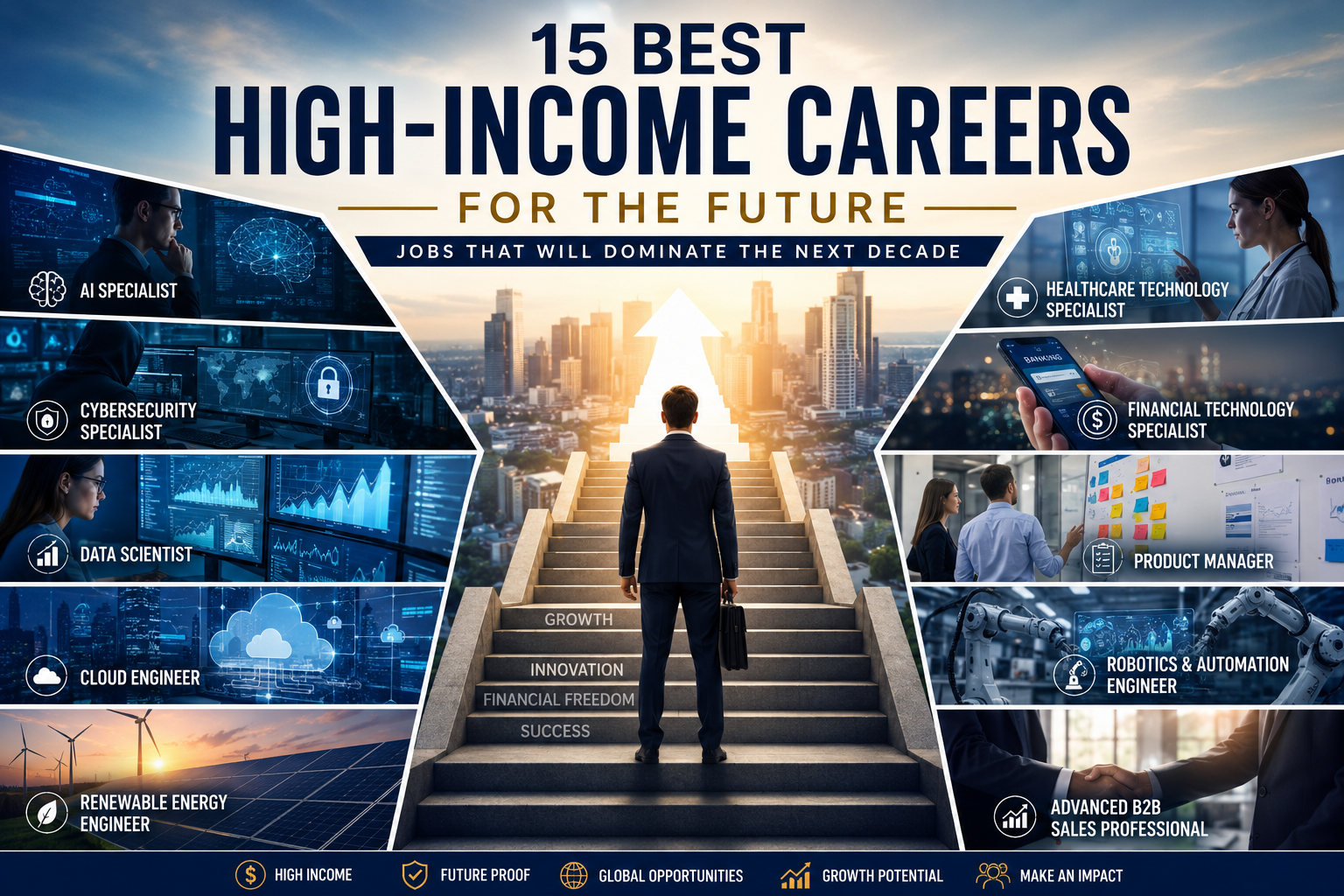
Career #1: Artificial Intelligence Specialist
Artificial intelligence is one of the most important career fields of the next decade.
Companies across nearly every industry are trying to understand how AI can improve productivity, reduce costs, increase revenue, and create better customer experiences.
This creates strong demand for professionals who understand how AI works and how to apply it in real business environments.
An AI specialist may work on:
AI strategy.
Machine learning systems.
AI product development.
AI workflow automation.
AI model evaluation.
AI governance.
AI integration inside companies.
The most valuable AI professionals are not only people who understand algorithms.
They are people who can connect AI capabilities to business problems.
Why This Career Has High Income Potential
AI is valuable because it can affect many expensive business areas.
It can reduce manual work.
It can improve decision-making.
It can speed up research.
It can automate customer support.
It can improve software development.
It can help analyze large amounts of data.
When a skill can influence revenue, productivity, and competitiveness, companies are usually willing to pay well for it.
This is why AI-related roles are likely to remain among the most attractive careers in the coming years.
Skills Needed
A strong AI specialist may need skills such as:
Machine learning fundamentals.
Python.
Data analysis.
Prompt engineering.
Automation.
Cloud platforms.
Model evaluation.
AI ethics.
Business process understanding.
Communication.
Not every AI career requires advanced mathematics, but higher-level technical roles often do.
However, there is also growing demand for AI consultants, AI product managers, AI workflow designers, and AI implementation specialists who combine technical understanding with business judgment.
Who This Career Is Best For
This career is best suited for people who enjoy technology, problem-solving, continuous learning, and working with complex systems.
It is also suitable for professionals from other fields who understand industry problems and can learn how to apply AI to solve them.
For example, a marketer who understands AI automation may become highly valuable.
A finance professional who understands AI analytics may gain a major advantage.
An engineer who understands AI-powered optimization may become more competitive.
AI is not only a standalone career.
It is also a powerful skill layer that can upgrade many existing careers.
Career #2: Cybersecurity Specialist
As the world becomes more digital, cybersecurity becomes more important.
Every business, government agency, hospital, bank, school, and online platform depends on digital systems.
This creates constant risk.
Cyberattacks can cause financial losses, data theft, business disruption, reputational damage, and legal problems.
This is why cybersecurity professionals are becoming essential.
A cybersecurity specialist may work on:
Protecting networks.
Securing cloud systems.
Monitoring threats.
Responding to attacks.
Testing security weaknesses.
Managing identity and access.
Training employees.
Building security policies.
Why Cybersecurity Demand Is Growing
Cybersecurity demand is driven by several long-term trends.
More businesses are moving online.
More employees are working remotely.
More data is stored in the cloud.
More financial transactions happen digitally.
More devices are connected to the internet.
More attackers are using advanced tools, including AI.
As digital dependence increases, security becomes non-negotiable.
This makes cybersecurity one of the most resilient career paths.
Even during economic downturns, companies cannot simply ignore security.
The cost of a serious breach can be far higher than the cost of prevention.
Skills Needed
Cybersecurity professionals may need skills such as:
Network security.
Cloud security.
Risk management.
Incident response.
Security tools.
Ethical hacking.
Identity management.
Compliance.
Threat analysis.
Communication.
Cybersecurity is not only technical.
A major part of the job involves explaining risk clearly to managers, employees, and decision-makers.
The best cybersecurity professionals combine technical depth with calm judgment.
Who This Career Is Best For
Cybersecurity is ideal for people who are detail-oriented, patient, analytical, and comfortable investigating problems.
It is also suitable for people who enjoy protecting systems and thinking like attackers in order to build better defenses.
The field can be demanding, but it offers strong long-term value because security risk is unlikely to disappear.
Career #3: Data Scientist and Data Analyst
Data has become one of the most valuable resources in business.
Companies collect information from websites, customers, sales systems, marketing campaigns, products, operations, and financial transactions.
But raw data is not useful by itself.
It must be cleaned, analyzed, interpreted, and turned into decisions.
This is where data professionals become valuable.
A data analyst may focus on dashboards, reports, business trends, and performance measurement.
A data scientist may build predictive models, advanced analysis systems, experiments, and machine learning solutions.
Both roles are important.
Why Data Careers Remain Valuable
Businesses do not only need more data.
They need better decisions.
A company may use data to answer questions such as:
Which products are most profitable?
Which customers are likely to leave?
Which marketing campaigns work best?
Which regions are growing fastest?
Which operations are inefficient?
Which pricing strategy performs better?
These questions directly affect revenue and strategy.
A skilled data professional helps organizations reduce guesswork.
That makes the role valuable.
Skills Needed
Common skills include:
Excel.
SQL.
Python or R.
Statistics.
Data visualization.
Business intelligence tools.
Dashboard design.
Data cleaning.
Critical thinking.
Storytelling with data.
The last skill is especially important.
A data professional who produces charts but cannot explain what they mean has limited impact.
A strong data professional helps leaders understand what action should be taken.
Who This Career Is Best For
This career is ideal for people who enjoy numbers, patterns, analysis, and business decision-making.
It is also a strong option for people who want a career that connects technology and strategy.
Data skills can also support other careers, including marketing, finance, operations, product management, and entrepreneurship.
In many industries, professionals who understand data become more valuable even if their job title is not “data analyst.”
Career #4: Cloud Computing Engineer
Cloud computing is the foundation of the modern digital economy.
Instead of running all software and data systems on local servers, companies increasingly use cloud platforms to store data, run applications, manage infrastructure, and scale services.
This shift has created strong demand for cloud engineers.
A cloud engineer may work on:
Cloud infrastructure.
System deployment.
Security.
Networking.
Automation.
Cost optimization.
Monitoring.
Disaster recovery.
Why Cloud Careers Are Important
Almost every digital service depends on cloud infrastructure.
Streaming platforms.
Banking apps.
E-commerce websites.
AI tools.
Enterprise software.
Mobile apps.
Online education platforms.
All require reliable cloud systems.
As more businesses move to the cloud, demand for professionals who can build and manage these systems continues growing.
Cloud expertise is especially valuable because mistakes can be expensive.
Poor cloud architecture can cause downtime, security risks, slow performance, and high costs.
A skilled cloud engineer can save companies large amounts of money while improving reliability.
Skills Needed
Cloud engineers often need skills such as:
AWS, Microsoft Azure, or Google Cloud.
Linux.
Networking.
Containers.
Kubernetes.
Infrastructure as code.
Security.
Monitoring.
Automation.
Scripting.
This career can be technical, but it offers strong earning potential because cloud systems are mission-critical.
Who This Career Is Best For
Cloud computing is suitable for people who enjoy technical systems, infrastructure, problem-solving, and continuous learning.
It is especially attractive for people interested in the backbone of digital products.
While software developers build applications, cloud engineers ensure those applications run securely, reliably, and efficiently.
Career #5: Renewable Energy Engineer
The global energy system is changing.
Governments, companies, and consumers are increasingly focused on cleaner energy, energy security, lower emissions, and more efficient infrastructure.
This is creating demand for professionals in renewable energy.
A renewable energy engineer may work with:
Solar power.
Wind energy.
Battery storage.
Energy efficiency.
Smart grids.
Heat pumps.
Industrial electrification.
Hydrogen systems.
Energy modeling.
Project design.
Why Renewable Energy Careers Matter
Energy is not a small industry.
It affects transportation, buildings, manufacturing, agriculture, technology, and national security.
As countries invest in cleaner and more efficient energy systems, technical professionals will be needed to design, build, operate, and improve those systems.
Renewable energy careers may become especially important in areas such as:
Commercial solar.
Industrial decarbonization.
Grid modernization.
Energy storage.
Electric vehicle infrastructure.
Building electrification.
Energy management systems.
This creates opportunities for engineers, analysts, project managers, technicians, consultants, and business developers.
Skills Needed
Useful skills include:
Electrical engineering.
Mechanical engineering.
Energy modeling.
Project management.
Solar system design.
Battery storage fundamentals.
Grid knowledge.
Financial analysis.
Policy understanding.
Technical communication.
The best professionals in this field often combine engineering knowledge with business awareness.
A technically strong project must also make financial sense.
Who This Career Is Best For
This career is ideal for people interested in engineering, sustainability, infrastructure, and long-term global challenges.
It is also suitable for professionals who want their work to connect income potential with real-world environmental impact.
Renewable energy is not only a “green” field.
It is an economic and industrial transformation.
Comparing the First Five Careers
These first five careers reveal an important pattern.
They are not random jobs.
They are connected to major global trends.
Artificial intelligence is transforming productivity.
Cybersecurity protects digital systems.
Data science improves decision-making.
Cloud computing powers modern software.
Renewable energy supports the future of infrastructure.
These careers have high-income potential because they sit close to areas where businesses and governments spend serious money.
They solve expensive problems.
They require specialized knowledge.
They are difficult to fully automate.
They remain relevant across many industries.
Which of These Careers Is Best?
There is no single best career for everyone.
The right choice depends on personality, skills, interests, education, and long-term goals.
AI may be best for people who enjoy innovation and advanced technology.
Cybersecurity may be best for people who enjoy protection, investigation, and risk management.
Data may be best for people who enjoy analysis and decision-making.
Cloud computing may be best for people who enjoy infrastructure and technical systems.
Renewable energy may be best for people who enjoy engineering and real-world impact.
The strongest career choice is usually where three things overlap:
What the market needs.
What you are capable of learning.
What you can stay interested in for years.
When these three align, career growth becomes much easier.
Coming Next
In the next section, we will explore careers #6 through #10, including some of the most valuable roles in healthcare, finance, product management, advanced sales, and robotics.
These careers are especially important because they combine human judgment, technical knowledge, business value, and long-term demand.
Career #6: Healthcare Technology Specialist
Healthcare is one of the most important industries in the world, and it is becoming more technology-driven every year.
Hospitals, clinics, insurance companies, medical device manufacturers, and digital health startups all depend increasingly on software, data, automation, connected devices, and artificial intelligence.
This creates a growing need for professionals who understand both healthcare and technology.
A healthcare technology specialist may work on:
- Electronic health record systems
- Telemedicine platforms
- Medical data management
- Healthcare cybersecurity
- Patient experience tools
- Clinical workflow automation
- Medical device integration
- AI-assisted healthcare operations
This role is valuable because healthcare is complex.
Technology alone is not enough.
A person must understand regulations, patient safety, privacy, workflows, and the daily reality of healthcare professionals.
Why This Career Has Strong Future Potential
Healthcare demand continues growing because populations are aging in many countries.
At the same time, healthcare systems are under pressure to become more efficient.
Doctors and nurses often face heavy workloads.
Patients expect faster access and better communication.
Hospitals need accurate data.
Insurance systems require documentation.
These challenges create space for technology.
But healthcare technology must be implemented carefully.
A poorly designed system can slow doctors down.
A weak security system can expose sensitive patient data.
A confusing patient portal can reduce trust.
This is why skilled healthcare technology professionals are valuable.
They help connect medical needs with digital solutions.
Skills Needed
Useful skills may include:
Healthcare systems knowledge.
Data privacy.
Digital health platforms.
Project management.
Workflow analysis.
Basic medical terminology.
Cybersecurity awareness.
Data analytics.
Communication with clinical teams.
Change management.
The most valuable professionals in this area are often translators.
They translate between doctors, software teams, administrators, and patients.
That combination can be difficult to find, which increases career value.
Who This Career Is Best For
This career is ideal for people interested in healthcare but not necessarily interested in becoming doctors or nurses.
It is also suitable for people with backgrounds in IT, data, administration, nursing, engineering, or healthcare management who want to move into a growing field.
The strongest candidates are those who can respect the seriousness of healthcare while still thinking creatively about technology.
Career #7: Financial Technology Specialist
Finance is being reshaped by technology.
Banking, investing, payments, lending, insurance, personal finance, and business finance are all becoming increasingly digital.
This has created strong demand for financial technology professionals.
A fintech specialist may work in:
- Digital banking
- Payment systems
- Fraud detection
- Investment platforms
- Financial apps
- Open banking
- Blockchain infrastructure
- Risk analytics
- Regulatory technology
- AI-powered financial tools
The financial system depends heavily on trust, speed, security, and accuracy.
Technology can improve all of these areas.
But mistakes in finance can be expensive.
This is why professionals who understand both finance and technology can build valuable careers.
Why Fintech Careers Are Growing
Consumers increasingly expect financial services to be fast, digital, and easy to use.
People want to transfer money instantly.
Businesses want online payment systems.
Investors want simple platforms.
Banks want fraud detection.
Companies want better financial automation.
Governments want stronger compliance tools.
These needs create career opportunities.
Fintech is not only about flashy apps.
It includes serious infrastructure behind the scenes.
The systems that move money, detect suspicious activity, verify identities, and protect transactions are extremely important.
Skills Needed
Important skills may include:
Financial analysis.
Payment systems knowledge.
Data analytics.
Risk management.
Cybersecurity basics.
Product thinking.
Compliance awareness.
AI and automation.
User experience understanding.
Business strategy.
A person does not need to master every area.
But combining finance knowledge with technical literacy can create a strong advantage.
Who This Career Is Best For
This career is suitable for people who enjoy finance, technology, systems, and problem-solving.
It can be especially attractive for people who want high income potential without necessarily becoming investment bankers or traditional accountants.
Fintech rewards people who understand how money moves and how digital systems improve financial services.
Career #8: Product Manager
Product management is one of the most influential careers in modern technology companies.
A product manager helps decide what a product should become, which problems it should solve, and how teams should build it.
This role sits between business, technology, design, and customers.
A product manager may work with:
- Engineers
- Designers
- Marketing teams
- Sales teams
- Customer support
- Executives
- Data analysts
- Customers
The job is not simply managing tasks.
It is making decisions about value.
Why Product Managers Are Valuable
Companies do not succeed just because they build software.
They succeed when they build the right product for the right customer at the right time.
A product manager helps guide that process.
They ask questions such as:
What problem are we solving?
Who is the customer?
Why does this feature matter?
What should we build first?
How do we measure success?
What should we stop doing?
How does this product make money?
This role is valuable because it affects business outcomes directly.
A good product manager can help a company avoid wasting months building the wrong thing.
Skills Needed
Important skills include:
Customer research.
Business strategy.
Data analysis.
Communication.
Prioritization.
Technical understanding.
User experience thinking.
Market analysis.
Leadership without authority.
Decision-making.
Product managers often lead without being direct managers.
They influence teams through clarity, reasoning, evidence, and trust.
This makes communication one of the most important skills in the role.
Who This Career Is Best For
Product management is ideal for people who enjoy solving customer problems, thinking strategically, working with teams, and making decisions under uncertainty.
It is a strong career for people who do not want to be purely technical but still want to work close to technology and business growth.
In AI, SaaS, fintech, healthcare technology, and digital platforms, strong product managers may become increasingly valuable.
Career #9: Robotics and Automation Engineer
Robotics and automation are becoming more important across manufacturing, logistics, healthcare, agriculture, defense, construction, and consumer technology.
Companies are looking for ways to improve productivity, reduce errors, solve labor shortages, and increase safety.
Robotics engineers help design, build, program, test, and improve robotic systems.
Automation engineers focus on systems that reduce manual work in physical or digital processes.
This career may involve:
- Industrial robots
- Warehouse automation
- Autonomous vehicles
- Medical robots
- Agricultural robots
- Manufacturing systems
- Control systems
- Sensors
- Machine vision
- AI-powered automation
Why Robotics and Automation Matter
Many countries face labor shortages in certain industries.
At the same time, companies need faster production, better quality control, and lower operational costs.
Robotics can help address these problems.
For example:
A warehouse may use robots to move goods.
A factory may use robotic arms for repetitive assembly.
A hospital may use robotic systems for logistics or surgery support.
A farm may use automation to monitor crops.
A construction company may use automated equipment for repetitive tasks.
The demand is not only for robots themselves.
It is also for people who can integrate robots into real workplaces.
Skills Needed
Useful skills include:
Mechanical engineering.
Electrical engineering.
Programming.
Control systems.
Sensors.
Machine vision.
AI basics.
Industrial automation.
CAD software.
Problem-solving.
Safety standards.
Robotics is multidisciplinary.
That makes it challenging but also valuable.
A robotics professional often needs to understand both hardware and software.
Who This Career Is Best For
This career is ideal for people who enjoy engineering, machines, programming, and real-world systems.
It is especially suitable for people who want to work on technology that interacts with the physical world.
While software careers are important, robotics careers may become increasingly valuable as automation moves beyond screens and into factories, warehouses, hospitals, farms, and cities.
Career #10: Advanced B2B Sales Professional
Sales is often underestimated by students and professionals.
Many people think sales is simply convincing people to buy.
In reality, advanced B2B sales is one of the most valuable business careers.
B2B means business-to-business.
Instead of selling to individual consumers, advanced B2B sales professionals sell products or services to companies.
These may include:
- Enterprise software
- Industrial equipment
- Energy systems
- Consulting services
- Cybersecurity solutions
- Medical technology
- Financial platforms
- Automation tools
- Cloud services
Why Advanced Sales Can Be High Income
Businesses spend large amounts of money when a product solves an important problem.
A single deal may be worth thousands, hundreds of thousands, or even millions of dollars.
This is why skilled sales professionals can earn high incomes through salaries, commissions, and bonuses.
Advanced sales is not about pressure.
It is about understanding customer needs, explaining value, building trust, managing long sales cycles, and helping clients make decisions.
Skills Needed
Important skills include:
Consultative selling.
Industry knowledge.
Communication.
Negotiation.
Relationship building.
Research.
Presentation skills.
Financial understanding.
Technical product knowledge.
CRM discipline.
Follow-up systems.
The best B2B sales professionals understand the customer’s business almost as well as the customer does.
They do not simply describe features.
They explain business impact.
Who This Career Is Best For
This career is ideal for people who are persuasive, resilient, organized, curious, and comfortable speaking with decision-makers.
It can be especially powerful when combined with technical knowledge.
For example, someone who understands renewable energy and sales can sell energy projects.
Someone who understands cybersecurity and sales can sell security solutions.
Someone who understands SaaS and sales can sell software.
This combination of industry knowledge and sales ability can create very high earning potential.
Why Careers #6–#10 Are Especially Important
These five careers are important because they show that the future is not only about coding.
Many high-income careers combine technology with another field.
Healthcare plus technology.
Finance plus technology.
Business plus product thinking.
Engineering plus automation.
Sales plus technical understanding.
This is where many of the best career opportunities will appear.
The future rewards hybrid professionals.
A hybrid professional is someone who combines two or more valuable skill areas.
For example:
A nurse who understands healthcare software.
A finance graduate who understands data automation.
An engineer who understands sales.
A marketer who understands AI.
A project manager who understands cloud systems.
Hybrid professionals are valuable because they can communicate across departments and solve practical problems.
The Power of Combining Technical and Human Skills
A common fear is that technology will replace human workers.
But the most valuable professionals often combine technical skills with human skills.
Technical skills help you understand systems.
Human skills help you influence people.
Both matter.
For example:
A product manager needs data and communication.
A fintech specialist needs financial knowledge and trust awareness.
A healthcare technology specialist needs technical understanding and empathy.
A B2B sales professional needs product knowledge and relationship-building ability.
A robotics engineer needs engineering skill and real-world problem-solving.
This combination is difficult to automate.
AI may assist these professionals, but it does not remove the need for judgment, trust, and accountability.
Coming Next
In the next section, we will examine careers #11 through #15, including roles in law, biotechnology, executive leadership, digital marketing strategy, and high-level consulting.
These careers may not all look the same, but they share one thing:
They solve difficult problems that people and organizations are willing to pay for.
Career #11: Biotechnology and Genetic Engineering Specialist
Biotechnology may become one of the most influential industries of the 21st century.
While artificial intelligence is transforming digital systems, biotechnology is transforming life sciences.
Advances in genetics, molecular biology, pharmaceuticals, diagnostics, personalized medicine, and bioengineering are creating opportunities that were impossible just a few decades ago.
Biotechnology professionals work on challenges such as:
- Disease prevention
- Drug development
- Genetic testing
- Agricultural innovation
- Medical diagnostics
- Personalized medicine
- Bio-manufacturing
- Gene therapies
Many of these fields are still in relatively early stages.
This creates long-term growth potential.
Why Biotechnology Has Massive Future Potential
Human health remains one of the world’s largest markets.
Governments spend billions.
Healthcare systems spend billions.
Pharmaceutical companies spend billions.
Research institutions spend billions.
People are willing to invest heavily in solutions that improve health, increase lifespan, reduce suffering, and enhance quality of life.
As scientific understanding improves, biotechnology professionals become increasingly valuable.
A breakthrough treatment can generate enormous economic value.
A better diagnostic tool can save lives and reduce costs.
A successful therapy can transform entire industries.
Skills Needed
Useful skills include:
- Biology
- Genetics
- Biochemistry
- Laboratory techniques
- Research methods
- Data analysis
- Bioinformatics
- Scientific communication
- Regulatory understanding
Many biotechnology careers require advanced education.
However, the long-term demand outlook remains strong.
Who This Career Is Best For
People who enjoy science, research, problem-solving, and healthcare innovation.
This field rewards curiosity, patience, precision, and continuous learning.
Career #12: Digital Marketing Strategist
Many people think marketing is simply advertising.
In reality, modern marketing is a combination of psychology, technology, analytics, branding, communication, and business strategy.
Companies need customers.
Without customers, businesses fail.
This simple reality makes marketing one of the most important business functions.
However, the future belongs less to basic marketers and more to strategic marketers.
A digital marketing strategist focuses on:
- Customer acquisition
- Brand growth
- Conversion optimization
- Content strategy
- Search visibility
- Paid advertising
- Marketing analytics
- Audience development
- Revenue growth
Why This Career Remains Valuable
Technology changes.
Human psychology changes slowly.
People still make decisions based on trust, emotion, logic, convenience, social proof, and perceived value.
This means businesses will always need professionals who understand customer behavior.
A strong strategist does not simply run advertisements.
They understand:
Why customers buy.
What motivates decisions.
How attention works.
How trust is built.
How audiences grow.
How businesses scale.
Skills Needed
Important skills include:
- SEO
- Content strategy
- Analytics
- Consumer psychology
- Paid advertising
- Conversion optimization
- Brand building
- Email marketing
- Data interpretation
- Business understanding
The highest-paid marketers are rarely specialists in only one tool.
They understand how the entire growth system works.
Why Strategic Marketers Earn More
Businesses care about outcomes.
Traffic matters.
But revenue matters more.
Followers matter.
But customers matter more.
A strategist who can consistently help businesses grow revenue becomes extremely valuable.
Career #13: Management Consultant
Consulting remains one of the highest-income professions in the world.
A consultant helps organizations solve important problems.
These problems may involve:
- Strategy
- Operations
- Growth
- Costs
- Technology
- Expansion
- Organizational change
- Market positioning
The reason consulting pays well is simple.
Businesses are willing to pay for solutions that generate large returns.
A recommendation that saves millions of dollars can justify a substantial consulting fee.
Why Consulting Will Continue Growing
The business world is becoming more complex.
Technology is changing rapidly.
Markets are evolving.
Competition is increasing.
Companies often need outside expertise.
Consultants provide:
- Perspective
- Analysis
- Specialized knowledge
- Experience
- Strategic guidance
The most successful consultants help organizations make better decisions.
Skills Needed
Consultants typically need:
- Analytical thinking
- Business knowledge
- Financial literacy
- Communication skills
- Presentation ability
- Research capability
- Problem-solving
- Leadership
- Industry expertise
The strongest consultants are trusted advisors rather than generic experts.
Who This Career Is Best For
People who enjoy solving difficult problems, working across industries, and helping organizations improve performance.
Consulting often rewards intellectual curiosity and structured thinking.
Career #14: Executive Leadership Roles
Many discussions about careers focus on technical skills.
However, leadership remains one of the most valuable professional capabilities.
Organizations need people who can:
- Set direction
- Make decisions
- Allocate resources
- Build teams
- Manage risk
- Drive growth
Executive leaders often carry significant responsibility.
Examples include:
- Chief Executive Officers
- Chief Operating Officers
- Chief Technology Officers
- Chief Financial Officers
- General Managers
- Business Unit Leaders
Why Leadership Remains Valuable
Technology can provide information.
Technology can provide analysis.
Technology can provide recommendations.
But leadership requires accountability.
When major decisions affect employees, customers, investors, and organizations, someone must take responsibility.
This responsibility creates value.
The best leaders help organizations navigate uncertainty.
Skills Needed
Leadership roles often require:
- Strategic thinking
- Decision-making
- Financial understanding
- Communication
- Negotiation
- Team building
- Emotional intelligence
- Risk management
- Industry expertise
Leadership is often built through years of experience rather than acquired quickly.
The Leadership Premium
Organizations frequently pay substantial compensation for strong leaders because leadership quality influences the performance of entire teams and departments.
A great leader can improve the productivity of hundreds or thousands of people.
That impact creates economic value.
Career #15: AI and Business Transformation Consultant
Perhaps one of the most interesting future careers combines technology, business, and change management.
Many organizations know they need AI.
Far fewer know how to implement it successfully.
This creates demand for professionals who can help businesses navigate transformation.
An AI and business transformation consultant may help organizations:
- Identify automation opportunities
- Improve workflows
- Implement AI systems
- Train employees
- Redesign processes
- Measure results
- Manage organizational change
Why This Career May Explode
Most companies are still early in their AI adoption journey.
Many executives understand the potential.
Many struggle with execution.
The gap between technology availability and organizational implementation creates opportunity.
Businesses do not simply need AI tools.
They need guidance.
They need strategy.
They need practical implementation.
They need measurable outcomes.
This is where transformation specialists become valuable.
Skills Needed
This role may require:
- AI literacy
- Business process analysis
- Project management
- Change management
- Communication
- Consulting skills
- Data understanding
- Leadership
- Industry knowledge
Interestingly, many future consultants may come from industries outside technology.
Someone who understands manufacturing, healthcare, finance, energy, or logistics can become extremely valuable by learning how AI applies to their field.
The Hybrid Advantage
This role demonstrates an important future trend.
The highest-value professionals are increasingly hybrids.
They combine:
Technology + Business
Data + Strategy
Engineering + Communication
Industry Expertise + Innovation
These combinations are difficult to replace and highly valuable.
What the Top 15 Careers Have in Common
Although these careers appear different, they share several characteristics.
They Solve Expensive Problems
Organizations pay well when a problem is costly.
Cybersecurity prevents losses.
AI improves productivity.
Consultants improve performance.
Engineers build infrastructure.
Healthcare specialists improve outcomes.
The bigger the problem, the larger the economic value.
They Require Continuous Learning
The future belongs to learners.
Technology changes.
Industries evolve.
Markets shift.
Professionals who continue learning often remain competitive.
They Combine Human and Technical Skills
Many high-income careers require more than technical knowledge.
Communication.
Leadership.
Decision-making.
Relationship building.
Strategic thinking.
These skills increase value because they are harder to automate.
They Operate in Growing Markets
Growth matters.
A highly skilled professional in a declining industry may struggle.
A skilled professional in a rapidly expanding industry often benefits from increasing demand.
This is why industry selection is important.
The Biggest Career Mistake People Make
Many people choose careers based solely on current salaries.
This can be misleading.
A better question is:
“What will this profession look like ten years from now?”
Future demand often matters more than current income.
A growing field may offer increasing opportunities.
A declining field may become more competitive.
Career decisions should therefore consider:
- Long-term demand
- Technological trends
- Industry growth
- Skill development
- Personal fit
The best careers usually sit at the intersection of all five.
The Formula for Career Success in the Next Decade
If there is one lesson from this guide, it is this:
The future rewards people who combine valuable skills with growing industries.
You do not need to predict every technological breakthrough.
You do not need to know exactly what the future holds.
But you should position yourself where opportunity is increasing rather than decreasing.
A useful formula is:
Growing Industry + Valuable Skills + Continuous Learning + Strong Execution = Long-Term Career Success
This formula applies across nearly every profession discussed in this article.
Coming Next
In the final section, we will compare all 15 careers, analyze income potential, education requirements, work-life balance, future demand, and career resilience.
Most importantly, we will identify which careers offer the strongest opportunities for different types of people, whether they prioritize income, flexibility, impact, stability, or entrepreneurship.
Comparing All 15 Careers: Which Path Offers the Best Future?
After examining 15 of the most promising high-income careers of the next decade, a natural question emerges:
Which career is actually the best?
The honest answer is that there is no universal winner.
The highest-paying career is not necessarily the best career.
The safest career is not necessarily the most rewarding.
The most prestigious career is not always the most fulfilling.
Career success depends on the alignment between:
- Market demand
- Skills
- Personality
- Interests
- Long-term goals
The strongest career path is usually the one where these factors overlap.
However, comparing careers through several important lenses can help identify which paths may be the best fit for different people.
Best Careers for Maximum Income Potential
Some careers offer extraordinary earning potential because they directly influence large amounts of money, business performance, or strategic decision-making.
Examples include:
- AI Specialist
- Management Consultant
- Executive Leadership
- Advanced B2B Sales
- AI Transformation Consultant
- Product Manager
These careers often sit close to revenue generation, productivity improvement, innovation, or business growth.
When professionals help organizations make or save significant amounts of money, compensation tends to increase accordingly.
Why Income Is Higher
Businesses generally pay more when:
- Skills are rare
- Problems are expensive
- Results are measurable
- Talent is difficult to replace
This explains why these careers often command strong salaries, bonuses, commissions, or equity opportunities.
Best Careers for Long-Term Stability
Some professions benefit from structural trends that are unlikely to disappear.
Examples include:
- Healthcare Technology
- Cybersecurity
- Renewable Energy
- Biotechnology
- Cloud Computing
These industries solve ongoing needs.
People will continue requiring healthcare.
Organizations will continue requiring security.
Energy infrastructure will continue expanding.
Cloud systems will continue supporting digital operations.
Because these needs persist regardless of economic cycles, demand often remains relatively resilient.
Stability vs Growth
Many people focus exclusively on growth.
However, stability has value.
A career that remains in demand for decades can provide predictable opportunities, lower career risk, and stronger long-term planning.
Best Careers for Work-Life Flexibility
The modern workforce increasingly values flexibility.
Many professionals want:
- Remote work options
- Geographic freedom
- Flexible schedules
- International opportunities
Some careers naturally support these goals.
Examples include:
- Data Science
- Product Management
- Digital Marketing Strategy
- AI Consulting
- Management Consulting
- Fintech
These careers often rely primarily on knowledge work rather than physical presence.
As remote work continues expanding, flexibility may become an increasingly important factor in career decisions.
Best Careers for Entrepreneurship
Not everyone wants to remain an employee forever.
Some people eventually want to build businesses.
Certain careers provide excellent preparation for entrepreneurship.
Examples include:
- Advanced B2B Sales
- Digital Marketing Strategy
- Product Management
- AI Consulting
- Management Consulting
These professions teach valuable business skills such as:
- Customer understanding
- Market analysis
- Revenue generation
- Leadership
- Communication
- Problem-solving
Many successful founders previously worked in these fields before launching companies.
Why Entrepreneurial Skills Matter
Even if someone never starts a business, entrepreneurial thinking remains valuable.
Organizations increasingly reward employees who think like owners.
People who understand value creation often become more effective professionals.
Best Careers for People Who Love Technology
Technology enthusiasts have numerous attractive options.
Examples include:
- AI Specialist
- Cybersecurity Specialist
- Cloud Engineer
- Robotics Engineer
- Data Scientist
- Fintech Professional
These careers allow professionals to work at the forefront of innovation.
However, the strongest technology careers usually combine technical depth with business understanding.
Technology alone is valuable.
Technology combined with business impact is often even more valuable.
Best Careers for People Who Enjoy Working With People
Not everyone wants to spend all day analyzing data or writing code.
Many individuals thrive in people-focused environments.
Examples include:
- Advanced B2B Sales
- Executive Leadership
- Management Consulting
- Product Management
- Healthcare Technology
These careers involve:
- Communication
- Influence
- Collaboration
- Negotiation
- Relationship building
Strong interpersonal skills can become a significant competitive advantage in these fields.
The Rise of Hybrid Careers
One of the most important trends of the next decade is the rise of hybrid careers.
Historically, careers were often more specialized.
Today, many of the highest-value roles combine multiple disciplines.
Examples include:
AI + Business
Healthcare + Technology
Finance + Data
Engineering + Sales
Technology + Leadership
Marketing + Analytics
These combinations create professionals who can bridge gaps between teams, departments, and industries.
This ability often becomes extremely valuable.
Why Hybrid Professionals Earn More
Organizations frequently struggle with communication between specialists.
Engineers may not understand business priorities.
Executives may not understand technical constraints.
Marketing teams may not understand data systems.
Hybrid professionals help connect these worlds.
As complexity increases, this skill becomes increasingly important.
Skills That Matter Across Every Career
Although industries differ, certain skills repeatedly appear among high-performing professionals.
Communication
The ability to explain ideas clearly remains essential.
Knowledge has limited value if it cannot be communicated effectively.
Problem-Solving
Organizations pay people to solve problems.
The bigger the problem, the greater the potential value.
Adaptability
Technology and industries continue evolving.
Adaptable professionals often outperform those who resist change.
Learning Ability
The future belongs to continuous learners.
The most successful professionals frequently update their skills.
Critical Thinking
Information is abundant.
Good judgment remains rare.
The ability to evaluate information and make sound decisions is increasingly valuable.
Leadership
Leadership is not limited to executives.
Professionals at every level benefit from the ability to guide projects, influence teams, and take responsibility.
What If AI Changes Everything?
Many people worry that AI will dramatically reshape employment.
This concern is understandable.
However, history suggests that technological change often transforms work rather than eliminating it entirely.
The strongest careers typically evolve.
For example:
Data professionals use AI tools.
Cybersecurity experts defend against AI-powered threats.
Healthcare specialists use AI-assisted systems.
Engineers use AI-enhanced design tools.
Consultants use AI for research and analysis.
The key lesson is not to avoid AI.
The key lesson is to learn how to work alongside it.
Professionals who effectively combine human expertise with technological tools may gain significant advantages.
The Career Selection Framework
If you are deciding on a future career path, consider five questions.
1. Does the Industry Have Long-Term Growth?
Growth creates opportunity.
Look for industries benefiting from major trends.
2. Can You Develop Valuable Skills?
A growing industry alone is not enough.
You must also build expertise.
3. Does the Work Match Your Strengths?
Career success becomes more sustainable when strengths and responsibilities align.
4. Can the Career Evolve With Technology?
Future-proof careers adapt rather than disappear.
5. Can You See Yourself Doing This for Years?
Long-term consistency often matters more than short-term enthusiasm.
Related Articles
Continue exploring these related guides:
- Best Skills to Learn in 2026 (High-Income Skills for the Future)
- Best Remote Jobs That Pay Well in 2026
- Best Online Businesses to Start in 2026
- Best Side Hustles That Can Make $1,000+ Per Month in 2026
- Best Passive Income Ideas for 2026
- AI Agents for Business in 2026
- How Small Businesses Are Using AI in 2026
- Best AI Tools to Make Money Online in 2026
Frequently Asked Questions
What is the highest-paying career in the future?
There is no single highest-paying career. However, fields such as artificial intelligence, executive leadership, advanced B2B sales, consulting, product management, and specialized technology roles often offer strong earning potential.
Which future careers are least likely to be automated?
Careers requiring human judgment, leadership, relationship-building, strategic thinking, and complex problem-solving are generally more resistant to automation.
Do I need a university degree for these careers?
Some careers, such as biotechnology and certain engineering roles, often require formal education. Others, including digital marketing, sales, consulting, and some technology roles, increasingly value demonstrable skills alongside or sometimes above formal credentials.
Which future career is best for remote work?
Data science, product management, digital marketing, AI consulting, cloud computing, and fintech-related roles often provide strong remote-work opportunities.
Which future career offers the best balance between income and stability?
Cybersecurity, healthcare technology, cloud computing, renewable energy, and data analytics often provide a strong combination of demand, stability, and earning potential.
Final Thoughts
The future job market will not simply reward experience.
It will reward relevance.
The most successful professionals of the next decade are unlikely to be those who resist change.
They will be those who continuously adapt, learn, and position themselves where opportunity is growing.
Technology will continue advancing.
Industries will continue evolving.
New challenges will emerge.
New professions will appear.
Yet one principle remains constant:
People who solve valuable problems create valuable careers.
Whether your path leads to artificial intelligence, cybersecurity, healthcare technology, renewable energy, consulting, leadership, finance, robotics, or entrepreneurship, the goal should not simply be finding a job.
The goal should be building a career that remains valuable in a changing world.
Because in the end, long-term success is rarely about predicting the future perfectly.
It is about preparing for it better than most people.