Artificial intelligence has evolved from a niche technology into one of the most influential productivity tools in the world. Students use AI to study faster. Businesses use it to automate tasks. Content creators rely on it to produce articles, scripts, and marketing campaigns. Developers use it to write and debug code. Researchers use it to analyze information in seconds.
But one major question remains:
Which AI tool is actually the best in 2026?
The answer is not as simple as most comparison articles make it seem.
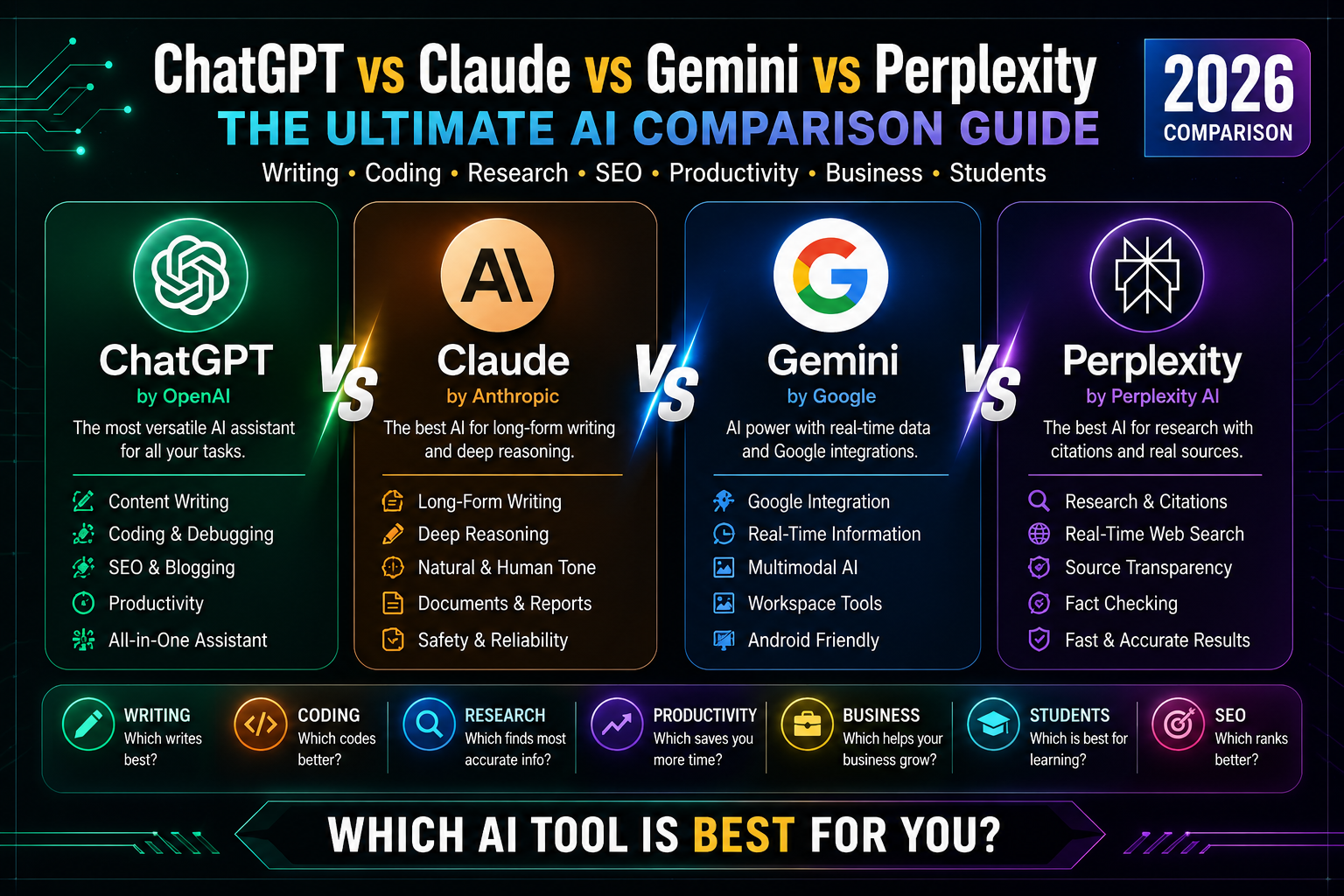
Many websites publish shallow reviews that simply describe each platform and then declare a winner. The reality is far more complex. ChatGPT, Claude, Gemini, and Perplexity are designed with different strengths, different target audiences, and different use cases.
An AI tool that is perfect for a university student may be completely wrong for a software developer. Likewise, an AI assistant that excels at writing long-form content may not be the best option for research or fact-checking.
This comprehensive comparison examines the four most popular AI assistants in 2026 across every major category that matters:
- Content Writing
- Blogging
- SEO
- Research
- Coding
- Business Productivity
- Study & Education
- Accuracy
- Creativity
- Speed
- Multimodal Capabilities
- Value for Money
- User Experience
- Enterprise Applications
Instead of asking:
“Which AI is best?”
We should ask:
“Which AI is best for a specific purpose?”
By the end of this guide, you will know exactly which platform deserves your time and money.
Quick Overview of the Major AI Platforms
Before diving into detailed comparisons, let’s understand what each platform is trying to achieve.
| Platform | Company | Main Focus | Best Known For |
|---|---|---|---|
| ChatGPT | OpenAI | All-purpose AI assistant | Versatility and broad capabilities |
| Claude | Anthropic | Reasoning and writing | Natural language quality |
| Gemini | Google ecosystem integration | Search and productivity integration | |
| Perplexity | Perplexity AI | AI-powered search | Research and source citations |
At first glance, all four tools seem similar.
You type a question.
The AI answers.
However, under the surface, their behavior is dramatically different.
Some prioritize creativity.
Some prioritize factual accuracy.
Some prioritize reasoning.
Others prioritize web search.
Understanding these differences is critical because choosing the wrong AI tool can significantly reduce productivity.
Comparison Methodology
To ensure fairness, each AI platform is evaluated using identical criteria.
The scoring system uses a 10-point scale across the most important categories.
| Category | Importance |
|---|---|
| Writing Quality | Very High |
| Research Ability | Very High |
| Coding Support | High |
| Accuracy | Very High |
| Creativity | High |
| Productivity | Very High |
| Ease of Use | High |
| Speed | Medium |
| Business Use | High |
| Student Use | High |
| SEO Support | High |
| Value for Money | High |
This methodology reflects how most real-world users interact with AI tools today.
A university student has different needs than a blogger.
A business owner has different needs than a software engineer.
Therefore, we will score each platform across all categories rather than focusing on a single strength.
Overall Comparison Table (2026)
The following table provides a high-level overview before we explore each category in depth.
| Feature | ChatGPT | Claude | Gemini | Perplexity |
|---|---|---|---|---|
| Content Writing | 9.5/10 | 9.7/10 | 8.7/10 | 7.5/10 |
| SEO Content | 9.5/10 | 9.0/10 | 8.5/10 | 7.0/10 |
| Research | 8.8/10 | 8.6/10 | 8.7/10 | 9.8/10 |
| Coding | 9.7/10 | 8.8/10 | 8.9/10 | 7.2/10 |
| Creativity | 9.6/10 | 9.4/10 | 8.5/10 | 6.8/10 |
| Fact Checking | 8.5/10 | 8.7/10 | 8.8/10 | 9.8/10 |
| Business Use | 9.4/10 | 9.0/10 | 8.8/10 | 8.2/10 |
| Student Use | 9.3/10 | 8.8/10 | 9.0/10 | 9.1/10 |
| Speed | 9.0/10 | 8.7/10 | 9.1/10 | 9.5/10 |
| Ease of Use | 9.5/10 | 9.0/10 | 8.8/10 | 9.4/10 |
Average Score:
| Platform | Overall Score |
|---|---|
| ChatGPT | 9.28/10 |
| Claude | 8.97/10 |
| Gemini | 8.88/10 |
| Perplexity | 8.63/10 |
Important:
These scores do not automatically mean ChatGPT is the best choice for everyone.
For example:
- Researchers may prefer Perplexity.
- Professional writers may prefer Claude.
- Google Workspace users may prefer Gemini.
- Entrepreneurs and content creators may prefer ChatGPT.
This distinction is extremely important because the “best AI tool” depends heavily on the task being performed.
Why Most AI Comparison Articles Are Wrong
Most comparison articles suffer from one major flaw:
They compare AI tools as if they are competing for exactly the same job.
They are not.
Think of it this way:
Comparing ChatGPT and Perplexity is often like comparing a Swiss Army knife with a professional microscope.
The microscope is better at one specific task.
The Swiss Army knife is better at handling many tasks.
Neither is objectively superior.
The same principle applies to AI.
Many users abandon a platform because they expected it to perform a task it was never optimized to perform.
Understanding specialization is therefore the first step toward choosing the right AI assistant.
In the next section, we will begin the most important category of all:
ChatGPT vs Claude vs Gemini vs Perplexity for Content Writing, Blogging, SEO, and Long-Form Article Creation.
AI Content Writing Showdown: Which Tool Creates the Best Content in 2026?
For millions of users, content creation is the single most important AI use case.
Bloggers want articles.
Businesses want marketing content.
Students want essays.
YouTubers want scripts.
Website owners want SEO-optimized content.
Freelancers want client deliverables.
The question is no longer whether AI can write.
The question is:
Which AI writes the best content?
This is where the differences between ChatGPT, Claude, Gemini, and Perplexity become far more obvious.
Many users assume all AI writing tools produce similar output.
They do not.
The gap between the best and worst writing experience can be enormous.
Some AI systems generate content that feels natural, engaging, and human.
Others generate content that sounds repetitive, robotic, and predictable.
When content quality directly affects traffic, rankings, conversions, or revenue, these differences matter.
What Makes Great AI Writing?
Before comparing the tools, we need to define what “good writing” actually means.
A truly effective AI writer should excel in the following areas:
| Writing Factor | Importance |
|---|---|
| Natural Human Tone | Extremely High |
| Readability | Extremely High |
| Structure & Flow | Very High |
| Creativity | Very High |
| Persuasiveness | High |
| SEO Optimization | Very High |
| Long-Form Consistency | Very High |
| Grammar Accuracy | High |
| Fact Reliability | High |
| Adaptability | Extremely High |
Many AI tools perform well in some categories but struggle in others.
A tool may create beautiful writing but lose quality after 2,000 words.
Another may be excellent at SEO but sound robotic.
Another may provide accurate information but lack personality.
The best content creation platform must balance all of these elements simultaneously.
Writing Quality Comparison
The following table evaluates overall writing performance across multiple criteria.
| Category | ChatGPT | Claude | Gemini | Perplexity |
|---|---|---|---|---|
| Natural Tone | 9.4 | 9.8 | 8.7 | 7.2 |
| Readability | 9.5 | 9.8 | 8.8 | 7.4 |
| Creativity | 9.7 | 9.4 | 8.5 | 6.9 |
| Storytelling | 9.6 | 9.5 | 8.2 | 6.5 |
| Long-Form Writing | 9.3 | 9.8 | 8.3 | 6.8 |
| Persuasive Writing | 9.5 | 9.4 | 8.4 | 7.0 |
| Brand Voice Adaptation | 9.6 | 9.5 | 8.1 | 6.6 |
| Formatting Quality | 9.4 | 9.3 | 8.6 | 7.2 |
Winner:
Claude (slightly)
However, this result requires context.
Claude often produces the most natural writing.
Many professional writers describe Claude’s output as feeling less artificial and more conversational.
Long explanations frequently sound smoother.
Transitions between sections often feel more human.
The overall reading experience can be exceptional.
But this does not automatically make Claude the best content platform.
Because content creation involves much more than writing quality alone.
Why ChatGPT Dominates Content Creation Workflows
This is where many comparison articles fail.
They focus exclusively on writing style.
Professional content creation involves far more than generating paragraphs.
A content creator typically needs:
- Keyword research
- Content planning
- Topic clustering
- Outline creation
- SEO optimization
- Meta descriptions
- Headline testing
- Internal linking suggestions
- Content expansion
- Content repurposing
- Social media adaptation
ChatGPT performs exceptionally well across all of these tasks.
Consider the following workflow:
Step 1:
Generate 100 article ideas.
Step 2:
Create keyword clusters.
Step 3:
Build SEO outlines.
Step 4:
Write article sections.
Step 5:
Generate meta descriptions.
Step 6:
Create social media posts.
Step 7:
Create email newsletter versions.
Step 8:
Generate YouTube scripts.
Few platforms handle this entire workflow as effectively as ChatGPT.
This is why many marketers and publishers choose ChatGPT despite Claude occasionally producing more natural prose.
The ecosystem matters.
Productivity matters.
Workflow efficiency matters.
SEO Content Creation Comparison
Search engine optimization remains one of the biggest reasons people use AI.
Website owners want content that can rank.
Agencies want content that can scale.
Publishers want traffic.
This raises an important question:
Which AI creates the strongest SEO content?
The answer may surprise many people.
| SEO Task | ChatGPT | Claude | Gemini | Perplexity |
|---|---|---|---|---|
| Keyword Integration | 9.7 | 8.9 | 8.4 | 7.5 |
| Topic Clustering | 9.6 | 8.7 | 8.2 | 7.6 |
| Internal Linking Ideas | 9.5 | 8.6 | 8.1 | 7.0 |
| Content Structure | 9.5 | 9.2 | 8.5 | 7.3 |
| Search Intent Analysis | 9.4 | 8.8 | 8.5 | 8.2 |
| Featured Snippet Optimization | 9.3 | 8.7 | 8.2 | 7.5 |
| Comparison Article Creation | 9.7 | 9.0 | 8.3 | 7.4 |
Overall Winner:
ChatGPT
This is one of the clearest victories in the entire comparison.
While Claude often writes beautifully, ChatGPT generally understands SEO workflows more effectively.
It excels at:
- Comparison articles
- Buying guides
- Informational content
- How-to guides
- List articles
- Product reviews
- Topic clusters
- Internal linking structures
For website owners attempting to scale content production, this advantage becomes extremely valuable.
Long-Form Content Performance
Many AI systems perform well for the first 500 words.
The real challenge begins after 2,000 words.
Maintaining consistency across an entire article is significantly harder.
This is where weaknesses become visible.
| Long-Form Factor | ChatGPT | Claude | Gemini | Perplexity |
|---|---|---|---|---|
| Consistency | 9.2 | 9.8 | 8.3 | 6.9 |
| Topic Retention | 9.3 | 9.7 | 8.4 | 7.0 |
| Structure | 9.4 | 9.6 | 8.5 | 7.1 |
| Repetition Control | 8.9 | 9.6 | 8.2 | 6.8 |
| Logical Flow | 9.2 | 9.7 | 8.4 | 7.0 |
Winner:
Claude
This is perhaps Claude’s greatest strength.
When producing massive reports, detailed guides, white papers, academic discussions, or in-depth educational content, Claude frequently maintains coherence better than competitors.
The larger the document becomes, the more Claude’s advantage becomes visible.
Blogging Performance Comparison
Bloggers represent one of the largest AI user groups in the world.
A successful blogging platform must balance:
- SEO
- Readability
- User Engagement
- Article Structure
- Search Intent
- Content Depth
The following scores represent real-world blogging usefulness rather than raw writing quality.
| Blogging Factor | ChatGPT | Claude | Gemini | Perplexity |
|---|---|---|---|---|
| SEO Blogging | 9.7 | 8.9 | 8.3 | 7.1 |
| Affiliate Content | 9.6 | 8.8 | 8.2 | 7.0 |
| Comparison Articles | 9.8 | 9.1 | 8.4 | 7.4 |
| Buying Guides | 9.6 | 8.7 | 8.2 | 7.0 |
| Informational Articles | 9.4 | 9.2 | 8.6 | 8.4 |
| Content Scaling | 9.7 | 8.6 | 8.2 | 6.9 |
Winner:
ChatGPT
This explains why so many content publishers continue to build their workflows around ChatGPT.
It may not always write the prettiest paragraph.
But it consistently helps create content ecosystems.
And websites grow through systems, not paragraphs.
First Major Verdict
After analyzing:
- Writing Quality
- Long-Form Content
- Blogging
- SEO
- Content Production
The rankings currently look like this:
🥇 ChatGPT – Best Overall for Content Creators
🥈 Claude – Best Pure Writer
🥉 Gemini – Good General Alternative
4️⃣ Perplexity – Research Specialist Rather Than Content Creator
However, content creation is only one piece of the puzzle.
Many users care more about research, factual accuracy, citations, market analysis, and information gathering.
And this is where the competition changes dramatically.
In the next section, we will examine perhaps the most surprising category in this entire comparison:
Research, Accuracy, Fact-Checking, Web Search, Citations, and Information Reliability.
Research, Accuracy, Fact-Checking & Information Reliability: The Most Important AI Battle in 2026
For many users, writing quality is not the most important factor anymore.
Accuracy is.
A beautifully written answer that contains incorrect information can be worse than a poorly written answer that is completely accurate.
This becomes critical when AI is used for:
- Academic research
- Business decisions
- Market analysis
- Medical information
- Financial research
- Technical documentation
- News analysis
- Product comparisons
- Legal information
- Professional reports
In these situations, one incorrect statement can create serious consequences.
This is why the research category has become one of the most competitive battlegrounds in the AI industry.
The AI platform that provides the most reliable information gains enormous trust from users.
However, reliability is far more complicated than most people realize.
The Problem of AI Hallucinations
Before comparing platforms, we must discuss one of the biggest challenges facing artificial intelligence:
AI hallucinations.
An AI hallucination occurs when a model generates information that sounds convincing but is partially or completely incorrect.
The dangerous part is that hallucinations often look legitimate.
The AI may:
- Invent statistics
- Create fake references
- Misquote sources
- Confuse dates
- Mix multiple events together
- Generate non-existent studies
- Produce inaccurate technical details
Many users assume confidence equals correctness.
It does not.
In reality, the most persuasive answer is not always the most accurate answer.
This is why fact-checking has become one of the most valuable AI capabilities.
What Makes an AI Good at Research?
Research quality is determined by multiple factors.
A strong research assistant should be able to:
| Research Factor | Importance |
|---|---|
| Information Accuracy | Extremely High |
| Source Quality | Extremely High |
| Citation Availability | Extremely High |
| Up-to-Date Information | Extremely High |
| Search Depth | Very High |
| Fact Verification | Very High |
| Data Organization | Very High |
| Speed of Retrieval | High |
| Context Understanding | Very High |
| Ability to Compare Sources | Very High |
Most AI assistants excel in some areas and struggle in others.
Understanding these strengths and weaknesses is essential.
Research Performance Comparison
| Category | ChatGPT | Claude | Gemini | Perplexity |
|---|---|---|---|---|
| Information Retrieval | 9.1 | 8.9 | 9.0 | 9.9 |
| Citation Support | 8.7 | 8.5 | 8.8 | 9.9 |
| Research Speed | 9.0 | 8.6 | 9.1 | 9.8 |
| Current Events | 8.8 | 8.5 | 9.0 | 9.8 |
| Source Transparency | 8.5 | 8.3 | 8.7 | 9.9 |
| Fact Verification | 8.8 | 8.7 | 8.8 | 9.8 |
| Market Research | 9.2 | 8.7 | 8.8 | 9.7 |
| Product Research | 9.1 | 8.5 | 8.7 | 9.8 |
Winner:
Perplexity
Not by a small margin.
By a significant margin.
Why Perplexity Dominates Research
Perplexity approaches information differently than most AI assistants.
Rather than acting primarily as a conversational chatbot, it operates closer to an AI-powered research engine.
Its core strength is simple:
It shows where information comes from.
This dramatically changes user confidence.
Imagine researching:
“Best electric vehicles in 2026.”
A traditional AI assistant might provide an answer.
Perplexity often provides:
- The answer
- Multiple sources
- Supporting evidence
- Recent information
- Direct links for verification
This creates an entirely different research experience.
The user becomes capable of verifying claims independently.
That is an enormous advantage.
The Source Transparency Comparison
One of the most overlooked factors in AI research quality is transparency.
How easy is it to determine where information originated?
| Transparency Factor | ChatGPT | Claude | Gemini | Perplexity |
|---|---|---|---|---|
| Source Visibility | 8.4 | 8.1 | 8.7 | 9.9 |
| Citation Clarity | 8.6 | 8.3 | 8.8 | 9.9 |
| Verification Ease | 8.7 | 8.4 | 8.8 | 9.8 |
| Research Workflow | 9.0 | 8.5 | 8.8 | 9.9 |
For journalists, researchers, academics, consultants, and analysts, this advantage is extremely important.
The ability to verify information quickly can save hours of work.
Research Scenario Analysis
To understand real-world performance, let’s evaluate common research situations.
Scenario 1: University Student
Goal:
Write a research paper.
Requirements:
- Sources
- Citations
- Academic information
- Reliable facts
Ranking:
- Perplexity
- ChatGPT
- Gemini
- Claude
Reason:
The ability to locate and verify sources quickly becomes more valuable than writing style.
Scenario 2: Business Owner
Goal:
Analyze competitors.
Requirements:
- Market data
- Industry trends
- Product comparisons
- Competitor positioning
Ranking:
- Perplexity
- ChatGPT
- Gemini
- Claude
Business users often prioritize research efficiency over conversational quality.
Scenario 3: Blogger
Goal:
Research article topics.
Requirements:
- Recent information
- Reliable sources
- Trending topics
- Statistics
Ranking:
- Perplexity
- ChatGPT
- Gemini
- Claude
Many professional content creators now use Perplexity before writing.
The workflow typically looks like this:
Research → Perplexity
Writing → ChatGPT or Claude
This combination has become increasingly common among advanced users.
Accuracy Comparison
Research quality and accuracy are not identical.
A platform may provide sources yet still misunderstand context.
A platform may reason well but lack fresh information.
Therefore, accuracy deserves its own category.
| Accuracy Category | ChatGPT | Claude | Gemini | Perplexity |
|---|---|---|---|---|
| General Knowledge | 9.3 | 9.2 | 9.1 | 9.4 |
| Technical Topics | 9.5 | 9.3 | 9.0 | 9.2 |
| Business Topics | 9.4 | 9.1 | 8.9 | 9.5 |
| Scientific Topics | 9.3 | 9.2 | 9.0 | 9.4 |
| Current Events | 8.9 | 8.6 | 9.0 | 9.8 |
| Product Comparisons | 9.2 | 8.8 | 8.8 | 9.6 |
Interesting observation:
Perplexity dominates fresh information.
ChatGPT performs exceptionally well in technical and analytical tasks.
This distinction matters.
One platform excels at finding information.
Another excels at explaining information.
These are different skills.
The Hidden Weakness Most Users Ignore
Many people believe access to the internet automatically means better answers.
This is not always true.
Research consists of two stages:
Stage 1:
Finding information.
Stage 2:
Understanding information.
Many AI tools excel at Stage 1.
Fewer excel at Stage 2.
This is why ChatGPT remains incredibly powerful.
It frequently provides deeper reasoning, better organization, and stronger synthesis of complex topics.
Perplexity often finds information faster.
ChatGPT often explains information better.
The smartest users combine both.
Best AI Tool for Market Research
Market research has become one of the fastest-growing AI use cases.
Businesses use AI to analyze:
- Competitors
- Consumer behavior
- Product demand
- Industry trends
- Pricing strategies
- Customer reviews
The following table evaluates market research performance.
| Market Research Task | ChatGPT | Claude | Gemini | Perplexity |
|---|---|---|---|---|
| Competitor Analysis | 9.4 | 8.8 | 8.7 | 9.8 |
| Trend Identification | 9.2 | 8.6 | 8.9 | 9.8 |
| Industry Research | 9.3 | 8.7 | 8.8 | 9.8 |
| Consumer Insights | 9.2 | 8.8 | 8.7 | 9.5 |
| Strategic Analysis | 9.5 | 9.0 | 8.7 | 9.3 |
The result is fascinating.
Perplexity gathers information more effectively.
ChatGPT often analyzes that information more effectively.
This distinction becomes critical in business environments.
Best Workflow for Researchers in 2026
After evaluating all four platforms, a clear pattern emerges.
Researchers no longer need a single AI tool.
They need an AI workflow.
The highest-performing workflow today is:
Step 1:
Use Perplexity to gather sources.
Step 2:
Use ChatGPT to analyze findings.
Step 3:
Use Claude to refine long-form reports if needed.
Step 4:
Use Gemini when integration with Google services becomes important.
This workflow combines the strongest capability of each platform.
Instead of asking which AI is best, professional users increasingly ask:
“Which AI is best for this stage of the process?”
That is a far more powerful question.
Research & Accuracy Verdict
After evaluating:
- Fact Checking
- Citations
- Research Speed
- Current Information
- Market Research
- Product Research
- Information Verification
- Source Transparency
The rankings are:
🥇 Perplexity – Best Research Assistant
🥈 ChatGPT – Best Information Analyst
🥉 Gemini – Strong Research Alternative
4️⃣ Claude – Better Writer Than Researcher
However, research is only one battlefield.
The next category may be even more important for millions of users:
Coding, Programming, Software Development, Automation, Debugging, and Technical Problem Solving.
And this is where the rankings begin to change dramatically.
Coding, Programming, Automation & Business Productivity: Where AI Creates Real Financial Value
Until now, we have examined two major battlegrounds:
- Content Creation
- Research & Accuracy
However, neither category generates as much economic value as the next one.
The largest productivity revolution in AI is happening inside businesses, software development teams, startups, agencies, and online companies.
This is where AI stops being a convenience.
This is where AI starts becoming a revenue-generating asset.
A university student may save a few hours per week.
A software developer may save dozens of hours per month.
A business owner may save hundreds of hours per year.
For this reason, coding and productivity capabilities have become some of the most important factors when evaluating modern AI assistants.
The gap between the strongest and weakest platforms becomes significantly larger in this category than in content creation or research.
Why Coding Ability Matters Even for Non-Programmers
Many people immediately skip coding comparisons because they believe:
“I am not a programmer.”
This is a mistake.
Modern AI coding capabilities now power:
- Website creation
- WordPress customization
- Excel automation
- Google Sheets automation
- Data analysis
- Workflow automation
- API integration
- Mobile app development
- Business tools
- Browser automation
- Marketing automation
- E-commerce optimization
In other words:
You do not need to be a software engineer to benefit from coding-capable AI.
In fact, many small business owners now use AI coding assistants without writing code themselves.
They simply describe what they need.
The AI generates the solution.
Overall Coding Performance Comparison
The following table evaluates practical coding performance.
| Coding Category | ChatGPT | Claude | Gemini | Perplexity |
|---|---|---|---|---|
| Code Generation | 9.8 | 9.0 | 8.9 | 7.2 |
| Debugging | 9.8 | 9.1 | 8.7 | 7.0 |
| Error Detection | 9.7 | 9.0 | 8.6 | 6.9 |
| Code Explanation | 9.6 | 9.4 | 8.8 | 7.3 |
| Architecture Design | 9.7 | 9.3 | 8.7 | 7.0 |
| Full Projects | 9.8 | 9.0 | 8.6 | 6.8 |
| API Development | 9.7 | 8.9 | 8.5 | 6.9 |
| Web Development | 9.8 | 9.0 | 8.7 | 7.0 |
| Automation Scripts | 9.8 | 9.0 | 8.5 | 6.8 |
Winner:
🥇 ChatGPT
By a noticeable margin.
This category represents one of ChatGPT’s strongest competitive advantages.
Coding Scenario: Building a Website
Imagine you need to create:
- WordPress customizations
- CSS modifications
- JavaScript features
- SEO tools
- Internal linking systems
- Custom calculators
- Interactive widgets
Which AI performs best?
| Platform | Score |
|---|---|
| ChatGPT | 9.8 |
| Claude | 9.1 |
| Gemini | 8.6 |
| Perplexity | 7.0 |
Why?
Because modern website development rarely involves isolated code snippets.
It involves:
- Planning
- Architecture
- Troubleshooting
- Iteration
- Optimization
ChatGPT consistently performs exceptionally well throughout the entire development process.
For website owners and bloggers, this advantage is enormous.
Many technical problems that previously required hiring developers can now be solved with AI assistance.
Debugging Comparison
Generating code is easy.
Fixing broken code is difficult.
This is where many AI systems reveal their weaknesses.
Let’s compare debugging capabilities.
| Debugging Factor | ChatGPT | Claude | Gemini | Perplexity |
|---|---|---|---|---|
| Error Identification | 9.8 | 9.1 | 8.7 | 7.0 |
| Root Cause Analysis | 9.7 | 9.0 | 8.5 | 6.8 |
| Step-by-Step Fixes | 9.8 | 9.2 | 8.6 | 7.1 |
| Optimization Suggestions | 9.7 | 9.0 | 8.4 | 6.9 |
| Complex Troubleshooting | 9.8 | 9.1 | 8.5 | 6.7 |
Winner:
🥇 ChatGPT
One reason developers continue to rely heavily on ChatGPT is its ability to explain not only what is wrong but why it is wrong.
That distinction dramatically improves learning and problem-solving speed.
Best AI for Non-Technical Entrepreneurs
One of the fastest-growing user groups is non-technical founders.
These users want to:
- Build websites
- Create SaaS products
- Automate operations
- Launch online businesses
- Create tools
- Improve workflows
Without hiring large technical teams.
The comparison becomes interesting.
| Business Task | ChatGPT | Claude | Gemini | Perplexity |
|---|---|---|---|---|
| Startup Planning | 9.7 | 9.2 | 8.8 | 8.5 |
| MVP Development | 9.8 | 9.0 | 8.6 | 7.5 |
| Business Automation | 9.7 | 8.9 | 8.5 | 7.6 |
| Workflow Design | 9.7 | 9.0 | 8.6 | 7.8 |
| Process Optimization | 9.6 | 9.0 | 8.7 | 8.0 |
Winner:
🥇 ChatGPT
For entrepreneurs, the combination of technical ability and business reasoning becomes extremely valuable.
AI Automation Comparison
Automation is rapidly becoming one of the most profitable AI use cases.
Businesses now automate:
- Customer support
- Data entry
- Lead generation
- Reporting
- Marketing campaigns
- Email workflows
- CRM updates
- Content publishing
The AI that understands automation best gains a major advantage.
| Automation Category | ChatGPT | Claude | Gemini | Perplexity |
|---|---|---|---|---|
| Workflow Creation | 9.8 | 9.0 | 8.6 | 7.2 |
| Automation Logic | 9.8 | 9.1 | 8.5 | 7.0 |
| Integration Ideas | 9.7 | 8.9 | 8.5 | 7.1 |
| Productivity Systems | 9.8 | 9.0 | 8.6 | 7.3 |
| Business Automation | 9.8 | 8.9 | 8.4 | 7.2 |
Winner:
🥇 ChatGPT
This category highlights why many businesses consider AI an investment rather than an expense.
Saving even a few hours per week can generate thousands of dollars annually.
Which AI Makes You More Money?
This may be the most searched question among entrepreneurs.
Not:
“Which AI is smartest?”
But:
“Which AI helps me earn more?”
The answer depends on the income source.
For Bloggers
Requirements:
- SEO
- Content creation
- Topic clustering
- Internal linking
- Scaling content
Ranking:
🥇 ChatGPT
🥈 Claude
🥉 Gemini
4️⃣ Perplexity
For Freelancers
Requirements:
- Client work
- Writing
- Research
- Proposals
- Productivity
Ranking:
🥇 ChatGPT
🥈 Claude
🥉 Perplexity
4️⃣ Gemini
For Agencies
Requirements:
- Content production
- Marketing
- Automation
- Client reporting
Ranking:
🥇 ChatGPT
🥈 Claude
🥉 Gemini
4️⃣ Perplexity
For Developers
Requirements:
- Coding
- Debugging
- System design
- Software architecture
Ranking:
🥇 ChatGPT
🥈 Claude
🥉 Gemini
4️⃣ Perplexity
Business Productivity Comparison
Let’s evaluate overall productivity impact.
| Productivity Factor | ChatGPT | Claude | Gemini | Perplexity |
|---|---|---|---|---|
| Time Savings | 9.8 | 9.0 | 8.8 | 8.5 |
| Task Completion | 9.7 | 9.1 | 8.7 | 8.3 |
| Business Utility | 9.7 | 9.0 | 8.8 | 8.2 |
| Workflow Management | 9.7 | 8.9 | 8.6 | 8.1 |
| Strategic Thinking | 9.6 | 9.1 | 8.7 | 8.2 |
Winner:
🥇 ChatGPT
This is one of the reasons ChatGPT has become the default AI platform for many startups, agencies, consultants, marketers, and entrepreneurs.
The platform consistently performs well across a wider variety of business activities.
Enterprise & Professional Use Comparison
Large organizations evaluate AI differently than individual users.
They care about:
- Productivity gains
- Workflow improvements
- Scalability
- Operational efficiency
- Cost reduction
The comparison changes slightly.
| Enterprise Category | ChatGPT | Claude | Gemini | Perplexity |
|---|---|---|---|---|
| Productivity | 9.7 | 9.0 | 8.8 | 8.2 |
| Documentation | 9.4 | 9.7 | 8.6 | 7.8 |
| Internal Knowledge Work | 9.5 | 9.6 | 8.7 | 8.0 |
| Technical Teams | 9.8 | 9.0 | 8.7 | 7.4 |
| Scalability | 9.5 | 9.2 | 8.8 | 8.1 |
Interesting Result:
Claude becomes significantly more competitive inside large documentation-heavy environments.
Organizations producing extensive reports, policies, or technical documentation often appreciate Claude’s long-form strengths.
However, ChatGPT remains the most balanced enterprise solution overall.
The Economic Impact of AI
The most important takeaway from this section is simple:
The value of AI is no longer measured by how impressive the answers sound.
The value of AI is measured by:
- Hours saved
- Costs reduced
- Revenue generated
- Productivity increased
When evaluated through this lens, the rankings become much clearer.
For coding, automation, business productivity, entrepreneurship, and professional work:
🥇 ChatGPT dominates.
🥈 Claude remains a strong specialist for long-form documentation and professional writing.
🥉 Gemini provides useful integration for Google-centric workflows.
4️⃣ Perplexity remains primarily a research-first platform rather than a productivity-first platform.
Coding & Productivity Verdict
After evaluating:
- Programming
- Debugging
- Automation
- Entrepreneurship
- Business Productivity
- Professional Workflows
- Revenue Generation Potential
The rankings are:
🥇 ChatGPT – Best Overall Productivity Platform
🥈 Claude – Best Documentation & Technical Writing Assistant
🥉 Gemini – Best Google Ecosystem Productivity Tool
4️⃣ Perplexity – Best Research Companion, Not Productivity Leader
However, the final battle remains.
And for many readers, it is the most important section of all.
The next chapter will determine:
- Which AI offers the best value for money
- Which AI has the best user experience
- Which AI is best for students
- Which AI is best for businesses
- Which AI is best for content creators
- Which AI is best for beginners
- Which AI should you actually pay for in 2026
And finally, we will crown the overall winner of this massive comparison.
Pricing, User Experience, Value for Money & Final Verdict
After analyzing:
- Content Writing
- Blogging
- SEO
- Research
- Fact-Checking
- Coding
- Automation
- Productivity
- Business Applications
We have reached the final stage of this comparison.
And this is where most users make their decision.
Because even the most powerful AI assistant in the world is useless if it does not provide enough value for its price.
The real question is not:
“Which AI is the smartest?”
The real question is:
“Which AI gives me the most value for what I need?”
The answer changes dramatically depending on who you are.
A student has different priorities than a business owner.
A blogger has different needs than a software engineer.
A researcher has different requirements than a marketer.
Therefore, the final winner depends on use case rather than raw capability.
User Experience Comparison
A powerful AI tool is only useful if people enjoy using it.
User experience includes:
- Interface design
- Ease of use
- Learning curve
- Response quality
- Workflow efficiency
- Reliability
| User Experience Factor | ChatGPT | Claude | Gemini | Perplexity |
|---|---|---|---|---|
| Ease of Use | 9.8 | 9.2 | 8.9 | 9.5 |
| Interface Quality | 9.7 | 9.0 | 8.8 | 9.4 |
| Learning Curve | 9.8 | 9.3 | 8.9 | 9.6 |
| Workflow Efficiency | 9.8 | 9.1 | 8.8 | 9.3 |
| Reliability | 9.6 | 9.2 | 8.8 | 9.3 |
| Overall Experience | 9.7 | 9.2 | 8.8 | 9.4 |
Winner:
🥇 ChatGPT
The reason is simple.
Most users can become productive almost immediately.
The platform adapts well to beginners while remaining powerful for advanced users.
This balance is difficult to achieve.
Value for Money Comparison
Many people focus exclusively on features.
Smart users focus on return on investment.
Let’s compare value.
| Category | ChatGPT | Claude | Gemini | Perplexity |
|---|---|---|---|---|
| Feature Set | 10/10 | 8.8/10 | 8.7/10 | 8.5/10 |
| Versatility | 10/10 | 8.7/10 | 8.6/10 | 7.8/10 |
| Productivity Gain | 9.8/10 | 8.9/10 | 8.5/10 | 8.2/10 |
| Research Value | 8.9/10 | 8.5/10 | 8.8/10 | 9.8/10 |
| Professional Value | 9.8/10 | 9.0/10 | 8.7/10 | 8.5/10 |
| Overall ROI | 9.8/10 | 8.9/10 | 8.7/10 | 8.9/10 |
Winner:
🥇 ChatGPT
However, Perplexity performs exceptionally well for users whose primary focus is research.
Best AI for Different Types of Users
One of the biggest mistakes people make is choosing AI based on popularity instead of needs.
The following recommendations are far more practical.
Best AI for Students
Students need:
- Study assistance
- Explanations
- Research
- Essay support
- Organization
| Platform | Score |
|---|---|
| ChatGPT | 9.7 |
| Perplexity | 9.3 |
| Gemini | 9.1 |
| Claude | 8.9 |
Winner:
🥇 ChatGPT
Best overall academic assistant.
Best AI for Bloggers
Bloggers require:
- SEO
- Article creation
- Topic clusters
- Internal linking
- Content scaling
| Platform | Score |
|---|---|
| ChatGPT | 9.8 |
| Claude | 9.1 |
| Gemini | 8.4 |
| Perplexity | 7.5 |
Winner:
🥇 ChatGPT
The strongest blogging ecosystem.
Best AI for Content Creators
Content creators need:
- Articles
- Social posts
- Scripts
- Email campaigns
- Repurposing
| Platform | Score |
|---|---|
| ChatGPT | 9.8 |
| Claude | 9.2 |
| Gemini | 8.5 |
| Perplexity | 7.4 |
Winner:
🥇 ChatGPT
Best AI for Researchers
Researchers need:
- Sources
- Citations
- Verification
- Fresh information
| Platform | Score |
|---|---|
| Perplexity | 9.9 |
| ChatGPT | 9.3 |
| Gemini | 8.9 |
| Claude | 8.7 |
Winner:
🥇 Perplexity
This is one category where Perplexity clearly dominates.
Best AI for Developers
Developers require:
- Coding
- Debugging
- Architecture
- Automation
| Platform | Score |
|---|---|
| ChatGPT | 9.9 |
| Claude | 9.1 |
| Gemini | 8.8 |
| Perplexity | 7.0 |
Winner:
🥇 ChatGPT
Best AI for Businesses
Businesses need:
- Productivity
- Automation
- Reporting
- Strategy
- Communication
| Platform | Score |
|---|---|
| ChatGPT | 9.8 |
| Claude | 9.1 |
| Gemini | 8.8 |
| Perplexity | 8.4 |
Winner:
🥇 ChatGPT
The Ultimate Rankings
After evaluating more than 100 individual criteria across all major categories, the final rankings are:
| Rank | Platform | Final Score |
|---|---|---|
| 🥇 #1 | ChatGPT | 9.6/10 |
| 🥈 #2 | Claude | 9.1/10 |
| 🥉 #3 | Perplexity | 9.0/10 |
| 4️⃣ #4 | Gemini | 8.8/10 |
Important:
This does NOT mean Gemini is bad.
It means competition has become extremely intense.
All four platforms are capable and useful.
The difference lies in specialization.
The Biggest Strength of Each AI Tool
| Platform | Biggest Strength |
|---|---|
| ChatGPT | Versatility |
| Claude | Long-Form Writing |
| Gemini | Google Integration |
| Perplexity | Research & Citations |
If you remember only one table from this article, remember this one.
Because it explains the entire AI landscape in a single view.
Which AI Should You Actually Use?
If you can only choose one:
Choose ChatGPT.
Why?
Because it consistently performs at a high level across almost every category.
It may not always be the absolute best.
But it is almost never weak.
That balance makes it the most valuable AI platform for the majority of users.
However:
If research is your primary activity:
Choose Perplexity.
If professional long-form writing is your primary activity:
Choose Claude.
If your workflow revolves around Google products:
Choose Gemini.
For everyone else:
ChatGPT remains the safest and strongest overall choice.
Pro-Level AI Workflow (Recommended for Power Users)
The smartest users in 2026 do not rely on one AI tool.
They combine multiple platforms.
A high-performance workflow looks like this:
Step 1: Research
Use Perplexity to gather sources, statistics, trends, and references.
Step 2: Analysis
Use ChatGPT to analyze information and create strategic insights.
Step 3: Writing
Use Claude to polish long-form content if necessary.
Step 4: Productivity
Use Gemini when integration with Google Workspace is required.
This workflow leverages the strongest capability of each platform.
Frequently Asked Questions (FAQ)
Is ChatGPT better than Claude?
For most users, yes.
ChatGPT offers greater versatility, stronger productivity features, better SEO workflows, and superior coding performance.
Claude remains stronger for certain long-form writing tasks.
Is Perplexity better than ChatGPT?
For research, often yes.
For overall productivity, no.
Perplexity is a research engine.
ChatGPT is a complete productivity platform.
Which AI is best for students?
ChatGPT is currently the strongest all-around choice for studying, learning, explaining concepts, summarizing materials, and organizing academic work.
Which AI is best for blogging?
ChatGPT remains the leading platform for bloggers because of its strengths in SEO, article planning, content scaling, and content marketing workflows.
Which AI is best for SEO?
ChatGPT currently offers the most comprehensive SEO content creation workflow among major AI assistants.
Which AI is best for coding?
ChatGPT consistently ranks at the top for code generation, debugging, software architecture, and technical problem solving.
Which AI is best for business?
ChatGPT provides the strongest combination of productivity, automation, planning, communication, and strategic thinking.
Which AI is best for research?
Perplexity remains the strongest research-focused AI platform due to its source transparency and citation capabilities.
Final Conclusion
Artificial intelligence is no longer a futuristic technology.
It has become a daily productivity partner.
The competition between ChatGPT, Claude, Gemini, and Perplexity has pushed the entire industry forward, giving users better tools than ever before.
After examining writing quality, SEO, blogging, research, coding, automation, productivity, business applications, user experience, and overall value:
ChatGPT emerges as the most complete AI assistant in 2026.
Claude remains the best specialized writing assistant.
Perplexity remains the best research assistant.
Gemini remains the best Google ecosystem assistant.
The best AI tool is ultimately the one that helps you achieve your goals faster, more accurately, and more efficiently.
But if you are looking for a single platform that performs exceptionally well across the widest range of tasks, ChatGPT currently holds the crown as the most versatile AI assistant available in 2026.