Meta Description: Learn how to use ChatGPT for studying effectively. Discover practical ways students can improve learning, research, note-taking, exam preparation, and productivity in 2026.
Quick Summary
| Feature | Benefit |
|---|---|
| Research | Faster information gathering |
| Note Taking | Better summaries and organization |
| Exam Preparation | Practice questions and revision |
| Writing Support | Improved essays and assignments |
| Productivity | Better time management |
Quick Answer
ChatGPT can help students study more effectively by explaining difficult concepts, creating study plans, generating practice questions, summarizing notes, assisting with research, and improving productivity. The best results come when students use ChatGPT as a learning assistant rather than a replacement for independent thinking.
Why More Students Are Using ChatGPT
Students today face an overwhelming amount of information. Between lectures, assignments, exams, projects, and extracurricular activities, managing academic work has become more challenging than ever.
ChatGPT helps bridge this gap by acting as an on-demand study assistant available at any time.
Unlike traditional search engines that require users to sort through multiple sources, ChatGPT can explain concepts, answer questions, and organize information in a conversational format.
However, the real value comes from using it correctly.
What ChatGPT Can Actually Do for Students
Many students believe ChatGPT is simply an AI chatbot that answers questions.
In reality, it can assist with nearly every stage of the learning process.
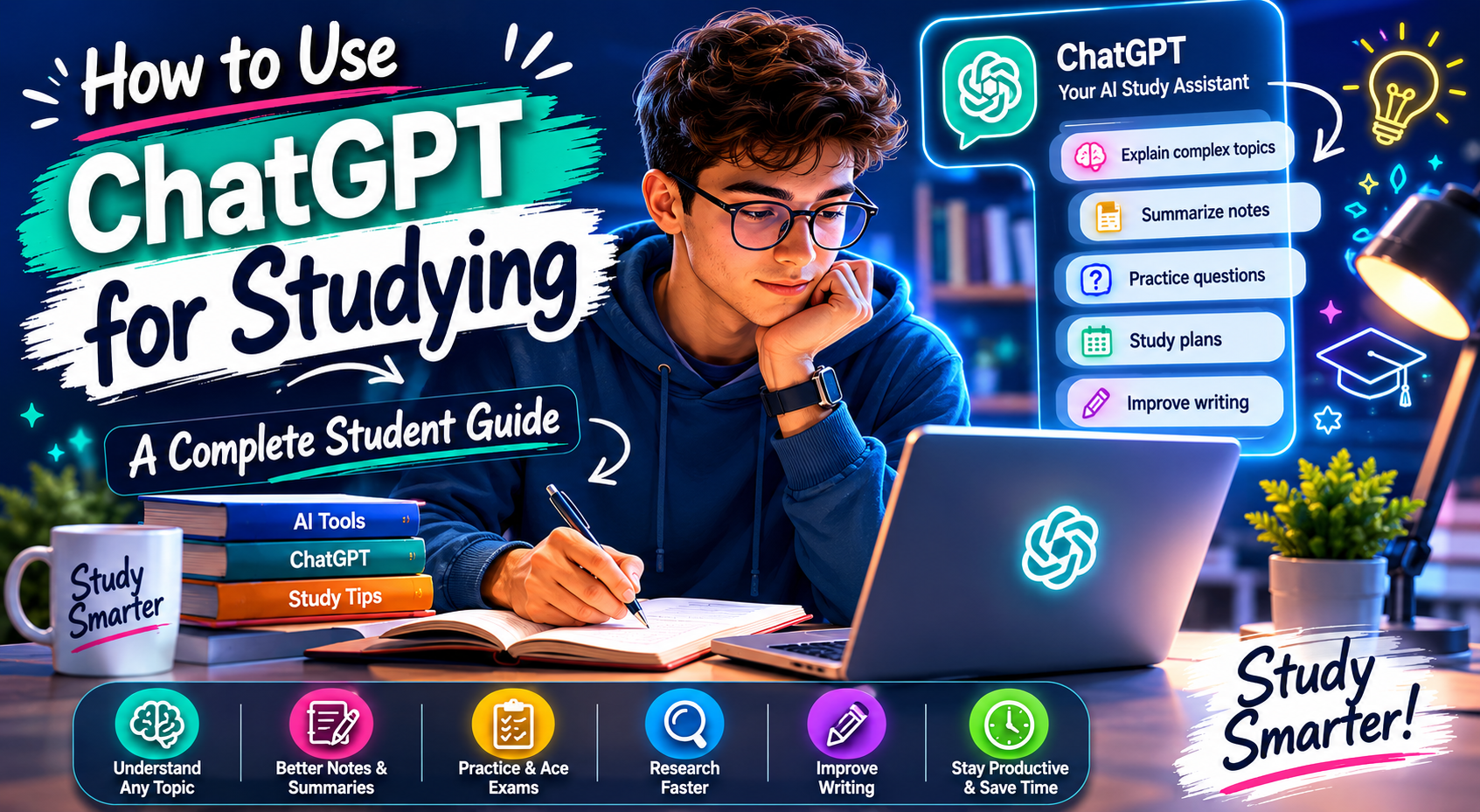
Students commonly use ChatGPT for:
- Understanding difficult concepts
- Summarizing notes
- Creating study plans
- Generating practice quizzes
- Learning new skills
- Improving writing
- Organizing projects
- Preparing presentations
The key is knowing when and how to use each feature.
1. Use ChatGPT to Understand Difficult Topics
One of the most powerful uses of ChatGPT is simplifying complex subjects.
Instead of reading multiple articles and textbooks, students can ask for explanations tailored to their level of understanding.
Example prompts:
- Explain photosynthesis like I’m a high school student.
- Teach me the basics of supply and demand.
- Explain Newton’s Laws using simple examples.
- Help me understand probability step by step.
This personalized approach often makes difficult topics easier to understand.
2. Create Personalized Study Plans
Many students struggle not because they lack ability, but because they lack structure.
ChatGPT can generate customized study schedules based on:
- Available time
- Subjects
- Exam dates
- Learning goals
Example prompt:
“Create a 14-day study plan for my biology final exam. I can study 2 hours per day.”
The result is a structured roadmap that reduces stress and improves consistency.
3. Turn Notes into Study Guides
Lecture notes often become difficult to review before exams.
Students can paste their notes into ChatGPT and ask it to:
- Create summaries
- Generate key points
- Identify important concepts
- Produce revision sheets
This can dramatically reduce revision time while improving retention.
4. Generate Practice Questions
Testing yourself is one of the most effective learning techniques.
ChatGPT can generate:
- Multiple-choice questions
- True or false quizzes
- Flashcard content
- Essay questions
- Short-answer exercises
Example prompt:
“Generate 20 multiple-choice questions about World War II with answers.”
Active recall strengthens memory far more effectively than passive reading.
5. Improve Writing Skills
Students frequently use ChatGPT during the writing process.
It can help:
- Improve clarity
- Correct grammar
- Suggest better wording
- Create outlines
- Structure arguments
However, students should avoid copying responses directly and instead use the suggestions to improve their own work.
6. Use ChatGPT for Research Preparation
Research becomes much easier when ChatGPT helps organize ideas.
Students can use it to:
- Brainstorm topics
- Generate research questions
- Create outlines
- Identify subtopics
- Understand unfamiliar concepts
For academic projects, it works best when combined with reliable sources and proper citation practices.
7. Learn Languages More Efficiently
Language learners benefit significantly from conversational AI.
Students can:
- Practice vocabulary
- Improve grammar
- Simulate conversations
- Translate phrases
- Receive explanations
Because ChatGPT responds instantly, it provides continuous practice opportunities.
8. Prepare for Exams
Exam preparation often involves reviewing large amounts of material.
ChatGPT can assist by creating:
- Revision summaries
- Study checklists
- Practice exams
- Topic breakdowns
- Memory aids
This helps students focus on understanding rather than simply rereading textbooks.
Common Mistakes Students Should Avoid
While ChatGPT is powerful, it is not perfect.
Avoid these mistakes:
Copying Assignments Directly
Submitting AI-generated content without understanding it can lead to academic problems.
Trusting Every Answer
AI can occasionally make mistakes. Always verify important information.
Replacing Learning
ChatGPT should support learning, not replace studying.
Ignoring Critical Thinking
The best students use AI to strengthen their thinking rather than outsource it.
Best ChatGPT Prompts for Students
Here are some useful prompts:
Studying
“Explain this topic using simple language and examples.”
Revision
“Create a summary sheet from these notes.”
Exam Preparation
“Generate 25 practice questions with answers.”
Writing
“Suggest improvements for clarity and readability.”
Productivity
“Create a weekly study schedule for my exams.”
Comparison: Traditional Studying vs ChatGPT-Assisted Studying
| Activity | Traditional Method | ChatGPT-Assisted Method |
|---|---|---|
| Research | Multiple searches | Faster explanations |
| Note Taking | Manual summaries | AI-assisted summaries |
| Revision | Reading repeatedly | Practice questions |
| Planning | Self-created schedules | Personalized plans |
| Writing | Manual editing | AI-assisted feedback |
Is ChatGPT Safe for Students?
Yes, when used responsibly.
Students should:
- Verify information
- Follow school policies
- Protect personal information
- Use AI ethically
- Focus on learning rather than shortcuts
When used properly, ChatGPT can become one of the most valuable educational tools available.
Frequently Asked Questions
Can ChatGPT help improve grades?
It can improve study efficiency and understanding, but academic success still depends on effort and learning.
Is ChatGPT free for students?
A free version is available, while premium plans provide additional capabilities.
Can ChatGPT replace teachers?
No. Teachers provide guidance, expertise, and personalized instruction that AI cannot fully replace.
What subjects can ChatGPT help with?
It can assist with science, mathematics, business, history, languages, programming, and many other subjects.
What is the best way to use ChatGPT for studying?
Use it as a tutor, research assistant, editor, and productivity tool rather than a source for completed assignments.
Final Thoughts
ChatGPT is changing the way students learn. When used correctly, it can help learners understand concepts faster, organize information more effectively, prepare for exams, improve writing, and increase productivity.
The most successful students use ChatGPT as a learning partner—not as a shortcut. By combining AI assistance with critical thinking and genuine effort, students can make studying more efficient and more enjoyable.
Related Articles
- Best AI Tools for Students in 2026
- Best Productivity Apps for Students
- NotebookLM for Students: Complete Guide
- Best AI Writing Tools in 2026
- AI Tools Every College Student Should Know