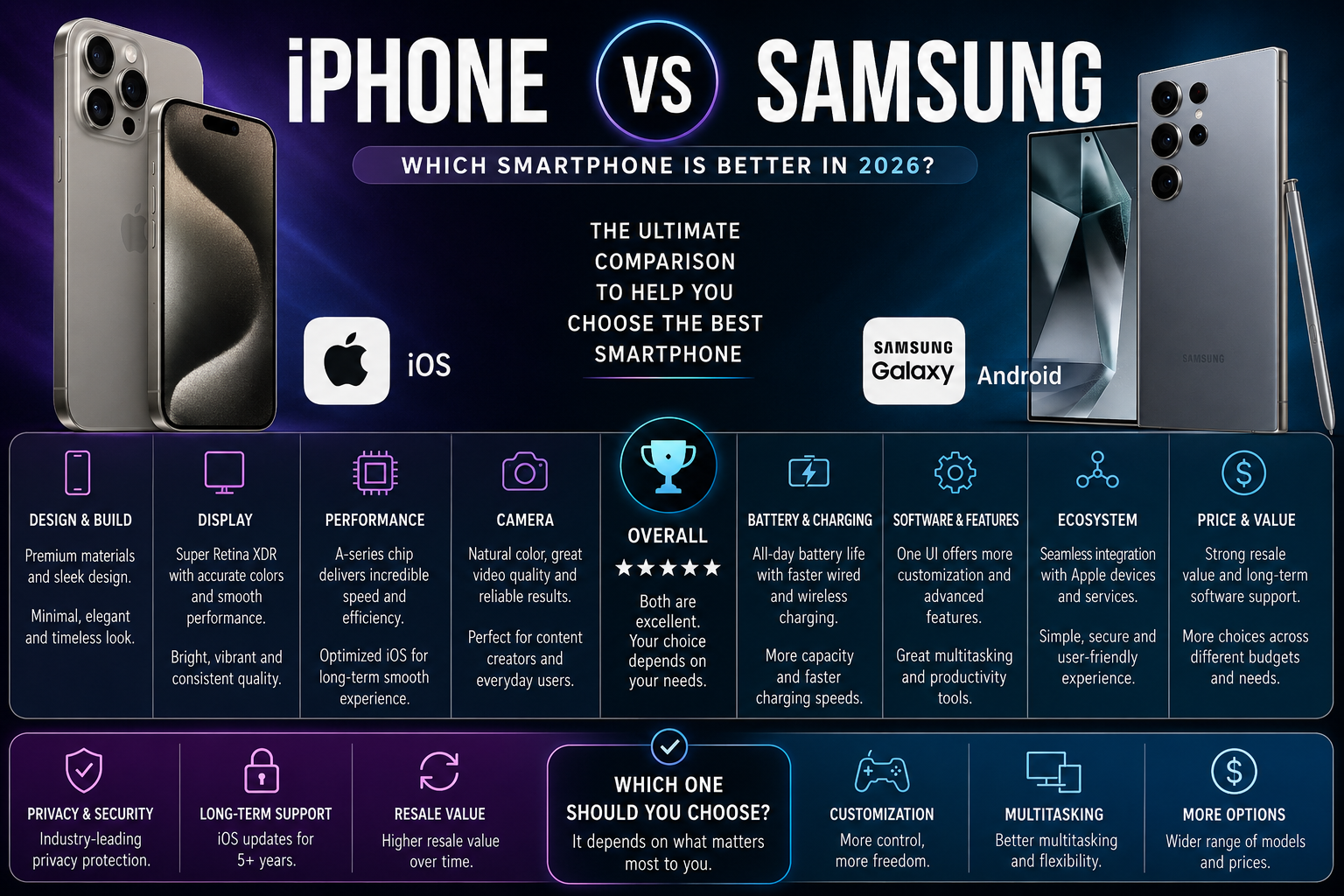
Choosing between an iPhone and a Samsung Galaxy phone is one of the most common technology decisions in the world. For many buyers, this is not just about buying a device. It is about choosing an ecosystem, a camera style, a software experience, a long-term investment, and sometimes even a personal identity.
In 2026, the iPhone vs Samsung debate is more important than ever because smartphones are no longer simple communication tools. They are cameras, work devices, payment tools, entertainment centers, AI assistants, travel companions, health trackers, and personal productivity systems.
Apple and Samsung dominate the premium smartphone market, but they approach the smartphone experience in very different ways.
Apple focuses on simplicity, consistency, performance, privacy, ecosystem integration, and long-term software support.
Samsung focuses on variety, customization, display technology, multitasking, camera flexibility, hardware innovation, and user control.
Both brands produce excellent phones. Both have loyal users. Both offer powerful flagship devices. But the better choice depends on what kind of user you are.
This detailed comparison examines the iPhone and Samsung Galaxy experience across design, performance, cameras, battery life, software, AI features, ecosystem, gaming, productivity, value, durability, and long-term ownership.
iPhone vs Samsung at a Glance
| Category | iPhone | Samsung |
|---|---|---|
| Operating System | iOS | Android with One UI |
| Main Strength | Simplicity and ecosystem | Customization and hardware variety |
| Best For | Users who want smooth, reliable, simple experience | Users who want control, flexibility, and features |
| Camera Style | Natural, consistent, excellent video | Vibrant, flexible, strong zoom |
| Software Updates | Very strong | Very strong on flagship models |
| App Optimization | Excellent | Strong |
| Customization | Limited | Excellent |
| Display Quality | Excellent | Industry-leading |
| AI Features | Growing | Very strong and feature-rich |
| Ecosystem | Very tight | Broad and flexible |
| Resale Value | Usually higher | Good, but varies by model |
| Price Range | Mostly premium | Wide range from budget to ultra-premium |
The Core Difference Between iPhone and Samsung
The simplest way to understand the difference is this:
The iPhone is built for people who want a smooth, polished, predictable experience with minimal effort.
Samsung is built for people who want more control, more options, and more advanced features.
Apple designs the iPhone around a controlled ecosystem. The hardware, software, apps, security features, chips, accessories, and services are all designed to work together in a highly integrated way. This creates a user experience that feels stable, clean, and easy to understand.
Samsung uses Android as its foundation and adds One UI, its own interface layer. This gives users more freedom to adjust the phone, change the layout, customize settings, use advanced multitasking features, and connect with a wider range of devices and platforms.
Neither philosophy is automatically better. They serve different users.
Brand Philosophy Comparison
| Factor | iPhone | Samsung |
|---|---|---|
| Main Philosophy | Keep things simple and controlled | Give users more features and flexibility |
| User Experience | Clean, consistent, polished | Flexible, rich, customizable |
| Learning Curve | Easier for most users | Slightly deeper because of more options |
| Settings Control | Limited but simple | Extensive and powerful |
| Design Consistency | Very high | High, but varies across models |
| Target User | Mainstream premium users | Power users, Android fans, productivity users |
| Best Experience When Used With | Mac, iPad, Apple Watch, AirPods | Galaxy Watch, Galaxy Buds, Windows PC, Android ecosystem |
Design and Build Quality
Both iPhone and Samsung flagship phones are premium devices with excellent build quality.
Apple usually follows a conservative design approach. iPhones tend to look elegant, minimal, and recognizable. The company does not change the design dramatically every year, but it focuses on refinement, material quality, durability, and consistency.
Samsung is often more experimental. Its flagship Galaxy S Ultra models usually feel more feature-packed, while foldable models like the Galaxy Z Fold and Z Flip show Samsung’s willingness to push smartphone design beyond traditional formats.
Design Comparison
| Design Factor | iPhone | Samsung |
|---|---|---|
| Premium Feel | Excellent | Excellent |
| Materials | Premium glass and metal | Premium glass and metal |
| Design Consistency | Very strong | Strong |
| Color Options | Elegant and controlled | More varied |
| Foldable Options | Not available | Available |
| Slimness | Excellent | Excellent |
| One-Hand Use | Better on standard models | Depends on model |
| Durability | Excellent | Excellent |
| Innovation in Form Factor | Conservative | More innovative |
Which Brand Feels More Premium?
At the flagship level, both brands feel premium. However, they feel premium in different ways.
The iPhone feels polished, simple, and iconic. It gives the impression of a carefully controlled product where every element is designed to fit Apple’s ecosystem.
Samsung flagship phones feel powerful, futuristic, and feature-rich. Devices like the Galaxy Ultra series often feel like productivity machines rather than simple phones.
For users who want elegance and simplicity, the iPhone usually feels better.
For users who want a phone that looks advanced and feature-heavy, Samsung often feels more exciting.
Display Quality
Samsung has long been one of the strongest companies in display technology. Its premium Galaxy phones are known for bright screens, deep contrast, high refresh rates, vivid colors, and excellent outdoor visibility.
Apple also uses excellent displays on modern iPhones, but Samsung often leads in terms of brightness, sharpness, and visual impact.
For people who watch a lot of videos, play games, edit photos, read content, or use their phone outdoors, display quality matters significantly.
Display Comparison
| Display Feature | iPhone | Samsung |
|---|---|---|
| Screen Brightness | Excellent | Excellent to industry-leading |
| Color Accuracy | Excellent | Excellent |
| Vivid Colors | Natural | More vibrant |
| Refresh Rate | Excellent on Pro models | Excellent across many premium models |
| Outdoor Visibility | Excellent | Excellent |
| Video Watching | Excellent | Excellent |
| Screen Customization | Limited | Strong |
| Always-On Display | Available on select models | More customizable |
| Foldable Displays | No | Yes |
Display Verdict
Samsung usually has the advantage in display technology, especially for users who enjoy vibrant screens, customization, and large displays.
The iPhone still offers one of the best display experiences in the market, especially for users who prefer natural colors, smooth animations, and excellent consistency.
Performance and Speed
Performance is one of Apple’s strongest areas.
iPhones are famous for extremely fast processors, smooth animations, excellent app optimization, and long-term performance stability. Because Apple designs both the hardware and software, iPhones often feel fast for many years.
Samsung flagship phones are also very powerful. Premium Galaxy devices can handle gaming, multitasking, productivity, video editing, and AI features with ease. However, Android phones can vary more depending on region, processor version, model, storage type, and software optimization.
Performance Comparison
| Performance Factor | iPhone | Samsung |
|---|---|---|
| Raw Chip Performance | Excellent | Excellent |
| App Optimization | Excellent | Strong |
| Gaming Performance | Excellent | Excellent |
| Multitasking | Good | Excellent |
| Long-Term Smoothness | Excellent | Strong |
| Thermal Management | Strong | Strong |
| RAM Management | Efficient | More RAM available |
| Heavy Productivity | Strong | Very strong |
| Video Editing | Excellent | Strong |
Real-Life Performance
In daily use, both iPhone and Samsung flagship phones are fast.
Opening apps, browsing the web, taking photos, using social media, watching videos, and switching between tasks feel smooth on both.
The difference becomes clearer in how each phone handles performance philosophy.
The iPhone focuses on efficiency and optimization. It may have less RAM on paper, but iOS manages memory effectively. Apps often feel polished because developers tend to optimize heavily for iPhone models.
Samsung offers more RAM, more multitasking features, and more visible control. Users can run apps in split screen, floating windows, and advanced productivity modes. This makes Samsung more powerful for users who treat their phone like a mini computer.
Performance Winner by User Type
| User Type | Better Choice |
|---|---|
| Casual user | iPhone |
| Heavy multitasker | Samsung |
| Mobile gamer | Tie |
| Video creator | iPhone |
| Productivity-focused user | Samsung |
| Long-term smoothness priority | iPhone |
| Power user | Samsung |
| Simple reliable performance | iPhone |
Software Experience
Software is where the iPhone vs Samsung debate becomes deeply personal.
iPhone uses iOS, a clean and controlled operating system designed for simplicity. It is easy to use, consistent, secure, and polished.
Samsung uses Android with One UI. It is more customizable, more flexible, and more feature-rich.
The iPhone feels like a system designed to reduce decisions.
Samsung feels like a system designed to give you more choices.
Software Comparison
| Software Factor | iPhone | Samsung |
|---|---|---|
| Ease of Use | Excellent | Very good |
| Customization | Limited | Excellent |
| App Quality | Excellent | Strong |
| Widgets | Good | Excellent |
| File Management | Limited | Better |
| Default App Flexibility | Limited | Better |
| Multitasking | Basic | Advanced |
| Security | Excellent | Strong |
| Privacy Controls | Excellent | Strong |
| Update Experience | Excellent | Very good |
iOS Strengths
iOS is one of the main reasons people stay with iPhone.
Its strengths include:
- Smooth interface
- Strong privacy features
- Excellent app quality
- Long software support
- Simple settings
- Strong security
- Seamless connection with Apple devices
- Stable performance over time
For users who do not want to think too much about settings, updates, permissions, file systems, launchers, or customization, iOS is extremely comfortable.
Samsung One UI Strengths
Samsung One UI is one of the most advanced Android experiences available.
Its strengths include:
- Deep customization
- Better multitasking
- Strong notification control
- Advanced display settings
- More flexible file management
- Split-screen apps
- Floating windows
- Edge panels
- Samsung DeX for desktop-like use
For users who enjoy controlling how their phone looks and works, Samsung provides far more freedom.
Software Verdict
| Priority | Better Choice |
|---|---|
| Simplicity | iPhone |
| Customization | Samsung |
| Privacy-focused experience | iPhone |
| Multitasking | Samsung |
| App polish | iPhone |
| File flexibility | Samsung |
| Beginner-friendly use | iPhone |
| Advanced controls | Samsung |
The iPhone is better for users who want software that feels clean, stable, and easy.
Samsung is better for users who want software that feels powerful, flexible, and customizable.
Camera Quality
Camera quality is one of the biggest reasons people compare iPhone and Samsung.
Both brands produce excellent cameras, but their image styles are different.
The iPhone focuses on consistency, natural colors, reliable results, and excellent video recording.
Samsung focuses on versatility, strong zoom, vibrant colors, high-resolution sensors, and feature-rich camera modes.
This means the better camera depends on what you shoot.
Camera Comparison
| Camera Factor | iPhone | Samsung |
|---|---|---|
| Photo Consistency | Excellent | Very good |
| Video Recording | Excellent | Strong |
| Portrait Mode | Excellent | Excellent |
| Night Mode | Excellent | Excellent |
| Zoom Quality | Good | Excellent |
| Color Style | Natural | More vibrant |
| Social Media Video | Excellent | Strong |
| Manual Camera Options | Limited | Better |
| Selfies | Excellent | Excellent |
| Point-and-Shoot Reliability | Excellent | Very good |
Photo Style Difference
iPhone photos usually look more natural. Skin tones, exposure, and colors often appear balanced and realistic. This makes the iPhone especially popular among people who want photos that look clean without too much processing.
Samsung photos often look brighter, sharper, and more colorful. This can make landscapes, food, buildings, skies, and social media images look more dramatic.
Some users prefer the iPhone because it looks realistic.
Others prefer Samsung because the photos look more vibrant and ready to post.
Camera Winner by Use Case
| Use Case | Better Choice |
|---|---|
| Everyday point-and-shoot | iPhone |
| Video recording | iPhone |
| Zoom photography | Samsung |
| Social media photos | Tie |
| Natural colors | iPhone |
| Vibrant colors | Samsung |
| Travel photography | Samsung |
| Family videos | iPhone |
| Manual camera control | Samsung |
| Consistent results | iPhone |
Video Recording
Apple remains extremely strong in video recording.
iPhones are widely used by content creators because video quality is stable, colors are consistent, audio is reliable, and social media apps often work very well with iPhone cameras.
Samsung video has improved significantly and is excellent on flagship models, but the iPhone still has a reputation for being the more reliable video tool for creators.
Video Comparison
| Video Factor | iPhone | Samsung |
|---|---|---|
| Video Stabilization | Excellent | Excellent |
| Color Consistency | Excellent | Very good |
| Low-Light Video | Excellent | Very good |
| Social Media App Optimization | Excellent | Good |
| Cinematic Video | Excellent | Strong |
| Pro Video Features | Strong | Strong |
| Ease of Recording | Excellent | Very good |
For users who record a lot of videos for TikTok, Instagram, YouTube Shorts, family memories, travel clips, or professional content, the iPhone usually has a slight advantage.
Battery Life and Charging
Battery life depends heavily on model, screen size, usage habits, network conditions, processor efficiency, and display settings.
Both iPhone and Samsung flagship phones can last a full day for most users.
Samsung often offers larger batteries and faster charging speeds, while Apple focuses on efficiency and battery health management.
Battery and Charging Comparison
| Battery Factor | iPhone | Samsung |
|---|---|---|
| Daily Battery Life | Excellent | Excellent |
| Charging Speed | Slower | Faster |
| Wireless Charging | Strong | Strong |
| Battery Optimization | Excellent | Strong |
| Power Saving Modes | Good | Excellent |
| Charger Included | Usually no | Usually no on flagships |
| Heavy Use Endurance | Strong | Strong |
| Custom Battery Controls | Limited | Better |
Battery Verdict
Samsung usually wins on charging speed and power controls.
iPhone often wins on efficiency and long-term battery consistency.
For users who care about fast charging, Samsung is often better.
For users who care about predictable all-day use and battery optimization, the iPhone remains excellent.
Ecosystem Comparison: The Hidden Factor Most Buyers Ignore
When people compare smartphones, they usually focus on cameras, battery life, processors, or displays.
However, after using a phone for several years, many users discover that the ecosystem often matters more than the phone itself.
The ecosystem includes:
- Smartwatches
- Tablets
- Laptops
- Earbuds
- Cloud services
- File sharing
- Messaging
- Productivity tools
- Smart home devices
This is one area where Apple has built one of the strongest competitive advantages in the technology industry.
Samsung also offers a large ecosystem, but it works differently.
Apple focuses on deep integration.
Samsung focuses on flexibility and compatibility.
Ecosystem Comparison
| Ecosystem Feature | iPhone | Samsung |
|---|---|---|
| Phone + Watch Integration | Excellent | Excellent |
| Phone + Tablet Integration | Excellent | Strong |
| Phone + Laptop Integration | Excellent | Strong |
| Cross-Device Copy/Paste | Excellent | Good |
| Device Handoff | Excellent | Moderate |
| Cloud Integration | Excellent | Strong |
| Smart Home Control | Excellent | Excellent |
| Device Compatibility | Limited but seamless | Broad and flexible |
| Ecosystem Lock-In | Very High | Lower |
| User Convenience | Excellent | Strong |
Why Apple’s Ecosystem Is So Powerful
Apple has spent years creating an environment where its products behave almost like a single device.
Examples include:
- Taking a call on a Mac that arrived on an iPhone.
- Copying text on an iPhone and pasting it instantly on an iPad.
- Unlocking a Mac using an Apple Watch.
- Seamlessly transferring files between Apple devices.
- Continuing work started on one device from another.
For users who own multiple Apple products, the experience is exceptionally smooth.
This is one reason many people who switch to iPhone rarely leave the Apple ecosystem.
Samsung’s Ecosystem Advantage
Samsung takes a different approach.
Instead of creating a closed environment, Samsung works across a wider range of devices and platforms.
Benefits include:
- Better compatibility with Windows PCs.
- More flexible file transfers.
- Easier interaction with non-Samsung products.
- Greater hardware variety.
- Less dependence on a single manufacturer.
For users who prefer flexibility over ecosystem lock-in, Samsung may be the better choice.
Apple Watch vs Samsung Galaxy Watch
A smartwatch is often the second-most-used device after a smartphone.
The experience varies significantly depending on which phone you choose.
Smartwatch Comparison
| Feature | Apple Watch | Galaxy Watch |
|---|---|---|
| Health Tracking | Excellent | Excellent |
| Fitness Features | Excellent | Excellent |
| App Ecosystem | Strong | Strong |
| Phone Integration | Best with iPhone | Best with Samsung |
| Battery Life | Moderate | Better |
| Customization | Moderate | Strong |
| Ease of Use | Excellent | Very Good |
| Productivity Features | Strong | Strong |
Apple Watch remains one of the strongest reasons people stay with the iPhone ecosystem.
Galaxy Watch is excellent and often offers more battery life and customization.
AirPods vs Galaxy Buds
Wireless earbuds have become an essential part of the smartphone experience.
Earbuds Comparison
| Feature | AirPods | Galaxy Buds |
|---|---|---|
| Ease of Pairing | Excellent | Excellent |
| Sound Quality | Excellent | Excellent |
| Noise Cancellation | Excellent | Excellent |
| Device Switching | Excellent in Apple Ecosystem | Good |
| Android Compatibility | Limited Features | Excellent |
| Customization | Moderate | Better |
For iPhone users, AirPods provide one of the most seamless experiences available.
For Android users, Galaxy Buds often provide better value and flexibility.
Artificial Intelligence Features
Artificial intelligence has become one of the biggest battlegrounds in smartphones.
The smartphone industry is rapidly moving toward AI-assisted experiences.
These include:
- Writing assistance
- Live translation
- Voice summarization
- Photo editing
- AI search
- Productivity tools
- Smart scheduling
- Context-aware assistance
Samsung has aggressively integrated AI features across many flagship devices.
Apple has begun expanding AI capabilities significantly, but its approach remains more controlled.
AI Comparison
| AI Feature | iPhone | Samsung |
|---|---|---|
| AI Writing Tools | Strong | Strong |
| AI Translation | Strong | Excellent |
| AI Photo Editing | Strong | Excellent |
| AI Summarization | Strong | Excellent |
| AI Search Functions | Growing | Strong |
| Productivity AI | Strong | Excellent |
| Custom AI Features | Limited | Better |
| AI Availability Across Devices | Growing | Extensive |
Which Brand Is Leading in AI?
As of 2026, Samsung generally offers more visible AI features and customization options.
Apple focuses more on privacy-focused AI experiences integrated directly into the operating system.
Samsung often introduces AI features earlier.
Apple often introduces fewer features but integrates them more deeply into the user experience.
Gaming Performance
Mobile gaming continues growing rapidly.
Many people now use their smartphones as primary gaming devices.
Modern flagship phones from both brands easily handle:
- Call of Duty Mobile
- PUBG Mobile
- Genshin Impact
- Fortnite
- EA Sports FC Mobile
- Warzone Mobile
Gaming Comparison
| Gaming Factor | iPhone | Samsung |
|---|---|---|
| Raw Performance | Excellent | Excellent |
| Frame Stability | Excellent | Very Good |
| Heat Management | Strong | Strong |
| Display Experience | Excellent | Excellent |
| Controller Support | Excellent | Excellent |
| Gaming Accessories | Strong | Strong |
| Long-Term Gaming Optimization | Excellent | Strong |
Why Many Mobile Gamers Prefer iPhone
Several major mobile games are optimized first for iOS devices.
Developers only need to support a limited number of iPhone models compared to the large variety of Android devices.
This often results in:
- Better optimization
- More stable performance
- Faster game updates
- Consistent frame rates
Why Some Gamers Prefer Samsung
Samsung offers advantages including:
- Larger displays
- Better multitasking
- Gaming-focused settings
- Faster charging
- More hardware options
For competitive gaming, both brands perform exceptionally well.
Productivity and Business Use
Many professionals now rely heavily on smartphones for work.
This includes:
- Emails
- Documents
- Video calls
- Presentations
- Task management
- Remote work
Productivity Comparison
| Productivity Factor | iPhone | Samsung |
|---|---|---|
| Email Experience | Excellent | Excellent |
| Document Editing | Strong | Strong |
| Multitasking | Moderate | Excellent |
| Desktop-Like Experience | Limited | Excellent |
| Business Apps | Excellent | Excellent |
| File Management | Limited | Better |
| External Monitor Support | Limited | Excellent |
| Professional Workflow | Strong | Excellent |
Samsung DeX: A Unique Advantage
One of Samsung’s most underrated features is Samsung DeX.
DeX allows compatible Galaxy phones to function almost like desktop computers when connected to a monitor.
Users can:
- Open multiple windows
- Use keyboard and mouse
- Work with documents
- Browse multiple tabs
- Manage files more efficiently
For professionals who frequently work on the go, this can be a significant advantage.
Apple currently offers nothing directly equivalent on the iPhone.
Security and Privacy
Privacy has become one of the most important considerations for smartphone buyers.
Apple has positioned privacy as one of its strongest selling points.
Samsung also invests heavily in security through Samsung Knox and advanced device protection systems.
Security Comparison
| Security Factor | iPhone | Samsung |
|---|---|---|
| Privacy Controls | Excellent | Strong |
| Security Updates | Excellent | Excellent |
| Biometric Security | Excellent | Excellent |
| Enterprise Security | Strong | Excellent |
| Data Transparency | Excellent | Strong |
| App Tracking Controls | Excellent | Strong |
| Malware Risk | Lower | Slightly Higher |
Apple generally maintains a slight advantage in privacy reputation.
Samsung remains one of the most secure Android manufacturers available.
Long-Term Ownership Experience
The real value of a smartphone is often determined after three, four, or five years.
A phone that remains fast, reliable, and valuable years later often represents the better investment.
Long-Term Ownership Comparison
| Factor | iPhone | Samsung |
|---|---|---|
| Software Longevity | Excellent | Excellent |
| Performance Aging | Excellent | Strong |
| Battery Aging | Strong | Strong |
| Resale Value | Excellent | Good |
| Market Demand | Excellent | Strong |
| Repair Availability | Excellent | Strong |
| Accessory Availability | Excellent | Strong |
One area where Apple continues to dominate is resale value.
Used iPhones generally retain their value longer than comparable Samsung devices.
For buyers who upgrade frequently, this can significantly reduce the true cost of ownership.
Ownership Cost Comparison
| Cost Factor | iPhone | Samsung |
|---|---|---|
| Initial Purchase Price | High | Wide Range |
| Accessory Costs | Higher | Lower |
| Repair Costs | High | Moderate |
| Resale Value | Higher | Lower |
| Long-Term Value Retention | Excellent | Good |
| Upgrade Cost Over Time | Often Lower Than Expected | Varies |
Many buyers focus only on purchase price.
However, resale value means the total cost of owning an iPhone can be closer to Samsung than many people expect.
For users who upgrade every two or three years, resale value becomes a major factor in the overall equation.
Storage, Memory, and Daily Performance Over Time
Many buyers compare iPhone and Samsung by looking at camera megapixels, screen size, or battery capacity, but one of the most important long-term factors is how the phone performs after years of daily use.
A smartphone may feel fast during the first few months, but the real test begins after the device is filled with apps, photos, videos, updates, files, messages, and background services.
This is where storage management, memory optimization, software efficiency, and system design become extremely important.
Storage Options Comparison
| Storage Factor | iPhone | Samsung |
|---|---|---|
| Base Storage | Usually premium-focused | Varies by model |
| High Storage Options | Available | Available |
| Expandable Storage | Not available on flagships | Rare on modern flagships |
| Cloud Integration | Strong with iCloud | Strong with Google Drive and OneDrive |
| File Transfer Flexibility | Limited | Better |
| External Drive Support | Available but controlled | More flexible |
| Storage Management | Simple | More detailed |
| Best For | Users who want simplicity | Users who manage many files |
Apple keeps storage management simple. The iPhone is designed for users who want their photos, apps, backups, and files handled quietly in the background through iCloud and system optimization.
Samsung gives users more control. You can access folders more easily, move files with greater flexibility, connect to external drives, and manage downloads in a more computer-like way.
For casual users, Apple’s simplicity is easier.
For professionals, students, creators, and people who frequently move files between devices, Samsung can feel more practical.
RAM and Multitasking
RAM is often misunderstood in smartphone comparisons.
Samsung phones often include more RAM than iPhones on paper. However, iPhones rely on extremely efficient memory management because Apple controls both the hardware and software.
This means an iPhone with less RAM can still feel extremely fast and smooth.
Samsung uses more RAM to support heavier multitasking, split-screen apps, floating windows, background processes, and productivity features.
Memory and Multitasking Comparison
| Factor | iPhone | Samsung |
|---|---|---|
| RAM Amount | Lower on paper | Higher on many models |
| Memory Efficiency | Excellent | Strong |
| App Reloading | Usually well controlled | Good |
| Split-Screen Apps | Limited | Excellent |
| Floating Windows | Limited | Available |
| Background App Control | Strong | Strong |
| Power User Multitasking | Moderate | Excellent |
| Casual Daily Use | Excellent | Excellent |
Real-World Multitasking Examples
| Task | Better Experience |
|---|---|
| Replying to messages while watching YouTube | Samsung |
| Editing a video and switching to notes | iPhone |
| Opening two apps side by side | Samsung |
| Keeping social apps smooth | Tie |
| Managing many work files | Samsung |
| Moving between Apple devices | iPhone |
| Using phone like a mini laptop | Samsung |
| Simple daily switching between apps | iPhone |
Samsung clearly has the advantage for visible multitasking.
iPhone has the advantage for smooth and predictable app behavior.
Camera System in More Detail
A smartphone camera is no longer just one camera. It is a complete imaging system made of lenses, sensors, software processing, AI enhancement, stabilization, HDR, portrait algorithms, night mode, video tools, and social media optimization.
This is why two phones with similar hardware can produce very different results.
Apple and Samsung use different image philosophies.
Apple tries to create a realistic, consistent, and balanced image.
Samsung often creates a brighter, sharper, more colorful image.
Photo Processing Comparison
| Camera Behavior | iPhone | Samsung |
|---|---|---|
| Color Style | Natural and balanced | Bright and vibrant |
| Skin Tones | Usually realistic | Sometimes brighter or smoother |
| Contrast | Controlled | Stronger |
| Sharpness | Natural | Higher |
| HDR Processing | Balanced | More dramatic |
| Night Photos | Natural | Brighter |
| Social Media Look | Clean | Eye-catching |
| Editing Flexibility | Strong | Strong |
Everyday Photography
For everyday photos, the iPhone is extremely reliable.
You can take a quick photo of family, food, documents, pets, travel moments, or street scenes and usually get a clean result without changing many settings.
Samsung can produce more visually striking images, especially outdoors, in bright light, or when photographing landscapes, architecture, and colorful scenes.
Everyday Camera Comparison
| Scenario | iPhone | Samsung |
|---|---|---|
| Family Photos | Excellent | Excellent |
| Food Photos | Natural | More vibrant |
| Travel Photos | Excellent | Excellent |
| Documents | Excellent | Excellent |
| Pets | Excellent | Very good |
| Moving Subjects | Strong | Strong |
| Quick Photos | Excellent | Very good |
| Landscapes | Excellent | Excellent, often more dramatic |
Zoom Photography
Zoom is one of Samsung’s strongest camera advantages.
Samsung Ultra models are known for powerful zoom systems that can capture distant objects more clearly than most iPhones.
This matters for:
- Travel
- Concerts
- Sports events
- Wildlife
- Architecture
- City views
- Outdoor photography
Zoom Comparison
| Zoom Use Case | iPhone | Samsung |
|---|---|---|
| 2x Portraits | Excellent | Excellent |
| 3x to 5x Zoom | Excellent | Excellent |
| 10x Zoom | Good | Excellent on Ultra models |
| Long-Distance Zoom | Limited | Strong |
| Travel Landmarks | Strong | Excellent |
| Concert Photos | Good | Better |
| Wildlife Photos | Limited | Better |
If zoom is important, Samsung flagship Ultra models usually offer a stronger experience.
Video Creation for Social Media
For content creators, video quality can matter more than photo quality.
This includes:
- TikTok videos
- Instagram Reels
- YouTube Shorts
- Product videos
- Travel clips
- Educational content
- Business content
- Family memories
The iPhone has built a strong reputation among creators because video recording is consistent, stable, and well supported by social media apps.
Creator Video Comparison
| Video Need | iPhone | Samsung |
|---|---|---|
| TikTok Recording | Excellent | Strong |
| Instagram Stories | Excellent | Strong |
| YouTube Shorts | Excellent | Strong |
| Vlogging | Excellent | Very good |
| Product Videos | Excellent | Strong |
| Stabilization | Excellent | Excellent |
| Color Consistency | Excellent | Very good |
| Editing Workflow | Excellent with Apple devices | Strong with Android/Windows |
For users who create short-form video content regularly, the iPhone remains one of the safest choices.
Samsung is excellent, but the iPhone still feels more consistent across recording, editing, posting, and sharing.
AI Photo Editing
AI editing has become a major smartphone feature.
Samsung has pushed strongly into visible AI editing tools, allowing users to remove objects, adjust images, generate missing background areas, and improve photos quickly.
Apple also offers intelligent editing features, but usually presents them in a cleaner and more controlled way.
AI Editing Comparison
| AI Editing Feature | iPhone | Samsung |
|---|---|---|
| Object Removal | Strong | Excellent |
| Background Adjustment | Strong | Excellent |
| Portrait Enhancement | Excellent | Excellent |
| Auto Suggestions | Strong | Strong |
| Creative Editing | Moderate | Strong |
| Ease of Use | Excellent | Very good |
| Control Level | Moderate | Higher |
Samsung is often better for users who want more visible AI editing power.
iPhone is better for users who want subtle, polished editing tools that feel simple.
App Quality and App Store Experience
Apps are a major reason why many people choose iPhone.
Developers often optimize apps carefully for iOS because there are fewer iPhone models compared with the huge number of Android devices.
This can result in smoother app performance, better camera integration in social apps, and more consistent design.
Samsung benefits from the broader Android app ecosystem, greater flexibility, and more openness.
App Experience Comparison
| App Factor | iPhone | Samsung |
|---|---|---|
| App Polish | Excellent | Strong |
| Social Media Optimization | Excellent | Good |
| App Variety | Excellent | Excellent |
| App Flexibility | Limited | Better |
| Alternative App Sources | Limited | More flexible |
| Developer Optimization | Excellent | Varies |
| Payment Apps | Excellent | Excellent |
| Creative Apps | Excellent | Strong |
| Business Apps | Excellent | Excellent |
Social Media Experience
This matters more than many people admit.
If you use Instagram, TikTok, Snapchat, Facebook, WhatsApp, X, YouTube, or LinkedIn daily, the app experience affects your phone satisfaction.
Social Media Comparison
| Social Media Use | iPhone | Samsung |
|---|---|---|
| Instagram Camera | Excellent | Good |
| TikTok Video | Excellent | Strong |
| Snapchat Camera | Excellent | Good |
| Excellent | Excellent | |
| Excellent | Excellent | |
| YouTube | Excellent | Excellent |
| Excellent | Excellent | |
| Content Upload Quality | Excellent | Strong |
For creators who post directly from social media apps, iPhone often delivers more reliable results.
For users who record using the native camera app and then upload, both brands perform very well.
Communication Experience
A phone is still a communication device, and this is where the ecosystem difference becomes very visible.
Apple users benefit from iMessage and FaceTime, especially in countries where iPhone usage is high.
Samsung users rely more on universal platforms like WhatsApp, Telegram, Google Meet, Zoom, Messenger, and standard SMS/RCS.
Communication Comparison
| Communication Feature | iPhone | Samsung |
|---|---|---|
| iMessage | Excellent, Apple-only | Not available |
| FaceTime | Excellent | Not native |
| Excellent | Excellent | |
| Telegram | Excellent | Excellent |
| Google Meet | Excellent | Excellent |
| RCS Messaging | Growing | Strong |
| Cross-Platform Messaging | Good | Strong |
| International Communication | Excellent through apps | Excellent through apps |
In countries where WhatsApp dominates, the iMessage advantage matters less.
In countries where iPhone usage is high, especially among friends, coworkers, and families, iMessage can become a major reason to stay with iPhone.
Business and Professional Communication
For professionals, reliability matters more than fun features.
Both iPhone and Samsung are excellent for email, calls, video meetings, calendars, and business apps.
However, they appeal to different work styles.
Professional Use Comparison
| Professional Need | iPhone | Samsung |
|---|---|---|
| Email Reliability | Excellent | Excellent |
| Calendar Use | Excellent | Excellent |
| Video Calls | Excellent | Excellent |
| Document Review | Strong | Strong |
| File Management | Limited | Better |
| Microsoft Office | Excellent | Excellent |
| Google Workspace | Excellent | Excellent |
| Remote Work | Strong | Strong |
| Desktop-Like Work | Limited | Excellent with DeX |
Samsung is often more useful for professionals who work with files, external displays, and multiple apps.
iPhone is often better for professionals already using MacBook, iPad, Apple Watch, and AirPods.
Durability and Repair Experience
A smartphone is a major investment, so durability matters.
Both Apple and Samsung use premium materials in flagship models, including strong glass, aluminum or titanium frames, water resistance, and improved drop protection.
However, no premium phone is immune to damage.
Durability Comparison
| Durability Factor | iPhone | Samsung |
|---|---|---|
| Water Resistance | Excellent | Excellent |
| Build Quality | Excellent | Excellent |
| Screen Strength | Excellent | Excellent |
| Frame Strength | Excellent | Excellent |
| Drop Resistance | Strong | Strong |
| Repair Availability | Excellent | Strong |
| Official Service Network | Excellent | Strong |
| Third-Party Repair Options | Strong | Strong |
| Repair Cost | High | Moderate to high |
Repair and Replacement Costs
Apple repairs can be expensive, especially without coverage.
Samsung repairs can also be expensive for flagship models, particularly curved displays and foldable phones.
Repair Risk Comparison
| Issue | iPhone | Samsung |
|---|---|---|
| Screen Replacement | Expensive | Expensive |
| Battery Replacement | Moderate to expensive | Moderate |
| Back Glass Damage | Expensive | Expensive |
| Foldable Screen Damage | Not applicable | Very expensive |
| Water Damage | Risky | Risky |
| Official Protection Plans | Available | Available |
For users who frequently drop phones, using a case and screen protector is essential regardless of brand.
Resale Value and Upgrade Strategy
Resale value is one of Apple’s biggest long-term advantages.
iPhones usually retain value better because of strong demand, long software support, brand loyalty, and consistent global recognition.
Samsung flagship phones also retain value, but depreciation is usually faster, especially because Samsung offers more frequent discounts and promotions.
Resale Value Comparison
| Resale Factor | iPhone | Samsung |
|---|---|---|
| Value Retention | Excellent | Good |
| Used Market Demand | Very high | Strong |
| Trade-In Value | Strong | Good |
| Depreciation Speed | Slower | Faster |
| Upgrade Cost | More predictable | Varies |
| Global Demand | Excellent | Strong |
Example Ownership Logic
A buyer may pay more for an iPhone at the beginning but recover more money when selling it later.
A Samsung buyer may get a better discount at purchase but may face faster resale depreciation.
This means the cheapest phone at checkout is not always the cheapest phone over three years.
Total Cost of Ownership
| Cost Element | iPhone | Samsung |
|---|---|---|
| Purchase Price | High | High, but discounts more common |
| Accessories | Expensive | Usually more flexible |
| Repairs | Expensive | Moderate to expensive |
| Resale Value | Strong | Lower than iPhone |
| Long-Term Software Use | Excellent | Excellent on flagships |
| Upgrade Flexibility | Strong | Strong |
| True Ownership Cost | Often better than price suggests | Depends heavily on purchase discount |
For users who keep phones for five years, both brands can be excellent.
For users who upgrade every two or three years, iPhone often has a stronger resale advantage.
Budget and Midrange Phones
One major difference between iPhone and Samsung is product variety.
Apple sells fewer models and focuses mostly on the premium market.
Samsung sells phones across many price levels, from budget devices to ultra-premium foldables.
This makes Samsung much more accessible to buyers who do not want to spend flagship-level money.
Price Range Comparison
| Price Segment | iPhone | Samsung |
|---|---|---|
| Budget Phones | Very limited | Many options |
| Midrange Phones | Limited | Strong |
| Premium Phones | Excellent | Excellent |
| Ultra-Premium Phones | Excellent | Excellent |
| Foldable Phones | Not available | Available |
| Best Variety | Limited | Excellent |
Samsung’s Midrange Advantage
Samsung’s Galaxy A series is one of the most important smartphone lines globally.
These phones often offer:
- Large displays
- Good cameras
- Strong battery life
- Modern design
- Reasonable pricing
- Reliable software support
For buyers who want a good smartphone without paying flagship prices, Samsung is often the more practical choice.
Apple’s Budget Challenge
Apple’s lower-cost iPhones can be attractive, especially for users who want iOS at a lower price.
However, Apple usually does not compete aggressively in the budget segment.
This means users with limited budgets often find more choices from Samsung.
Budget Buyer Verdict
| Buyer Type | Better Choice |
|---|---|
| Wants cheapest good phone | Samsung |
| Wants iOS at lowest price | iPhone |
| Wants best midrange value | Samsung |
| Wants premium resale value | iPhone |
| Wants many model choices | Samsung |
| Wants simple model lineup | iPhone |
Samsung clearly wins in variety and affordability.
Apple wins if the buyer specifically wants the iPhone experience and long-term resale value.
Software Updates and Long-Term Support
One of the most important factors when purchasing a smartphone is how long it remains secure, fast, and fully supported.
A phone is no longer a one-year purchase. Many users now keep their devices for three, four, five, or even six years.
This makes software support a major factor in the total value of ownership.
A smartphone that receives updates for many years can remain secure, compatible with new apps, and useful long after its launch.
Historically, Apple dominated this category.
In recent years, Samsung has significantly improved its update policy and now competes much more closely.
Software Support Comparison
| Factor | iPhone | Samsung |
|---|---|---|
| OS Updates | Excellent | Excellent on flagship devices |
| Security Updates | Excellent | Excellent |
| Long-Term Device Support | Excellent | Excellent |
| App Compatibility Over Time | Excellent | Strong |
| Older Device Performance | Excellent | Strong |
| Ecosystem Integration After Years | Excellent | Strong |
| Reliability of Updates | Excellent | Very Good |
Why Software Support Matters
Many users focus heavily on specifications during purchase but ignore longevity.
Consider two buyers:
- Buyer A purchases a phone and replaces it every two years.
- Buyer B purchases a phone and keeps it for five years.
For Buyer B, long-term software support becomes one of the most important features.
Benefits include:
- Better security
- New features
- App compatibility
- Longer lifespan
- Better resale value
This is one reason premium smartphones often provide better long-term value than cheaper alternatives.
Privacy Philosophy
Privacy has become one of the biggest topics in modern technology.
Every smartphone stores:
- Photos
- Banking information
- Passwords
- Emails
- Location history
- Conversations
- Health data
- Business information
As a result, privacy is no longer a niche concern.
It affects nearly every user.
Privacy Comparison
| Privacy Factor | iPhone | Samsung |
|---|---|---|
| Privacy Reputation | Excellent | Strong |
| App Tracking Controls | Excellent | Strong |
| Data Transparency | Excellent | Strong |
| Permission Controls | Excellent | Strong |
| Security Features | Excellent | Excellent |
| Enterprise Security | Strong | Excellent |
| User Trust | Very High | High |
Apple has built much of its modern marketing around privacy.
Many iPhone users specifically choose Apple because they believe the company places greater emphasis on protecting personal information.
Samsung also offers strong security protections, especially through Samsung Knox, which is widely respected in business and enterprise environments.
Travel Experience
For travelers, smartphones have become essential tools.
A modern phone handles:
- Navigation
- Translation
- Photography
- Flight bookings
- Hotel reservations
- Mobile payments
- Communication
- Entertainment
Both iPhone and Samsung excel as travel companions.
However, they offer slightly different strengths.
Travel Comparison
| Travel Feature | iPhone | Samsung |
|---|---|---|
| Navigation | Excellent | Excellent |
| Travel Photography | Excellent | Excellent |
| Zoom Capability | Good | Excellent |
| Offline Maps | Excellent | Excellent |
| Translation Features | Strong | Excellent |
| Battery During Travel | Strong | Strong |
| International App Support | Excellent | Excellent |
| File Sharing During Travel | Moderate | Better |
Best Choice for Travelers
Travelers who prioritize photography flexibility often prefer Samsung Ultra devices because of superior zoom capabilities.
Travelers who prioritize video creation and social media content often prefer iPhone.
Both are among the best travel smartphones available.
Students: Which Brand Is Better?
Students represent one of the largest smartphone-buying groups globally.
The ideal student smartphone should balance:
- Price
- Battery life
- Reliability
- Camera quality
- Productivity
- Longevity
Student Comparison
| Student Need | iPhone | Samsung |
|---|---|---|
| Note Taking | Strong | Strong |
| Online Learning | Excellent | Excellent |
| Budget Options | Limited | Excellent |
| Long-Term Ownership | Excellent | Strong |
| Ecosystem Benefits | Excellent | Strong |
| Productivity Features | Strong | Excellent |
| Resale Value | Excellent | Good |
Student Recommendation
Students already using MacBooks and iPads often benefit greatly from an iPhone.
Students seeking maximum value for money often find Samsung devices more attractive, especially in the midrange segment.
Content Creators and Influencers
The rise of TikTok, Instagram, YouTube Shorts, and personal branding has transformed smartphone purchasing decisions.
Many people now buy phones primarily for content creation.
Creator Comparison
| Creator Need | iPhone | Samsung |
|---|---|---|
| Instagram Content | Excellent | Strong |
| TikTok Content | Excellent | Strong |
| YouTube Recording | Excellent | Strong |
| Video Editing | Excellent | Strong |
| Social Media Upload Quality | Excellent | Good |
| Camera Consistency | Excellent | Very Good |
| Creative Camera Features | Strong | Excellent |
| Zoom Content | Good | Excellent |
Why Many Creators Prefer iPhone
Several reasons explain the popularity of iPhones among creators:
- Excellent video quality
- Strong app optimization
- Consistent camera results
- Reliable color science
- Better integration with editing workflows
Why Some Creators Prefer Samsung
Samsung offers unique advantages:
- Better zoom
- More camera experimentation
- More manual controls
- Foldable devices for creative workflows
- Larger displays
The best choice depends on the type of content being produced.
Business Professionals
Professionals increasingly rely on smartphones for daily productivity.
Important factors include:
- Email management
- Meetings
- Calendars
- Document editing
- Security
- Device reliability
Professional Comparison
| Business Need | iPhone | Samsung |
|---|---|---|
| Email Management | Excellent | Excellent |
| Calendar Integration | Excellent | Excellent |
| Security | Excellent | Excellent |
| Business Apps | Excellent | Excellent |
| File Handling | Moderate | Excellent |
| Desktop-Like Productivity | Limited | Excellent |
| Ecosystem Integration | Excellent | Strong |
| Reliability | Excellent | Strong |
Corporate Environment
Many organizations choose iPhones because:
- Standardized device management
- Security reputation
- Long support cycles
- Reliable software behavior
Samsung remains extremely popular among professionals who need greater flexibility and productivity features.
Foldable Phones: Samsung’s Unique Advantage
One area where Samsung currently has a significant advantage is foldable technology.
Samsung has invested heavily in foldable smartphones and continues to lead this category.
Apple has not yet released a foldable iPhone.
Foldable Comparison
| Factor | iPhone | Samsung |
|---|---|---|
| Foldable Devices | No | Yes |
| Productivity Potential | Limited | Excellent |
| Screen Size Flexibility | Limited | Excellent |
| Innovation Leadership | Moderate | Strong |
| Multi-App Usage | Limited | Excellent |
For users interested in foldables, Samsung is currently the obvious choice.
The Galaxy Fold series effectively combines elements of a phone and tablet into a single device.
Accessibility Features
Accessibility affects millions of users.
Modern smartphones include features for:
- Vision impairments
- Hearing impairments
- Mobility challenges
- Cognitive accessibility
Accessibility Comparison
| Accessibility Feature | iPhone | Samsung |
|---|---|---|
| Voice Assistance | Excellent | Excellent |
| Screen Readers | Excellent | Excellent |
| Hearing Support | Excellent | Strong |
| Visual Assistance | Excellent | Strong |
| Accessibility Settings | Excellent | Strong |
| Ease of Use | Excellent | Very Good |
Apple has historically been recognized as one of the strongest companies in accessibility design.
Samsung also provides comprehensive accessibility tools and continues improving them.
Reliability Over Five Years
When spending hundreds or thousands of dollars on a smartphone, reliability matters.
A great phone should still feel capable years later.
Long-Term Reliability Comparison
| Reliability Factor | iPhone | Samsung |
|---|---|---|
| Performance After Years | Excellent | Strong |
| Battery Aging | Strong | Strong |
| Software Stability | Excellent | Strong |
| App Support | Excellent | Strong |
| Hardware Longevity | Excellent | Excellent |
| Resale Market Demand | Excellent | Good |
| Overall Longevity | Excellent | Strong |
For users planning to keep a phone for five years or more, both brands are excellent choices.
However, Apple’s track record in long-term performance consistency remains one of its strongest advantages.
Market Leadership and Global Popularity
Both Apple and Samsung are among the most influential technology companies in history.
Yet they dominate different regions and demographics.
Brand Comparison
| Category | iPhone | Samsung |
|---|---|---|
| Brand Recognition | Excellent | Excellent |
| Premium Market Strength | Excellent | Excellent |
| Global Reach | Strong | Exceptional |
| Product Variety | Limited | Extensive |
| Ecosystem Strength | Excellent | Strong |
| Innovation Variety | Moderate | Excellent |
| User Loyalty | Extremely High | High |
Apple dominates loyalty metrics.
Samsung dominates variety and market coverage.
This difference reflects their fundamentally different strategies.
Apple aims to create the best integrated premium experience.
Samsung aims to offer solutions for nearly every type of smartphone user.
Decision Matrix
The answer to “Which phone is better?” becomes clearer when viewed through user priorities.
| If You Want… | Better Choice |
|---|---|
| Maximum simplicity | iPhone |
| Strongest ecosystem | iPhone |
| Best resale value | iPhone |
| Best video recording | iPhone |
| Long-term consistency | iPhone |
| More customization | Samsung |
| Better multitasking | Samsung |
| More hardware variety | Samsung |
| Better zoom camera | Samsung |
| Foldable technology | Samsung |
| Better midrange value | Samsung |
| More flexibility | Samsung |
The reality is that both companies now build world-class smartphones.
The difference is no longer about which phone is good and which phone is bad.
The difference is about which philosophy matches the user.
Final Verdict: iPhone vs Samsung in 2026
After comparing design, performance, software, cameras, battery life, artificial intelligence, productivity, ecosystem integration, gaming, privacy, long-term ownership, business use, content creation, and value retention, one thing becomes clear:
The iPhone vs Samsung debate is no longer about which company makes a better smartphone.
Both companies produce some of the most advanced consumer technology products ever created.
The real question is:
Which smartphone experience fits your lifestyle better?
Apple and Samsung have spent years refining completely different approaches to mobile technology.
Apple has focused on simplicity, ecosystem integration, long-term consistency, privacy, and a tightly controlled user experience.
Samsung has focused on flexibility, customization, hardware innovation, multitasking, display leadership, and giving users more control.
Both strategies are successful because they serve different types of people.
Overall Comparison Scorecard
| Category | Winner |
|---|---|
| Ease of Use | iPhone |
| Ecosystem Integration | iPhone |
| Video Recording | iPhone |
| Social Media Optimization | iPhone |
| Resale Value | iPhone |
| Long-Term Consistency | iPhone |
| Privacy Reputation | iPhone |
| App Optimization | iPhone |
| Display Technology | Samsung |
| Customization | Samsung |
| Multitasking | Samsung |
| Productivity Features | Samsung |
| Zoom Photography | Samsung |
| AI Features | Samsung |
| Hardware Variety | Samsung |
| Foldable Technology | Samsung |
| Midrange Value | Samsung |
| File Management | Samsung |
Final Result
| Brand | Categories Won |
|---|---|
| iPhone | 8 |
| Samsung | 10 |
Samsung wins slightly on total categories.
However, the score alone does not tell the full story.
Some categories matter far more than others depending on the user.
For example:
A content creator may value video recording more than file management.
A business professional may value productivity more than camera zoom.
A student may care more about price than ecosystem integration.
This is why there is no universal winner.
Best Phone for Different Types of Users
Best for Casual Users
Many smartphone owners simply want a device that works reliably every day.
Their priorities are:
- Easy setup
- Smooth performance
- Good camera
- Reliable updates
- Minimal complexity
Winner: iPhone
The iPhone is often easier for non-technical users.
Its interface is simple, consistent, and highly polished.
Many people can use an iPhone for years without ever needing to adjust advanced settings.
Best for Power Users
Power users often want:
- Advanced settings
- Multitasking
- File control
- Productivity tools
- Customization
Winner: Samsung
Samsung’s One UI and Android ecosystem offer significantly more flexibility.
Advanced users can customize nearly every aspect of the device.
Best for Students
Students typically balance:
- Budget
- Productivity
- Camera quality
- Longevity
Winner: Samsung for Value
Winner: iPhone for Ecosystem
Students using Windows laptops often benefit from Samsung’s flexibility and pricing.
Students using MacBooks and iPads often benefit from Apple’s ecosystem integration.
Best for Business Professionals
Professionals need:
- Security
- Reliability
- Productivity
- Communication tools
Winner: Tie
Both brands perform exceptionally well in professional environments.
The better choice often depends on the user’s existing devices and workflow.
Best for Content Creators
Content creators need:
- Strong cameras
- Excellent video quality
- Reliable uploads
- Editing support
Winner: iPhone
The iPhone remains one of the most trusted tools for creators because of its video quality and app optimization.
Many professional creators continue using iPhones even when competing devices offer more camera specifications.
Best for Mobile Photographers
Photography preferences vary.
Some users want realistic photos.
Others want dramatic images.
Winner for Natural Photography: iPhone
Winner for Zoom and Flexibility: Samsung
The iPhone often produces more consistent and natural-looking photos.
Samsung often produces more vibrant images and offers superior zoom capabilities.
Best for Travelers
Travelers typically value:
- Battery life
- Camera flexibility
- Reliability
- Navigation
- Translation tools
Winner: Samsung Ultra Models
The superior zoom system and strong AI tools make Samsung especially attractive for travel photography.
Best for Long-Term Ownership
Many buyers keep their phones for four to six years.
Long-term ownership depends on:
- Software support
- Reliability
- Resale value
- Performance aging
Winner: iPhone
Apple’s combination of software support, ecosystem integration, and resale value makes the iPhone one of the strongest long-term investments in the smartphone industry.
Best for Value for Money
Value does not necessarily mean the cheapest phone.
Value means maximizing what you receive for your money.
Winner: Samsung
Samsung offers:
- Budget phones
- Midrange phones
- Flagship phones
- Foldables
This gives buyers more options at almost every price point.
Common Myths About iPhone and Samsung
Myth #1: Samsung Phones Always Lag
This belief originated years ago when Android optimization was less mature.
Modern Samsung flagship devices are extremely fast and capable.
Performance differences in daily use are much smaller than many people assume.
Myth #2: iPhones Never Have Problems
iPhones are excellent devices, but they are not perfect.
They can experience:
- Battery degradation
- Hardware failures
- Software bugs
- Expensive repairs
No smartphone is flawless.
Myth #3: More Megapixels Means Better Photos
Camera quality depends on many factors:
- Sensor size
- Lens quality
- Image processing
- HDR algorithms
- AI optimization
Megapixels alone rarely determine camera quality.
Myth #4: Android Is Less Secure
Security depends heavily on the manufacturer.
Samsung is widely regarded as one of the most secure Android brands available.
Myth #5: iPhones Are Only for Status
Many users choose iPhones because of:
- Software quality
- Ecosystem integration
- Reliability
- Long-term support
The decision is often practical rather than social.
Related Articles
- ChatGPT vs Claude vs Gemini: Which AI Assistant Is Best in 2026?
- USA vs Canada: Which Country Is Better to Live, Work, Study, and Immigrate to in 2026?
- Best AI Tools to Make Money Online in 2026
- Best Skills to Learn in 2026
- Best Remote Jobs That Pay Well in 2026
- Best Online Businesses to Start in 2026
Conclusion
The iPhone vs Samsung debate has lasted for more than a decade because there is no simple answer.
Both companies have reached a level of excellence where the differences are increasingly about priorities rather than quality.
Choose the iPhone if you want:
- Simplicity
- Reliability
- Excellent video recording
- Strong privacy features
- A seamless ecosystem
- Better resale value
- Long-term consistency
Choose Samsung if you want:
- Greater customization
- Better multitasking
- More hardware choices
- Superior zoom photography
- Advanced AI tools
- Foldable devices
- Better value across multiple price ranges
For many users, the best smartphone is not the one with the highest specifications.
It is the one that fits naturally into their daily life.
In 2026, both the iPhone and Samsung Galaxy lineup remain among the best smartphones in the world, making this one of the closest and most interesting technology comparisons available today.