2026 Total Solar Eclipse: Check Your Exact Location
Find out whether the 12 August 2026 eclipse is total, partial, or below the horizon where you are — with local contact times and an official path map.
- Local browser calculation
- No account
- NASA path reference
Greatest eclipse: 17:45:53 UTC · Maximum totality: about 2m 18s
Will you see the eclipse?
Search a supported city, use your device location, or enter precise coordinates. The astronomy calculation runs on this device.
The event-specific forecast appears when 12 August enters MET Norway’s nine-day window.
Astronomy calculations stay in your browser. When weather is requested, rounded coordinates are relayed through Trezonic’s cached endpoint to MET Norway; they are not added to the page or an account.
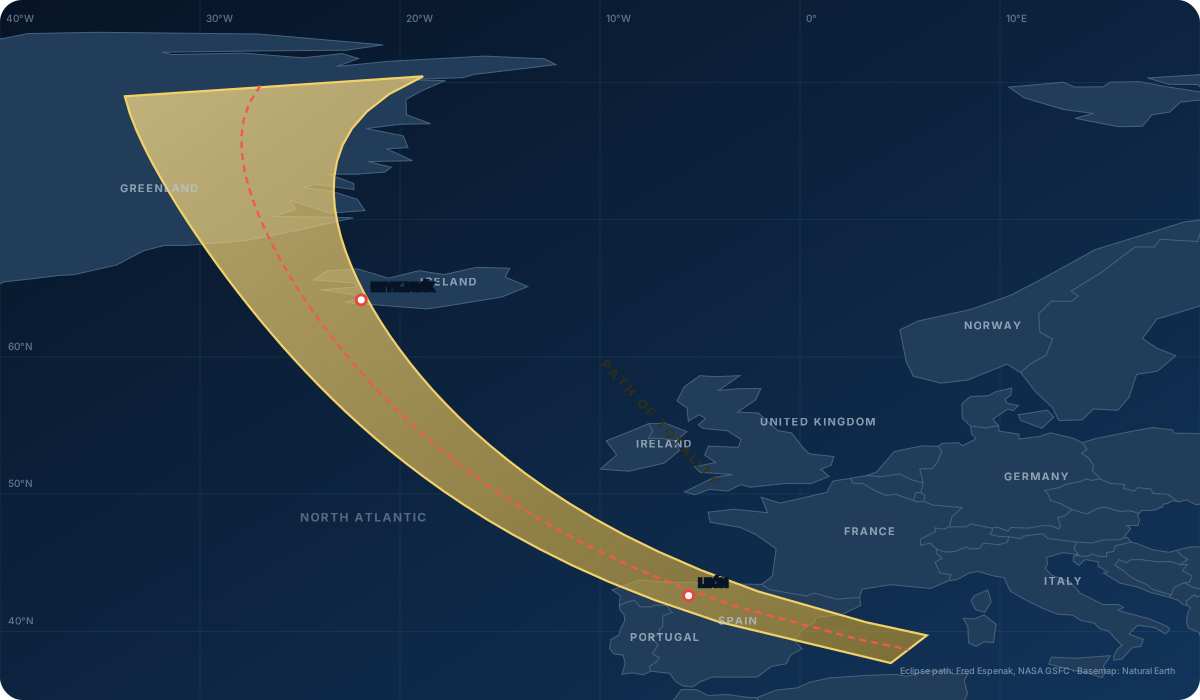
Where totality crosses Europe
The gold band follows NASA’s northern and southern limits. A selected location appears as a marker after you calculate it.
Regular sunglasses are not safe
Use viewers from a known manufacturer or an authorised dealer. Wear them throughout every partial phase. Only observers inside totality may briefly remove them after the Sun is completely covered, and they must go back on before bright sunlight reappears.
Read the AAS safe-viewer guidance →What makes this eclipse special?
Greenland, Iceland, Spain, and a small area of northeastern Portugal.
The longest central-line duration is over the North Atlantic and eastern Greenland region.
For much of Europe, this is the most significant solar eclipse viewing opportunity in decades.
2026 eclipse FAQ
Times are calculated for the coordinates you select. Always allow for local terrain, horizon visibility, and last-minute weather changes.
Where is the 2026 eclipse total?
The path of totality crosses parts of Greenland, western Iceland, northern Spain, and a small part of northeastern Portugal. Surrounding regions see a partial eclipse.
Why do two nearby cities get different results?
Totality is a narrow moving shadow. A few kilometres can change the duration near its edge, while locations outside the band remain partial.
Are the times exact?
The calculator uses a tested astronomy engine and WGS 84 coordinates. NASA notes that the lunar limb and terrain can shift path limits by roughly 1–3 km and contact times by a few seconds.
When will cloud information appear?
MET Norway provides forecasts up to nine days ahead. The event card updates automatically once 12 August enters that window and remains secondary to local official forecasts.
Can I look through a phone or camera?
Optical devices require a proper solar filter fitted over the front aperture. Eclipse glasses alone do not protect your eyes when looking through binoculars, telescopes, or camera viewfinders.
Local circumstances are calculated in the browser with Astronomy Engine 2.1.19. The displayed totality band reproduces coordinates from “Eclipse Predictions by Fred Espenak, NASA’s GSFC.” Safety guidance links to the American Astronomical Society. Weather data, when available, is credited to MET Norway.