The electric vehicle revolution is no longer coming.
It is already here.
Across North America, Europe, Asia, and the Middle East, governments, consumers, and manufacturers are accelerating the transition away from traditional internal combustion engines toward electric transportation.
At the center of this transformation stand two companies that increasingly dominate the global EV conversation:
Tesla and BYD.
For years, Tesla was viewed as the undisputed leader of the electric vehicle industry.
Founded by entrepreneurs determined to accelerate sustainable transportation, Tesla transformed EVs from niche products into desirable mainstream vehicles.
BYD, meanwhile, followed a different path.
Rather than focusing primarily on premium electric vehicles, the Chinese manufacturer built a vast industrial ecosystem spanning batteries, buses, passenger vehicles, energy storage systems, and electric mobility solutions.
Today, the competition between Tesla and BYD is no longer simply about cars.
It is about technology, manufacturing, batteries, software, global expansion, energy systems, autonomous driving, and the future of transportation itself.
Both companies sell millions of vehicles.
Both invest billions in research and development.
Both are shaping how the world moves.
The question is no longer whether Tesla or BYD will influence the future.
The question is which company is better positioned to lead it.
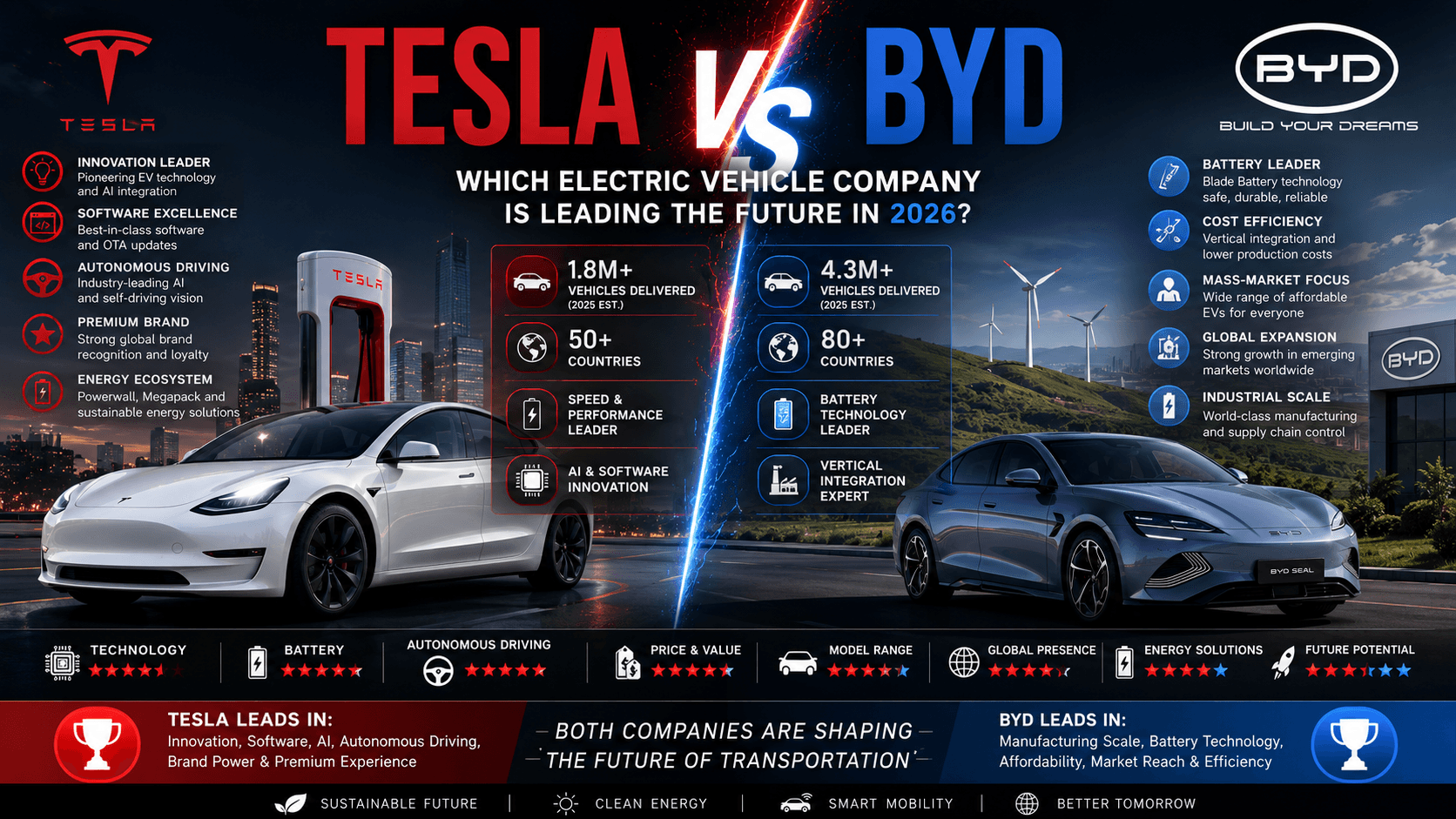
Tesla vs BYD at a Glance
| Category | Tesla | BYD |
|---|---|---|
| Founded | 2003 | 1995 |
| Headquarters | United States | China |
| Core Business | EVs, Software, Energy | EVs, Batteries, Energy |
| Global Brand Recognition | Excellent | Strong |
| EV Innovation | Excellent | Strong |
| Battery Manufacturing | Strong | Excellent |
| Autonomous Driving | Excellent | Moderate |
| Vehicle Variety | Moderate | Excellent |
| Global Expansion | Excellent | Strong |
| Vertical Integration | Strong | Excellent |
The Fundamental Difference Between Tesla and BYD
Many people compare Tesla and BYD as if they are pursuing identical strategies.
In reality, they are building very different businesses.
Tesla views itself as a technology company that happens to manufacture cars.
BYD views itself as an industrial ecosystem company that happens to manufacture vehicles.
This distinction influences every aspect of their operations.
Strategic Comparison
| Factor | Tesla | BYD |
|---|---|---|
| Technology Focus | Excellent | Strong |
| Manufacturing Focus | Strong | Excellent |
| Software Development | Excellent | Strong |
| Battery Integration | Strong | Excellent |
| Vehicle Portfolio | Moderate | Excellent |
| Energy Ecosystem | Excellent | Excellent |
| Global Branding | Excellent | Strong |
| Cost Leadership | Moderate | Excellent |
Tesla often prioritizes innovation and software.
BYD often prioritizes scale and manufacturing efficiency.
Both approaches have proven successful.
Market Position in 2026
The global EV industry has changed dramatically.
A few years ago, Tesla dominated discussions surrounding electric vehicles.
Today, BYD has emerged as one of the largest EV manufacturers in the world.
This shift reflects broader changes occurring throughout the automotive industry.
Market Position Comparison
| Category | Tesla | BYD |
|---|---|---|
| Premium EV Segment | Excellent | Strong |
| Mass Market EV Segment | Strong | Excellent |
| Emerging Markets | Moderate | Excellent |
| Brand Prestige | Excellent | Strong |
| Production Scale | Strong | Excellent |
| Global Recognition | Excellent | Strong |
| Market Momentum | Strong | Excellent |
Why BYD’s Growth Matters
BYD’s rise represents more than corporate success.
It demonstrates the increasing importance of manufacturing scale and battery control.
Unlike many automakers that rely heavily on external suppliers, BYD produces a significant portion of its own components.
This creates advantages in:
- Cost control
- Supply chain stability
- Production efficiency
- Battery availability
These advantages become increasingly important as EV demand grows.
Vehicle Portfolio Comparison
One of the largest differences between Tesla and BYD is product diversity.
Tesla maintains a relatively focused lineup.
BYD offers a much broader range of vehicles.
Vehicle Lineup Comparison
| Vehicle Category | Tesla | BYD |
|---|---|---|
| Compact Cars | Limited | Excellent |
| Sedans | Excellent | Excellent |
| SUVs | Excellent | Excellent |
| Luxury EVs | Strong | Strong |
| Budget EVs | Limited | Excellent |
| Commercial Vehicles | Limited | Strong |
| Electric Buses | No | Excellent |
| Fleet Solutions | Limited | Excellent |
Tesla’s Focused Approach
Tesla concentrates resources on a smaller number of models.
Benefits include:
- Simpler manufacturing
- Stronger software integration
- Easier updates
- Production efficiency
However, it limits market coverage.
BYD’s Diversified Approach
BYD targets:
- Budget buyers
- Families
- Fleet operators
- Public transportation systems
- Commercial customers
This broader strategy allows BYD to participate in more market segments.
Design Philosophy
Vehicle design remains one of the most visible differences between the two companies.
Tesla emphasizes:
- Minimalism
- Clean interiors
- Large touchscreens
- Software-first experiences
BYD emphasizes:
- Traditional comfort
- Feature-rich cabins
- Practical usability
- Market-specific preferences
Design Comparison
| Design Factor | Tesla | BYD |
|---|---|---|
| Interior Minimalism | Excellent | Moderate |
| Technology Appearance | Excellent | Strong |
| Traditional Controls | Limited | Strong |
| Cabin Features | Strong | Excellent |
| User Familiarity | Moderate | Excellent |
| Premium Feel | Excellent | Strong |
Different Customer Priorities
Tesla appeals strongly to buyers who want a futuristic experience.
BYD often appeals to buyers who want a balance between modern technology and traditional automotive comfort.
Neither philosophy is universally better.
They simply target different audiences.
Battery Technology: The Heart of the EV Industry
If electric vehicles have a single defining technology, it is batteries.
Battery performance influences:
- Range
- Safety
- Charging speed
- Cost
- Reliability
- Vehicle pricing
This is one area where BYD possesses a unique advantage.
Battery Comparison
| Battery Factor | Tesla | BYD |
|---|---|---|
| Battery Innovation | Excellent | Excellent |
| Manufacturing Scale | Strong | Excellent |
| Vertical Integration | Strong | Excellent |
| Safety Focus | Strong | Excellent |
| Cost Efficiency | Strong | Excellent |
| Energy Storage Expertise | Excellent | Excellent |
BYD’s Battery Advantage
BYD began as a battery company before becoming a major automaker.
This history gives it deep expertise in battery production.
The company controls a larger portion of its battery supply chain than many competitors.
This can provide significant advantages during periods of high demand.
Manufacturing and Production Scale
Modern automotive competition is increasingly determined by manufacturing capability.
The company that can efficiently produce millions of vehicles often gains a substantial advantage.
Manufacturing Comparison
| Manufacturing Factor | Tesla | BYD |
|---|---|---|
| Production Efficiency | Excellent | Excellent |
| Factory Scale | Excellent | Excellent |
| Supply Chain Control | Strong | Excellent |
| Manufacturing Flexibility | Strong | Excellent |
| Cost Efficiency | Strong | Excellent |
| Production Growth Potential | Strong | Excellent |
Why Manufacturing Matters
The EV industry is no longer constrained primarily by demand.
The challenge increasingly involves:
- Producing enough vehicles
- Securing batteries
- Managing costs
- Expanding capacity
Companies that solve these problems effectively gain enormous competitive advantages.
Pricing Strategy
Pricing remains one of the most important drivers of EV adoption.
Many consumers support electric vehicles in principle but remain highly sensitive to cost.
Pricing Comparison
| Pricing Factor | Tesla | BYD |
|---|---|---|
| Premium Segment | Excellent | Strong |
| Budget Segment | Moderate | Excellent |
| Entry-Level Access | Moderate | Excellent |
| Fleet Pricing | Limited | Excellent |
| Value for Money | Strong | Excellent |
| Market Accessibility | Strong | Excellent |
Why Pricing May Decide the EV Race
The next billion EV buyers are unlikely to be luxury customers.
They will be:
- Middle-class consumers
- Fleet operators
- Small businesses
- Developing markets
BYD’s pricing strategy positions it strongly for this phase of market expansion.
Early Assessment
After evaluating company strategy, market position, manufacturing scale, battery expertise, vehicle diversity, design philosophy, and pricing strategy, several trends are already visible.
Tesla continues to dominate in:
- Brand prestige
- Software
- Innovation
- Global recognition
- Technology perception
BYD continues to dominate in:
- Manufacturing scale
- Vehicle variety
- Battery integration
- Cost efficiency
- Mass-market accessibility
The next phase of this comparison will examine software, autonomous driving, charging infrastructure, ownership experience, reliability, profitability, global expansion, and long-term leadership potential before determining which company is best positioned to shape the future of electric transportation.
Software and User Experience: The Biggest Competitive Advantage
For more than a century, automakers competed primarily through:
- Engine performance
- Manufacturing quality
- Design
- Reliability
The electric vehicle era has fundamentally changed the rules.
Today, software increasingly determines how drivers experience their vehicles.
This is one of the most important reasons Tesla became a global phenomenon.
Tesla does not simply sell cars.
It sells a software-driven transportation platform.
BYD, meanwhile, has dramatically improved its software capabilities but continues to approach vehicle design from a more traditional automotive perspective.
Software Comparison
| Software Factor | Tesla | BYD |
|---|---|---|
| Operating System Integration | Excellent | Strong |
| User Interface | Excellent | Strong |
| Over-the-Air Updates | Excellent | Strong |
| App Ecosystem | Excellent | Moderate |
| Software Innovation | Excellent | Strong |
| Digital Experience | Excellent | Strong |
| Smartphone Integration | Strong | Strong |
| Future Software Potential | Excellent | Strong |
Why Software Matters More Every Year
Modern EV owners increasingly interact with software every time they drive.
Examples include:
- Navigation
- Charging planning
- Entertainment
- Vehicle settings
- Driver assistance
- Energy management
The smoother these systems become, the more valuable the vehicle becomes over time.
Tesla has built much of its reputation around this principle.
Over-the-Air Updates
Traditional vehicles often remain largely unchanged after purchase.
Tesla helped popularize a different model.
Vehicles can continuously improve through software updates.
OTA Update Comparison
| OTA Factor | Tesla | BYD |
|---|---|---|
| Update Frequency | Excellent | Strong |
| Feature Expansion | Excellent | Moderate |
| Performance Improvements | Excellent | Moderate |
| User Experience Enhancements | Excellent | Strong |
| Long-Term Vehicle Evolution | Excellent | Strong |
Why OTA Updates Are Revolutionary
Imagine purchasing a vehicle and receiving:
- Improved efficiency
- New features
- Better navigation
- Enhanced safety systems
years after the original purchase.
This changes the ownership experience dramatically.
Many Tesla owners view their vehicles more like smartphones than traditional cars.
Autonomous Driving and Driver Assistance
Perhaps no topic generates more debate in the EV industry than autonomous driving.
Both Tesla and BYD are investing heavily in advanced driver assistance systems.
However, their ambitions differ significantly.
Autonomous Driving Comparison
| Factor | Tesla | BYD |
|---|---|---|
| Autonomous Vision | Excellent | Strong |
| Driver Assistance | Excellent | Strong |
| AI Integration | Excellent | Moderate |
| Software Development | Excellent | Strong |
| Data Collection Scale | Excellent | Moderate |
| Long-Term Self-Driving Potential | Excellent | Strong |
Tesla’s Autonomous Driving Strategy
Tesla believes that artificial intelligence and massive amounts of real-world driving data can eventually create highly capable autonomous systems.
The company’s strategy focuses heavily on:
- Machine learning
- Computer vision
- AI training
- Fleet-generated driving data
This approach has become one of Tesla’s defining characteristics.
BYD’s Approach
BYD continues to expand driver assistance capabilities while maintaining a broader focus on affordability, manufacturing scale, and vehicle accessibility.
Its priorities are often more balanced across multiple business areas.
Charging Infrastructure
One of the biggest concerns for EV buyers remains charging.
Questions often include:
- How quickly can I charge?
- Where can I charge?
- How convenient is charging?
The answers strongly influence adoption.
Charging Comparison
| Charging Factor | Tesla | BYD |
|---|---|---|
| Charging Ecosystem | Excellent | Strong |
| Fast Charging Capability | Excellent | Strong |
| Charging Convenience | Excellent | Strong |
| Charging Network Recognition | Excellent | Moderate |
| Long-Distance Travel Confidence | Excellent | Strong |
Why Charging Infrastructure Matters
Many potential buyers experience range anxiety.
A strong charging ecosystem helps eliminate this concern.
The easier charging becomes, the easier EV adoption becomes.
Tesla’s charging reputation remains one of its strongest competitive advantages in many regions.
Driving Experience
The driving experience remains one of the most emotional aspects of vehicle ownership.
Even in the EV era, consumers still care about:
- Acceleration
- Comfort
- Handling
- Responsiveness
- Quietness
Driving Experience Comparison
| Driving Factor | Tesla | BYD |
|---|---|---|
| Acceleration | Excellent | Strong |
| Performance Feel | Excellent | Strong |
| Handling | Excellent | Strong |
| Ride Comfort | Strong | Excellent |
| Daily Usability | Excellent | Excellent |
| Driver Engagement | Excellent | Strong |
Tesla’s Performance Reputation
Tesla helped redefine expectations regarding EV performance.
Many consumers were surprised to discover that electric vehicles could outperform traditional sports cars in acceleration.
This performance advantage played a major role in changing public perception of EVs.
BYD’s Strength
BYD often focuses more heavily on comfort, practicality, and value.
For many consumers, these qualities matter more than extreme performance.
Reliability and Ownership Experience
Consumers purchasing vehicles often keep them for years.
Therefore, reliability becomes one of the most important purchasing factors.
Reliability Comparison
| Ownership Factor | Tesla | BYD |
|---|---|---|
| Mechanical Simplicity | Excellent | Excellent |
| Battery Reliability | Strong | Excellent |
| Ownership Costs | Strong | Excellent |
| Maintenance Requirements | Excellent | Excellent |
| Daily Reliability | Strong | Excellent |
| Long-Term Durability | Strong | Excellent |
Why Reliability Is Becoming More Important
As EV adoption moves beyond early adopters, mainstream consumers increasingly prioritize:
- Durability
- Predictability
- Maintenance costs
- Long-term ownership value
Companies that excel in these areas will gain significant advantages.
Cost of Ownership
The purchase price is only one component of total ownership cost.
Drivers must also consider:
- Charging costs
- Maintenance
- Repairs
- Insurance
- Depreciation
Ownership Cost Comparison
| Cost Factor | Tesla | BYD |
|---|---|---|
| Purchase Price | Strong | Excellent |
| Energy Efficiency | Excellent | Strong |
| Maintenance Costs | Excellent | Excellent |
| Battery Value | Strong | Excellent |
| Total Cost of Ownership | Strong | Excellent |
| Budget Accessibility | Moderate | Excellent |
Why Total Cost Matters
For many households, affordability ultimately determines purchasing decisions.
A vehicle that saves money over many years may become significantly more attractive than one with higher upfront costs.
BYD’s strength in cost efficiency positions it strongly in this category.
Global Expansion Strategy
The EV race is increasingly global.
Success can no longer be measured solely in domestic markets.
Global Expansion Comparison
| Expansion Factor | Tesla | BYD |
|---|---|---|
| North America | Excellent | Moderate |
| Europe | Excellent | Strong |
| Asia | Strong | Excellent |
| Emerging Markets | Strong | Excellent |
| Brand Awareness | Excellent | Strong |
| Global Presence | Excellent | Strong |
Different Expansion Models
Tesla often expands through strong brand positioning and premium market penetration.
BYD often expands through scale, affordability, and broader market accessibility.
Both strategies have produced impressive results.
Profitability and Financial Strength
Long-term industry leadership requires more than strong products.
It requires sustainable financial performance.
Financial Comparison
| Financial Factor | Tesla | BYD |
|---|---|---|
| Profitability Potential | Excellent | Strong |
| Manufacturing Scale | Strong | Excellent |
| Revenue Diversification | Strong | Excellent |
| Battery Business Strength | Moderate | Excellent |
| Energy Storage Business | Excellent | Excellent |
| Long-Term Stability | Excellent | Excellent |
Beyond Cars
Both companies are increasingly becoming energy companies.
Their businesses now include:
- Energy storage
- Battery technology
- Grid solutions
- Renewable energy integration
This diversification may become increasingly important over the next decade.
Competitive Moats
A competitive moat is a sustainable advantage that is difficult for competitors to replicate.
Moat Comparison
| Competitive Advantage | Tesla | BYD |
|---|---|---|
| Brand Strength | Excellent | Strong |
| Software Ecosystem | Excellent | Strong |
| Autonomous Driving | Excellent | Strong |
| Battery Manufacturing | Strong | Excellent |
| Supply Chain Control | Strong | Excellent |
| Production Scale | Strong | Excellent |
| Global Recognition | Excellent | Strong |
Mid-Article Assessment
At this stage of the comparison, Tesla continues to dominate in:
- Software
- User experience
- Brand prestige
- Autonomous driving
- Innovation perception
- Performance
BYD continues to dominate in:
- Battery manufacturing
- Vehicle variety
- Production scale
- Cost efficiency
- Supply chain control
- Mass-market accessibility
The competition is becoming increasingly fascinating because each company excels in areas where the other is relatively weaker.
The next analysis will examine battery safety, energy storage, environmental impact, fleet adoption, government influence, future technologies, investor perspectives, and long-term industry leadership before determining which company is truly leading the future of electric transportation in 2026.
Battery Safety: The Most Important Technology in Electric Vehicles
When most consumers compare electric vehicles, they focus on:
- Range
- Performance
- Price
- Design
However, industry experts often focus on something far more important:
Battery safety.
A battery is not only the most expensive component in an electric vehicle.
It is also the component that determines:
- Reliability
- Vehicle lifespan
- Thermal stability
- Operating costs
- Consumer confidence
As EV adoption expands from early adopters to mainstream buyers, battery safety is becoming one of the industry’s most critical competitive factors.
Battery Safety Comparison
| Safety Factor | Tesla | BYD |
|---|---|---|
| Thermal Stability | Strong | Excellent |
| Fire Resistance | Strong | Excellent |
| Structural Protection | Excellent | Excellent |
| Battery Durability | Strong | Excellent |
| Safety Reputation | Strong | Excellent |
| Real-World Reliability | Strong | Excellent |
Why BYD Receives So Much Attention
BYD’s Blade Battery has become one of the most discussed battery technologies in the automotive industry.
Its design prioritizes:
- Structural integrity
- Thermal management
- Safety performance
- Longevity
This has helped BYD build a reputation for battery safety and reliability.
For fleet operators and family buyers, these factors can be as important as performance.
Battery Lifespan and Long-Term Ownership
A common concern among EV buyers is battery degradation.
Questions often include:
- How long will the battery last?
- How much range will be lost?
- Will replacement costs be high?
The answers influence resale value and consumer confidence.
Battery Longevity Comparison
| Longevity Factor | Tesla | BYD |
|---|---|---|
| Long-Term Reliability | Strong | Excellent |
| Cycle Life | Strong | Excellent |
| Degradation Resistance | Strong | Excellent |
| Daily Usage Durability | Excellent | Excellent |
| Fleet Suitability | Strong | Excellent |
| Long-Term Ownership Confidence | Strong | Excellent |
Why Longevity Matters
Many EVs now remain on the road for far longer than early critics predicted.
As the market matures, consumers increasingly evaluate vehicles as long-term assets rather than experimental technologies.
Manufacturers that demonstrate strong battery longevity gain a major competitive advantage.
Energy Storage: The Industry Beyond Vehicles
One of the biggest misconceptions about Tesla and BYD is that they are simply car companies.
In reality, both are becoming energy companies.
The future EV leader may not necessarily be the company that sells the most cars.
It may be the company that dominates the broader energy ecosystem.
Energy Business Comparison
| Energy Factor | Tesla | BYD |
|---|---|---|
| Residential Storage | Excellent | Strong |
| Commercial Storage | Excellent | Excellent |
| Utility Scale Projects | Excellent | Excellent |
| Battery Production | Strong | Excellent |
| Renewable Integration | Excellent | Excellent |
| Grid Solutions | Excellent | Strong |
Why Energy Storage Is Exploding
The rapid growth of:
- Solar power
- Wind power
- Distributed generation
creates increasing demand for energy storage.
Without storage, renewable energy faces limitations.
Both Tesla and BYD are investing heavily in solving this problem.
This could become a multi-trillion-dollar market during the coming decades.
Tesla Energy vs BYD Energy
Most investors and consumers focus almost entirely on vehicle sales.
However, the energy divisions of both companies may become equally important.
Energy Division Comparison
| Category | Tesla Energy | BYD Energy |
|---|---|---|
| Brand Recognition | Excellent | Moderate |
| Global Awareness | Excellent | Strong |
| Storage Deployment | Excellent | Excellent |
| Innovation Potential | Excellent | Strong |
| Manufacturing Scale | Strong | Excellent |
| Growth Potential | Excellent | Excellent |
The Bigger Picture
Transportation electrification and renewable energy expansion are deeply connected.
The company that succeeds in both areas may gain enormous advantages.
This is why many analysts increasingly evaluate Tesla and BYD as energy infrastructure companies rather than traditional automakers.
Environmental Impact and Sustainability
Electric vehicles are often promoted as environmentally friendly alternatives to traditional vehicles.
However, sustainability extends far beyond tailpipe emissions.
Key considerations include:
- Manufacturing emissions
- Battery production
- Resource sourcing
- Energy efficiency
- Recycling
Sustainability Comparison
| Sustainability Factor | Tesla | BYD |
|---|---|---|
| Renewable Energy Integration | Excellent | Strong |
| Manufacturing Efficiency | Strong | Excellent |
| Battery Recycling Potential | Strong | Strong |
| Carbon Reduction Impact | Excellent | Excellent |
| Clean Energy Ecosystem | Excellent | Excellent |
| Long-Term Sustainability Strategy | Excellent | Strong |
Why Sustainability Will Matter More
Governments worldwide are implementing stricter environmental regulations.
Consumers are increasingly considering sustainability when making purchasing decisions.
Companies that successfully combine profitability and sustainability may gain long-term advantages.
Fleet Adoption: The Next Major Battlefield
Private consumers are important.
Fleet operators may be even more important.
Large fleets include:
- Taxi companies
- Delivery services
- Logistics providers
- Government fleets
- Corporate fleets
- Public transportation systems
These buyers often purchase vehicles in large quantities.
Fleet Comparison
| Fleet Factor | Tesla | BYD |
|---|---|---|
| Fleet Affordability | Strong | Excellent |
| Commercial Solutions | Moderate | Excellent |
| Bus Electrification | Limited | Excellent |
| Logistics Adoption | Strong | Excellent |
| Government Fleet Appeal | Strong | Excellent |
| Fleet Expansion Potential | Strong | Excellent |
Why Fleets Matter
Winning a fleet contract can result in:
- Thousands of vehicle sales
- Long-term service relationships
- Stronger market presence
BYD’s broader vehicle portfolio provides significant advantages in this category.
Government Support and Policy Influence
Government policy continues to shape the EV industry.
Factors include:
- Subsidies
- Incentives
- Infrastructure spending
- Environmental regulations
- Industrial policies
Government Position Comparison
| Policy Factor | Tesla | BYD |
|---|---|---|
| Global Policy Alignment | Excellent | Excellent |
| Infrastructure Benefits | Excellent | Strong |
| Domestic Market Support | Strong | Excellent |
| Industrial Ecosystem Support | Strong | Excellent |
| Regulatory Adaptability | Excellent | Strong |
The Role of Governments
The EV transition is not occurring solely through market forces.
Government involvement remains substantial.
Companies capable of aligning with policy trends often gain strategic advantages.
Future Technologies
The next decade of EV competition may be determined by technologies that are still evolving.
These include:
- Artificial intelligence
- Autonomous driving
- Advanced batteries
- Vehicle-to-grid systems
- Smart energy networks
- Robotics
Future Technology Comparison
| Future Technology | Tesla | BYD |
|---|---|---|
| Artificial Intelligence | Excellent | Strong |
| Autonomous Driving | Excellent | Strong |
| Battery Innovation | Excellent | Excellent |
| Smart Energy Integration | Excellent | Strong |
| Robotics Potential | Excellent | Moderate |
| Software Evolution | Excellent | Strong |
Tesla’s Future Vision
Tesla’s long-term ambitions extend beyond vehicles.
The company increasingly positions itself around:
- AI
- Robotics
- Autonomous transportation
- Energy systems
This broad vision attracts significant investor attention.
BYD’s Future Vision
BYD’s strategy focuses on:
- Manufacturing leadership
- Battery leadership
- Affordable electrification
- Global transportation solutions
This approach may be less visible but remains extremely powerful.
Investor Perspective
Investors often evaluate companies differently than consumers.
Consumers ask:
“Which vehicle should I buy?”
Investors ask:
“Which company will create the most value over the next decade?”
Investment Perspective Comparison
| Investment Factor | Tesla | BYD |
|---|---|---|
| Brand Premium | Excellent | Strong |
| Growth Narrative | Excellent | Strong |
| Manufacturing Expansion | Strong | Excellent |
| Battery Leadership | Strong | Excellent |
| Software Potential | Excellent | Strong |
| Diversification | Excellent | Excellent |
| Long-Term Optionality | Excellent | Strong |
Why Investors Remain Divided
Tesla attracts investors who believe:
- AI will transform transportation.
- Software will create massive value.
- Autonomous driving will become reality.
BYD attracts investors who believe:
- Manufacturing scale wins.
- Batteries drive the future.
- Affordable EVs dominate global adoption.
Both arguments are compelling.
Strategic Assessment Before the Final Verdict
After examining:
- Battery safety
- Battery longevity
- Energy storage
- Sustainability
- Fleet adoption
- Government influence
- Future technologies
- Investment perspectives
the competition becomes even more balanced.
Tesla Continues to Lead In:
- Software
- Artificial intelligence
- Autonomous driving
- Brand prestige
- Innovation perception
- Technology ecosystem
- Future optionality
BYD Continues to Lead In:
- Battery manufacturing
- Cost efficiency
- Vehicle diversity
- Production scale
- Fleet adoption
- Supply chain control
- Mass-market reach
The final portion will determine which company is winning among consumers, governments, investors, and the broader transportation industry before delivering the ultimate verdict on whether Tesla or BYD is leading the future of electric mobility in 2026.
Consumer Perception: Which Brand Do Buyers Trust More?
Technology and manufacturing are important.
However, consumer perception often determines purchasing decisions long before a buyer visits a dealership.
People do not simply buy specifications.
They buy confidence.
They buy reputation.
They buy expectations.
This is one of Tesla’s greatest strengths.
Tesla has become one of the most recognizable automotive brands in the world despite being significantly younger than traditional manufacturers.
BYD has achieved remarkable growth, but consumer perception differs significantly across regions.
Brand Perception Comparison
| Brand Factor | Tesla | BYD |
|---|---|---|
| Global Recognition | Excellent | Strong |
| Innovation Reputation | Excellent | Strong |
| Technology Image | Excellent | Strong |
| Premium Perception | Excellent | Moderate |
| Mainstream Appeal | Strong | Excellent |
| Consumer Awareness | Excellent | Strong |
| Media Visibility | Excellent | Strong |
| Aspirational Value | Excellent | Moderate |
Why Brand Matters
A strong brand influences:
- Purchase decisions
- Resale value
- Customer loyalty
- Market expansion
- Investor confidence
Tesla’s brand often allows it to command attention far beyond its actual production numbers.
BYD increasingly commands respect because of execution and manufacturing strength.
Resale Value and Depreciation
Vehicle ownership extends beyond the initial purchase.
Many buyers consider:
- Future resale value
- Depreciation rates
- Long-term ownership economics
A vehicle that retains value effectively may be cheaper to own despite a higher purchase price.
Resale Value Comparison
| Resale Factor | Tesla | BYD |
|---|---|---|
| Global Demand | Excellent | Strong |
| Used Market Recognition | Excellent | Moderate |
| Brand Premium Retention | Excellent | Strong |
| International Resale Potential | Excellent | Strong |
| Consumer Confidence | Excellent | Strong |
| Long-Term Value Preservation | Strong | Strong |
Why Depreciation Matters
For many households, depreciation represents the largest ownership cost.
A vehicle losing value rapidly can become far more expensive than expected.
Tesla historically benefited from strong demand and brand strength.
BYD’s growing market presence may improve resale performance over time.
The Battle for Emerging Markets
The future EV industry will not be decided only in:
- United States
- Germany
- United Kingdom
- Norway
It will increasingly be decided in:
- India
- Southeast Asia
- Latin America
- Africa
- Middle East
These markets represent hundreds of millions of future vehicle buyers.
Emerging Market Comparison
| Market Factor | Tesla | BYD |
|---|---|---|
| Affordability | Moderate | Excellent |
| Market Accessibility | Strong | Excellent |
| Fleet Opportunities | Strong | Excellent |
| Government Projects | Strong | Excellent |
| Public Transportation Opportunities | Limited | Excellent |
| Growth Potential | Strong | Excellent |
Why Emerging Markets Are Critical
The next wave of EV growth may come from consumers purchasing their first electric vehicle rather than upgrading from one EV to another.
Price sensitivity becomes dramatically more important in these markets.
This favors manufacturers capable of delivering strong value at lower costs.
Luxury EV Segment
The luxury market remains highly profitable.
While it represents a smaller portion of total vehicle sales, it often generates significant margins.
Luxury Segment Comparison
| Luxury Factor | Tesla | BYD |
|---|---|---|
| Premium Branding | Excellent | Strong |
| Technology Appeal | Excellent | Strong |
| Performance Reputation | Excellent | Strong |
| Luxury Recognition | Excellent | Moderate |
| Global Prestige | Excellent | Moderate |
| Premium Market Influence | Excellent | Strong |
Tesla’s Luxury Advantage
Tesla helped redefine luxury.
Traditional luxury focused on:
- Leather
- Wood trim
- Mechanical craftsmanship
Tesla introduced a different concept:
- Software
- Performance
- Technology
- Digital experiences
This shift permanently changed consumer expectations.
Mass-Market EV Leadership
Luxury buyers attract headlines.
Mass-market buyers create volume.
The company that successfully serves millions of mainstream consumers may ultimately dominate the industry.
Mass-Market Comparison
| Mass Market Factor | Tesla | BYD |
|---|---|---|
| Affordability | Moderate | Excellent |
| Product Variety | Moderate | Excellent |
| Market Coverage | Strong | Excellent |
| Entry-Level Accessibility | Moderate | Excellent |
| Fleet Potential | Strong | Excellent |
| Volume Opportunity | Strong | Excellent |
Why Volume Matters
Large-scale adoption drives:
- Manufacturing efficiencies
- Cost reductions
- Infrastructure growth
- Market influence
BYD’s strategy aligns closely with mass-market expansion.
Supply Chain Resilience
The automotive industry has learned difficult lessons regarding supply chains.
Disruptions can affect:
- Production
- Pricing
- Deliveries
- Profitability
Companies with stronger control over critical components gain major advantages.
Supply Chain Comparison
| Supply Chain Factor | Tesla | BYD |
|---|---|---|
| Vertical Integration | Strong | Excellent |
| Battery Control | Strong | Excellent |
| Manufacturing Independence | Strong | Excellent |
| Supply Security | Strong | Excellent |
| Cost Management | Strong | Excellent |
| Production Stability | Strong | Excellent |
Why Vertical Integration Matters
The less a company depends on external suppliers, the greater its ability to:
- Control costs
- Maintain production
- Protect margins
BYD’s extensive vertical integration has become one of its strongest competitive advantages.
Innovation vs Execution
Perhaps the most interesting distinction between Tesla and BYD is that they represent two different paths to leadership.
Tesla represents innovation.
BYD represents execution.
Strategic Identity Comparison
| Strategic Factor | Tesla | BYD |
|---|---|---|
| Innovation Leadership | Excellent | Strong |
| Manufacturing Execution | Strong | Excellent |
| Technology Vision | Excellent | Strong |
| Operational Efficiency | Strong | Excellent |
| Industry Influence | Excellent | Strong |
| Scalability | Strong | Excellent |
Tesla’s Philosophy
Tesla asks:
“What can transportation become?”
BYD asks:
“How can transportation be electrified at scale?”
Both questions are important.
Both create different forms of leadership.
Which Company Is Better Positioned for the Next Decade?
The answer depends on how the future develops.
If the future is driven primarily by:
- Artificial intelligence
- Autonomous driving
- Software ecosystems
- Robotics
Tesla may have the advantage.
If the future is driven primarily by:
- Manufacturing scale
- Battery production
- Affordable vehicles
- Global electrification
BYD may have the advantage.
Future Readiness Comparison
| Future Factor | Tesla | BYD |
|---|---|---|
| AI Potential | Excellent | Strong |
| Software Leadership | Excellent | Strong |
| Autonomous Driving | Excellent | Strong |
| Battery Leadership | Strong | Excellent |
| Production Growth | Strong | Excellent |
| Global Electrification Potential | Strong | Excellent |
| Market Expansion Potential | Excellent | Excellent |
The Industry Transformation
The EV industry is still in its early stages.
The companies leading today may look very different by 2030.
What remains clear is that Tesla and BYD have established themselves as the two most influential pure-play EV leaders in the world.
Performance Scorecard Before the Final Verdict
After evaluating:
- Brand strength
- Consumer perception
- Resale value
- Luxury leadership
- Mass-market accessibility
- Emerging markets
- Supply chains
- Innovation
- Manufacturing
- Future readiness
the competition has become remarkably balanced.
Tesla Leads In:
- Brand prestige
- Software
- AI
- Autonomous driving
- Innovation
- Premium positioning
- Technology perception
- Global recognition
BYD Leads In:
- Battery manufacturing
- Cost efficiency
- Vehicle diversity
- Production scale
- Supply chain control
- Mass-market accessibility
- Fleet opportunities
- Emerging markets
The final analysis will determine which company offers the better vehicles for consumers, which company presents the stronger investment case, which company is shaping the EV industry more effectively, and ultimately which company is leading the future of transportation in 2026.
Final Verdict: Tesla vs BYD in 2026
After examining manufacturing, batteries, software, autonomous driving, energy storage, vehicle portfolios, pricing, global expansion, supply chains, profitability, sustainability, consumer perception, and future technologies, we can finally answer the central question:
Which company is leading the future of electric transportation in 2026?
The answer depends on how leadership is defined.
If leadership means technological influence, software innovation, artificial intelligence, autonomous driving ambitions, and global brand prestige, Tesla remains the benchmark.
If leadership means manufacturing scale, battery dominance, affordability, supply chain control, and accelerating EV adoption worldwide, BYD has emerged as arguably the strongest industrial force in the electric vehicle sector.
The reality is that both companies are winning—but in different ways.
Overall Comparison Scorecard
| Category | Winner |
|---|---|
| Brand Recognition | Tesla |
| Technology Image | Tesla |
| Software Experience | Tesla |
| User Interface | Tesla |
| Autonomous Driving | Tesla |
| AI Integration | Tesla |
| OTA Updates | Tesla |
| Global Prestige | Tesla |
| Premium EV Segment | Tesla |
| Innovation Leadership | Tesla |
| Battery Manufacturing | BYD |
| Battery Safety | BYD |
| Vehicle Variety | BYD |
| Cost Efficiency | BYD |
| Production Scale | BYD |
| Supply Chain Control | BYD |
| Fleet Solutions | BYD |
| Public Transportation | BYD |
| Mass-Market Accessibility | BYD |
| Emerging Market Potential | BYD |
Final Score
| Company | Categories Won |
|---|---|
| Tesla | 10 |
| BYD | 10 |
This perfectly illustrates why the competition is so fascinating.
Both companies dominate different parts of the EV ecosystem.
Best Company for Different Types of Buyers
Best for Technology Enthusiasts
Technology-focused buyers often prioritize:
- Software
- Automation
- AI
- Digital experiences
- Innovation
Winner: Tesla
Tesla remains one of the most technology-driven vehicle manufacturers in the world.
Its software ecosystem continues to influence the entire automotive industry.
Best for Value-Conscious Buyers
Many consumers prioritize:
- Affordability
- Practicality
- Ownership costs
- Reliability
Winner: BYD
BYD’s manufacturing scale and battery integration allow it to compete aggressively on value.
This makes it especially attractive to mainstream buyers.
Best for Families
Families often prioritize:
- Safety
- Affordability
- Reliability
- Comfort
Winner: BYD
The broader product lineup and strong safety reputation provide significant advantages.
Best for Luxury Buyers
Luxury consumers often seek:
- Premium experiences
- Brand prestige
- Technology
- Performance
Winner: Tesla
Tesla remains one of the strongest premium EV brands globally.
Best for Fleet Operators
Fleet buyers evaluate:
- Total cost of ownership
- Reliability
- Production capacity
- Vehicle availability
Winner: BYD
This is one of BYD’s strongest categories.
Its scale and product diversity make it highly attractive for large fleets.
Best for Emerging Markets
Emerging markets often prioritize:
- Affordability
- Accessibility
- Operating costs
Winner: BYD
Its cost structure aligns exceptionally well with these markets.
Best for Early Adopters
Early adopters typically seek:
- New technologies
- Software innovation
- Industry-leading features
Winner: Tesla
Tesla continues to define expectations for what modern EVs can become.
Which Company Has the Better Long-Term Strategy?
This question may ultimately determine the winner over the next decade.
Tesla’s Strategy
Tesla is building around:
- Artificial intelligence
- Software
- Autonomous driving
- Robotics
- Energy systems
Its vision extends far beyond automobiles.
The company increasingly behaves like a technology platform.
BYD’s Strategy
BYD is building around:
- Battery leadership
- Manufacturing scale
- Vertical integration
- Affordable electrification
- Global transportation solutions
Its vision focuses on industrial dominance.
Both strategies are powerful.
They simply attack the future from different directions.
Tesla’s Biggest Strength
Tesla’s greatest strength is not a specific vehicle.
It is perception.
The company successfully convinced the world that electric vehicles could be:
- Desirable
- Fast
- Innovative
- Aspirational
Before Tesla, EVs were often viewed as compromises.
After Tesla, EVs became objects of desire.
Few companies have changed an entire industry’s image so dramatically.
BYD’s Biggest Strength
BYD’s greatest strength is execution.
While much of the world focused on Tesla’s innovation, BYD quietly built:
- Battery factories
- Supply chains
- Manufacturing capacity
- Global production systems
This industrial foundation now provides enormous competitive advantages.
In many ways, BYD represents the manufacturing side of the EV revolution.
The Most Important Question: Who Is Actually Winning?
The answer depends on the metric.
If the Metric Is Technology
Winner: Tesla
If the Metric Is Production Scale
Winner: BYD
If the Metric Is Software
Winner: Tesla
If the Metric Is Battery Manufacturing
Winner: BYD
If the Metric Is Brand Prestige
Winner: Tesla
If the Metric Is Cost Efficiency
Winner: BYD
If the Metric Is Autonomous Driving Potential
Winner: Tesla
If the Metric Is Mass-Market Reach
Winner: BYD
If the Metric Is Future Transportation Vision
Winner: Tesla
If the Metric Is Global Electrification Execution
Winner: BYD
The reality is that no single metric fully captures leadership.
Frequently Asked Questions
Is BYD Bigger Than Tesla in 2026?
BYD has become one of the largest EV manufacturers in the world and competes directly with Tesla in overall production and market influence.
Is Tesla Still the EV Leader?
Tesla remains the global leader in software, brand recognition, and EV innovation.
However, leadership is no longer uncontested.
Why Is BYD Growing So Fast?
Key factors include:
- Battery expertise
- Manufacturing scale
- Cost efficiency
- Vertical integration
- Strong demand in multiple markets
Which Company Has Better Batteries?
Both companies are industry leaders.
BYD often receives particular recognition for battery safety and manufacturing capabilities.
Which Company Has Better Technology?
Tesla generally leads in software, AI integration, and autonomous driving ambitions.
Which Company Is Better for Investors?
This depends on whether an investor believes the future will be driven primarily by:
- Technology and AI (Tesla)
or
- Manufacturing and electrification scale (BYD)
Which Company Has Better Cars?
There is no universal answer.
Tesla often appeals to technology-focused buyers.
BYD often appeals to value-focused buyers.
Related Articles
- Tesla Model 3 vs BYD Seal: Which EV Is Better in 2026?
- iPhone vs Samsung: Which Smartphone Is Better in 2026?
- ChatGPT vs Google Gemini: Which AI Assistant Is Better in 2026?
- YouTube Premium vs Spotify Premium: Which Subscription Is Worth Your Money in 2026?
- Netflix vs Disney Plus: Which Streaming Service Is Better in 2026?
- USA vs Canada: Which Country Is Better to Live, Work, Study, and Immigrate to in 2026?
Conclusion
The electric vehicle industry has evolved beyond a simple race between companies.
It has become a competition between two philosophies.
Tesla represents innovation, software, artificial intelligence, and the vision of a highly automated future.
BYD represents manufacturing excellence, battery leadership, affordability, and the large-scale electrification of transportation.
Tesla changed how the world thinks about electric vehicles.
BYD is changing how the world produces them.
In 2026, Tesla remains the most influential EV technology company.
BYD has become the most formidable EV manufacturing powerhouse.
If your priority is cutting-edge technology, software, and future-focused innovation, Tesla remains the stronger choice.
If your priority is affordability, production scale, battery leadership, and global accessibility, BYD may be the stronger choice.
The most accurate conclusion is that the future of electric transportation is unlikely to be led by one company alone.
Tesla and BYD are shaping different parts of that future simultaneously.
Together, they are accelerating one of the most significant industrial transformations of the 21st century.