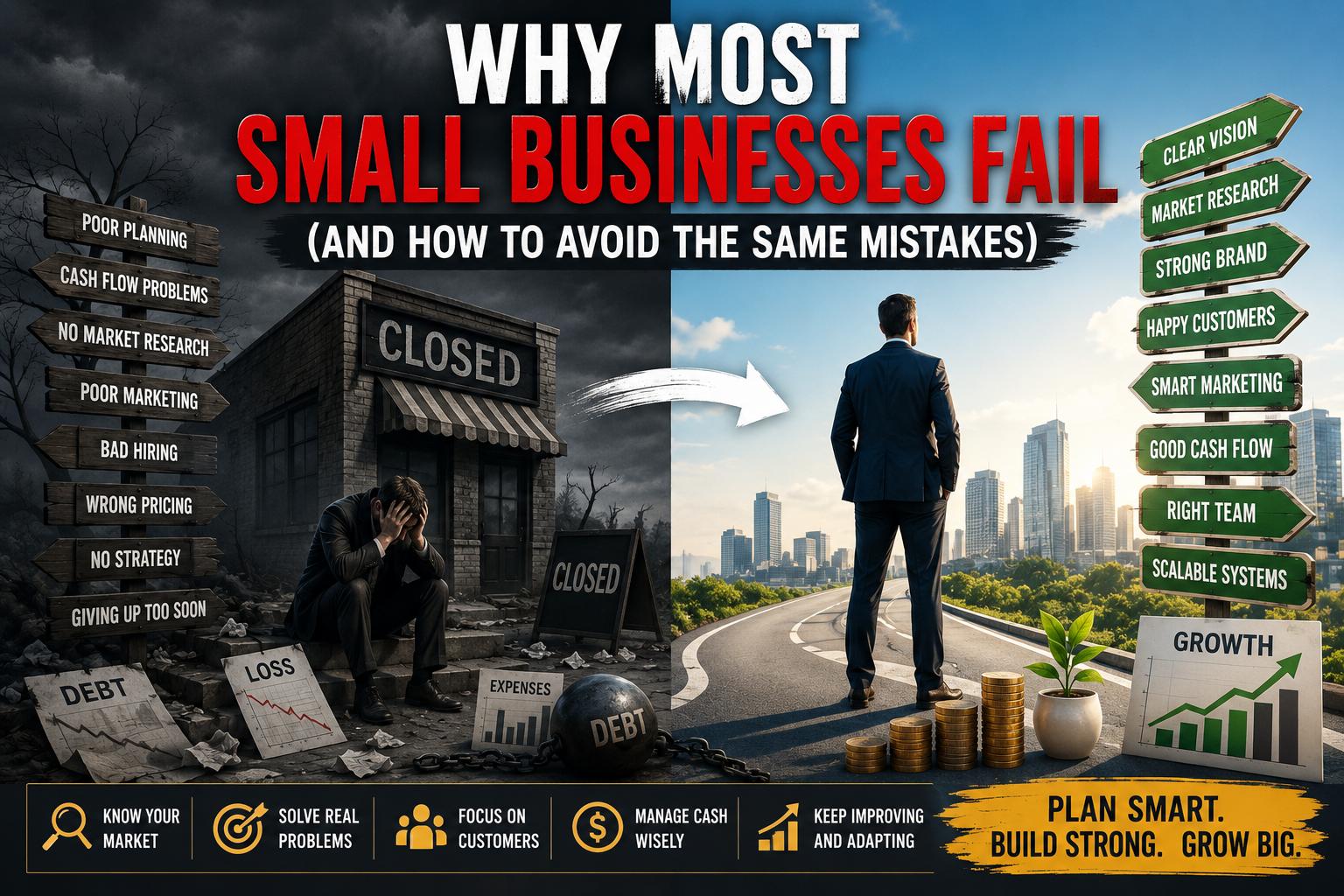
Introduction: The Hard Truth About Business Success
Every year, millions of people decide to start a business.
Some launch online stores.
Others open restaurants.
Some create consulting firms.
Others build software companies, agencies, websites, or local service businesses.
The motivation is usually similar.
Freedom.
Income.
Opportunity.
Control over one’s future.
The possibility of building something meaningful.
Yet despite the excitement surrounding entrepreneurship, there is an uncomfortable reality that many people prefer to ignore.
Most businesses fail.
Not after twenty years.
Not after ten years.
Many fail within the first few years.
Some fail within months.
This reality discourages many aspiring entrepreneurs.
However, it should not.
Because understanding why businesses fail is one of the most valuable lessons an entrepreneur can learn.
Failure is rarely random.
Businesses usually fail for predictable reasons.
And predictable problems can often be avoided.
Why Studying Failure Is More Valuable Than Studying Success
When people study successful companies, they often focus on outcomes.
Revenue.
Growth.
Famous founders.
Media attention.
Large valuations.
The problem is that success stories can be misleading.
Many successful businesses benefited from:
- Timing
- Market conditions
- Luck
- Capital access
- Existing networks
Failure often provides clearer lessons.
When hundreds of businesses collapse for the same reasons, patterns emerge.
Those patterns become valuable.
This article focuses on those patterns.
Because avoiding catastrophic mistakes is often more important than finding a magical growth strategy.
The Entrepreneurial Myth
Many people imagine entrepreneurship as a straight line.
Idea.
Launch.
Growth.
Profit.
Success.
Reality looks very different.
Most businesses experience:
- Uncertainty
- Mistakes
- Setbacks
- Unexpected costs
- Customer problems
- Competitive pressure
- Slow growth
The journey is rarely smooth.
Understanding this reality creates realistic expectations.
Realistic expectations improve decision-making.
The Most Dangerous Assumption in Business
The single most dangerous assumption an entrepreneur can make is:
“If I build it, customers will come.”
History repeatedly proves otherwise.
Customers do not automatically appear because a product exists.
People are overwhelmed with choices.
Attention is limited.
Trust must be earned.
Demand must be created or captured.
Many businesses fail because founders spend months building products before verifying whether customers actually want them.
This mistake can be devastating.
What Business Actually Is
Many people misunderstand the nature of business.
A business is not:
- A website
- A logo
- A product
- A social media account
- An office
Those things may help.
But they are not the business.
A business is a system that solves a valuable problem for customers profitably.
Everything else is secondary.
This definition may seem simple.
Yet it explains why some companies succeed while others struggle.
The companies that consistently solve valuable problems usually survive.
The companies that fail to create enough value often disappear.
The Five Foundations Every Successful Business Needs
Regardless of industry, geography, or size, nearly every successful business depends on five foundations.
1. Demand
People must genuinely want what you offer.
2. Value
Your solution must be worth paying for.
3. Profitability
Revenue must exceed costs over time.
4. Execution
Ideas are worthless without implementation.
5. Adaptability
Markets change.
Businesses must evolve.
Weakness in any of these areas creates risk.
Weakness in multiple areas often creates failure.
Why Great Products Still Fail
One of the most surprising realities in business is that great products fail all the time.
Many entrepreneurs believe product quality guarantees success.
Unfortunately, it does not.
A great product with poor distribution often loses to an average product with excellent distribution.
Consider the following questions:
Do customers know you exist?
Can they find you?
Do they trust you?
Can they understand your value quickly?
Can they buy easily?
If the answer to these questions is no, even an outstanding product may struggle.
This explains why marketing, sales, and positioning matter so much.
The Hidden Importance of Customer Problems
The most successful businesses are often obsessed with customer problems.
Many failing businesses become obsessed with their own ideas.
This difference is critical.
A founder may love an idea.
Customers do not care about ideas.
Customers care about outcomes.
They ask:
Will this save me time?
Will this save me money?
Will this reduce risk?
Will this improve my life?
Will this help my business grow?
The stronger the problem, the stronger the opportunity.
This is why solving painful problems tends to be more profitable than solving minor inconveniences.
Why Most Entrepreneurs Focus on the Wrong Things
When new entrepreneurs start businesses, they often focus on:
- Business cards
- Branding
- Logos
- Office space
- Company names
- Website colors
These elements can matter.
But they are not usually what determines success.
Customers rarely buy because of a logo.
Customers buy because of value.
The fundamentals matter more:
- Customer acquisition
- Retention
- Profit margins
- Product quality
- Market demand
Founders who focus on fundamentals often outperform founders who focus on appearance.
The Reality of Competition
Many entrepreneurs fear competition.
Ironically, competition is often a positive sign.
Competition frequently indicates demand.
If many companies exist in a market, customers are probably spending money there.
The real question is not:
“Is there competition?”
The real question is:
“Can I create enough value to compete effectively?”
Competition should be studied.
Not feared.
The strongest businesses often understand competitors better than competitors understand themselves.
Why Timing Matters More Than People Realize
A great business launched at the wrong time can fail.
An average business launched at the right time can thrive.
Timing affects:
- Consumer behavior
- Technology adoption
- Economic conditions
- Regulation
- Market readiness
Many founders underestimate timing.
Yet it frequently influences outcomes.
Some opportunities arrive years too early.
Others arrive years too late.
Recognizing timing is one of the most difficult entrepreneurial skills.
The Most Important Question Every Entrepreneur Should Ask
Before investing significant time, money, or energy into a business, ask:
“What problem am I solving, and why does that problem matter enough for someone to pay me?”
This question appears simple.
Yet it can prevent countless mistakes.
Businesses ultimately survive because they create value.
The clearer the value, the stronger the foundation.
Coming Next
In the next section, we will analyze the first five major reasons small businesses fail.
We will examine real-world business mistakes involving cash flow, poor market research, weak sales systems, bad pricing strategies, and customer acquisition problems.
Most importantly, we will explore practical ways to avoid these mistakes before they become fatal.
The First Five Reasons Small Businesses Fail
Most businesses do not collapse because of one catastrophic event.
They fail because of a series of mistakes that slowly weaken the company until survival becomes difficult.
This is important to understand.
Business failure is usually a process.
Not an event.
The encouraging news is that many of these mistakes are predictable.
And predictable mistakes can often be prevented.
Let’s examine the first five reasons why small businesses fail and how successful companies avoid them.
Reason #1: Running Out of Cash
If there is one reason responsible for more business failures than any other, it is cash flow problems.
Many entrepreneurs believe profit is the most important financial metric.
Profit matters.
Cash matters more.
A company can appear profitable on paper and still fail because it runs out of cash.
Understanding the Difference
Imagine a company sells $100,000 worth of products.
Customers promise payment in 90 days.
Meanwhile, the company must immediately pay:
- Salaries
- Rent
- Suppliers
- Utilities
- Marketing
- Taxes
The business may technically be profitable.
But if cash does not arrive quickly enough, survival becomes difficult.
This is why experienced entrepreneurs constantly monitor cash flow.
Why Cash Flow Kills Businesses
Businesses often die because:
- Customers pay late
- Expenses rise unexpectedly
- Growth requires more working capital
- Inventory consumes cash
- Debt payments increase
- Revenue becomes inconsistent
Many founders focus entirely on sales.
Smart founders monitor cash.
Because businesses rarely die from accounting.
They die from running out of money.
How Successful Businesses Protect Cash
Strong companies often:
- Maintain cash reserves
- Forecast future expenses
- Avoid unnecessary debt
- Negotiate favorable payment terms
- Monitor monthly cash flow
Cash provides flexibility.
Flexibility increases survival odds.
Reason #2: Building Something Nobody Wants
Many entrepreneurs fall in love with ideas.
Customers care about solutions.
This difference destroys countless businesses.
Founders often spend months or years building products before validating demand.
They assume people will buy.
Then reality arrives.
Customers show little interest.
Why This Happens
Founders frequently ask:
“Can I build this?”
Instead of asking:
“Should I build this?”
The first question focuses on capability.
The second focuses on demand.
Demand determines success.
The Market Validation Principle
Before building anything significant, smart entrepreneurs test demand.
They seek evidence.
Examples include:
- Customer interviews
- Surveys
- Pre-orders
- Pilot projects
- Small launches
- Market research
These activities reduce risk.
The goal is simple:
Discover whether customers truly care before investing heavily.
The Pain Principle
The strongest businesses solve painful problems.
Customers rarely pay significant amounts to solve minor inconveniences.
The more expensive, frustrating, risky, or time-consuming the problem, the stronger the opportunity.
Businesses that solve urgent problems usually grow faster than businesses that solve optional problems.
Reason #3: Weak Customer Acquisition
Many businesses fail even though their product is excellent.
The reason?
Customers never discover it.
This is one of the harsh realities of entrepreneurship.
Being the best does not guarantee visibility.
The Visibility Problem
Imagine two companies.
Company A has a fantastic product.
Company B has an average product.
Company B has superior marketing.
In many cases, Company B wins.
Why?
Because customers cannot buy what they cannot see.
The Three Growth Engines
Most successful businesses eventually master one or more of these:
Organic Acquisition
Examples:
- SEO
- Content marketing
- Social media
- Referrals
Paid Acquisition
Examples:
- Google Ads
- Facebook Ads
- LinkedIn Ads
- Sponsored campaigns
Partnership Acquisition
Examples:
- Strategic partnerships
- Affiliates
- Distributors
- Industry relationships
The specific channel matters less than consistency.
Businesses without customer acquisition systems often struggle regardless of product quality.
The Business Equation Most Entrepreneurs Ignore
No customers.
No revenue.
No business.
It is really that simple.
Customer acquisition is not optional.
It is survival.
Reason #4: Poor Pricing Strategy
Pricing mistakes destroy profitability.
Many entrepreneurs make one of two errors.
They charge too little.
Or they charge too much without providing enough value.
Why Underpricing Is Dangerous
New businesses often fear losing customers.
As a result, they reduce prices excessively.
This creates several problems.
Lower profit margins.
Less cash available for growth.
Lower perceived value.
More difficulty hiring talent.
Greater financial pressure.
Ironically, underpricing often creates more risk than premium pricing.
Why Customers Do Not Always Buy the Cheapest Option
People frequently assume buyers choose the lowest price.
Reality is more complicated.
Customers evaluate:
- Trust
- Reliability
- Quality
- Reputation
- Convenience
- Service
Price is only one factor.
In many industries, customers willingly pay more when they believe they are reducing risk.
The Value-Based Pricing Mindset
Successful businesses often focus on value rather than cost.
They ask:
“What is the outcome worth to the customer?”
This perspective frequently leads to stronger pricing decisions.
Reason #5: Founders Who Refuse to Adapt
The marketplace changes continuously.
Technology changes.
Customer preferences change.
Competitors change.
Economic conditions change.
Businesses that refuse to evolve often struggle.
The Adaptation Advantage
Many famous companies survived because they adapted.
Not because they were perfect.
The ability to change direction when necessary is often more important than having the perfect original plan.
Why Entrepreneurs Resist Change
Several psychological factors contribute:
- Ego
- Attachment to ideas
- Fear of failure
- Confirmation bias
- Emotional investment
These forces make adaptation difficult.
Yet adaptability remains one of the strongest predictors of long-term success.
The Most Dangerous Phrase in Business
“We’ve always done it this way.”
History shows that industries can transform rapidly.
Businesses that remain flexible often survive.
Businesses that become rigid often face increasing challenges.
Why Smart Businesses Think Like Scientists
Many entrepreneurs think like gamblers.
Successful entrepreneurs think like scientists.
A gambler assumes.
A scientist tests.
A gambler hopes.
A scientist measures.
A gambler becomes emotionally attached.
A scientist follows evidence.
This mindset creates advantages.
Successful companies constantly test:
- Prices
- Marketing
- Offers
- Sales processes
- Customer experiences
- New products
Testing reduces uncertainty.
Data improves decisions.
Better decisions improve outcomes.
The Hidden Link Between All Five Failures
At first glance, these problems appear unrelated.
Cash flow.
Demand.
Customer acquisition.
Pricing.
Adaptability.
However, they share a common theme.
Decision quality.
Business success often depends on making slightly better decisions consistently.
Small improvements compound.
Small mistakes compound too.
This is why business building is less about genius and more about disciplined execution.
What Separates Survivors From Failures
After studying thousands of businesses, an interesting pattern emerges.
The companies that survive are not always the smartest.
Not always the best funded.
Not always the most innovative.
They are often the companies that:
- Learn quickly
- Listen to customers
- Protect cash
- Adapt effectively
- Execute consistently
These habits sound simple.
Yet they are surprisingly rare.
And rarity often creates opportunity.
Coming Next
In the next section, we will explore five additional reasons businesses fail, including hiring mistakes, leadership problems, scaling too quickly, lack of competitive advantage, and poor strategic planning.
These issues become even more important as companies grow and attempt to move beyond the startup phase into sustainable long-term businesses.
Five More Reasons Small Businesses Fail
Many entrepreneurs survive the early-stage challenges discussed in the previous section.
They validate demand.
They generate sales.
They avoid immediate cash flow problems.
They build momentum.
Then something surprising happens.
Growth creates new problems.
In fact, many businesses fail not because they cannot start, but because they cannot scale effectively.
The skills required to launch a company are not always the same skills required to grow one.
This is where many promising businesses begin to struggle.
Reason #6: Hiring the Wrong People
A business can only grow so far with one person.
Eventually, founders must rely on others.
Employees.
Contractors.
Managers.
Partners.
Freelancers.
The quality of these people often determines the quality of the business.
Why Hiring Mistakes Are Expensive
A poor hire creates costs beyond salary.
They may cause:
- Lower productivity
- Customer complaints
- Team frustration
- Delays
- Mistakes
- Lost opportunities
- Reduced morale
The damage can be significant.
Especially in small businesses where every person has a large impact.
The Common Hiring Trap
Many founders hire based on:
- Low cost
- Availability
- Urgency
Instead of:
- Competence
- Reliability
- Cultural fit
- Long-term value
This often creates future problems.
A cheap employee who performs poorly can cost far more than an expensive employee who performs well.
What Strong Companies Look For
Successful businesses often prioritize:
- Character
- Accountability
- Learning ability
- Communication
- Problem-solving
Technical skills matter.
But attitude frequently determines long-term success.
Skills can be taught.
Character is harder to change.
Why Great Teams Beat Great Ideas
Many entrepreneurs believe success comes from brilliant ideas.
In reality, execution often matters more.
A mediocre idea executed by an exceptional team can outperform a brilliant idea executed poorly.
This explains why investors frequently evaluate founders and teams as carefully as business concepts.
Businesses evolve.
Markets change.
Challenges emerge.
Strong teams adapt.
Weak teams struggle.
Reason #7: Poor Leadership
Leadership is one of the most misunderstood business skills.
Many founders assume leadership means authority.
In reality, leadership means responsibility.
A leader sets direction.
Creates clarity.
Makes decisions.
Solves conflicts.
Builds trust.
Maintains standards.
When leadership weakens, businesses often become chaotic.
Symptoms of Weak Leadership
Examples include:
- Constant confusion
- Unclear priorities
- Low accountability
- Internal conflict
- Slow decision-making
- Poor communication
These issues reduce efficiency.
Eventually they affect customers.
Eventually they affect revenue.
The Leadership Multiplier Effect
One strong leader can improve the performance of an entire organization.
One weak leader can reduce the performance of an entire organization.
This multiplier effect explains why leadership quality matters so much.
The larger the company becomes, the more important leadership becomes.
Why Leadership Cannot Be Delegated
Processes can be delegated.
Tasks can be delegated.
Leadership cannot.
Founders who ignore leadership development often create growth ceilings for their businesses.
Reason #8: Scaling Too Quickly
Growth is exciting.
Revenue increases.
Customers increase.
Attention increases.
Confidence increases.
Ironically, growth itself can become dangerous.
Many businesses collapse because they grow faster than their systems.
The Growth Trap
Imagine a company receiving three times more customers than expected.
At first, this seems positive.
However:
- Customer support becomes overwhelmed.
- Operations become strained.
- Delivery slows.
- Quality declines.
- Costs increase.
Growth without infrastructure creates instability.
The Hidden Cost of Expansion
Expansion often requires:
- New employees
- More inventory
- Better systems
- Larger facilities
- Additional technology
All of these require resources.
If growth outpaces operational capacity, the business may struggle despite strong sales.
Sustainable Growth vs Explosive Growth
Many entrepreneurs chase rapid growth.
Experienced business owners often prioritize sustainable growth.
Why?
Because sustainable growth is easier to manage.
A company that grows steadily for ten years often creates more wealth than a company that grows rapidly and collapses after two.
Reason #9: No Competitive Advantage
Many businesses enter crowded markets.
This is not necessarily a problem.
The problem occurs when customers have no reason to choose them.
The Commodity Problem
If your business is identical to competitors, customers often compare only one thing:
Price.
Price competition is dangerous.
It reduces margins.
Reduces profitability.
Reduces flexibility.
Creates constant pressure.
What Creates Competitive Advantage?
Examples include:
Better Service
Customers remember exceptional experiences.
Better Expertise
Specialized knowledge creates trust.
Better Brand Positioning
Strong brands reduce direct competition.
Better Technology
Efficiency creates advantages.
Better Relationships
Relationships often outperform marketing.
Better Customer Results
Results create referrals.
Results create reputation.
Results create loyalty.
The Most Powerful Competitive Advantage
Many entrepreneurs search for secret strategies.
Often the strongest advantage is simple:
Delivering more value than competitors consistently.
This sounds obvious.
Yet relatively few businesses do it exceptionally well.
Why Customers Stay Loyal
Customers rarely remain loyal because of features.
They remain loyal because of trust.
Trust is one of the most valuable assets in business.
Trust reduces:
- Customer acquisition costs
- Marketing costs
- Sales friction
Trust increases:
- Retention
- Referrals
- Lifetime value
Companies that consistently earn trust often enjoy enormous advantages.
Reason #10: Lack of Strategic Thinking
Many businesses become trapped in daily operations.
They focus on:
- Emails
- Meetings
- Tasks
- Emergencies
- Deadlines
These activities matter.
However, they often consume all available attention.
As a result, founders stop thinking strategically.
The Difference Between Operations and Strategy
Operations ask:
“What needs to happen today?”
Strategy asks:
“What should happen next year?”
Both are important.
Businesses that ignore operations become disorganized.
Businesses that ignore strategy become stagnant.
Why Strategic Thinking Creates Opportunity
Strategic thinking helps businesses identify:
- Emerging trends
- New markets
- Competitive threats
- Growth opportunities
- Technological changes
Companies that think strategically often adapt faster than competitors.
The Cost of Reactive Management
Many businesses spend years reacting.
Reacting to problems.
Reacting to competitors.
Reacting to market changes.
Strong businesses proactively create plans.
They position themselves before change becomes necessary.
This often creates major advantages.
The Difference Between Business Owners and Business Builders
An important distinction exists.
Many people own businesses.
Far fewer build businesses.
A business owner manages today’s activity.
A business builder creates systems that work tomorrow.
The difference is profound.
Builders think about:
- Scalability
- Processes
- Talent
- Systems
- Strategy
- Long-term value
Owners focus on daily survival.
Builders focus on long-term growth.
The strongest companies do both.
Why Systems Matter More Than Motivation
Many entrepreneurs rely heavily on motivation.
Motivation is useful.
Systems are better.
Motivation changes daily.
Systems operate consistently.
Examples include:
- Sales processes
- Customer onboarding
- Financial tracking
- Marketing workflows
- Hiring procedures
Strong systems reduce dependence on individual effort.
This allows businesses to grow more efficiently.
The Business Formula Few People Understand
Many entrepreneurs believe:
Hard work = success.
Hard work matters.
However, long-term business success often looks more like:
Value + Systems + Execution + Adaptation = Sustainable Growth
Each component matters.
Missing one can create problems.
Mastering all four creates significant advantages.
The Real Reason Businesses Survive
After examining the first ten reasons businesses fail, a pattern becomes visible.
Businesses rarely survive because they are perfect.
They survive because they continuously solve problems.
Every company faces:
- Competition
- Mistakes
- Uncertainty
- Economic shifts
- Customer demands
The strongest businesses respond effectively.
Success is not the absence of problems.
Success is the ability to solve problems faster than they destroy value.
Coming Next
In the next section, we will explore advanced business failure factors including founder burnout, poor financial literacy, customer retention mistakes, weak branding, market disruptions, and the hidden characteristics shared by businesses that survive for decades.
This is where the discussion moves from simply avoiding failure to building a truly resilient company.
Advanced Reasons Businesses Fail — And Why Some Survive for Decades
At this point, we have explored ten major reasons businesses fail.
Many entrepreneurs assume that avoiding these mistakes is enough.
Unfortunately, the business world is more complex.
Some companies have:
- Strong products
- Healthy revenue
- Growing customer bases
- Talented teams
Yet they still fail.
Why?
Because business success is not only about external challenges.
It is also about internal sustainability.
The next group of failure factors often appears later in a company’s life cycle.
These issues are less obvious.
Yet they can be just as dangerous.
Reason #11: Founder Burnout
Many businesses are built on the energy of one person.
The founder.
In the early stages, this can be an advantage.
Founders often work:
- Nights
- Weekends
- Holidays
- Long hours
They solve every problem.
Handle every customer.
Manage every expense.
Drive every sale.
This intensity may work temporarily.
It rarely works forever.
The Hidden Cost of Burnout
Burnout affects decision-making.
A tired entrepreneur often becomes:
- Less creative
- Less patient
- Less strategic
- Less productive
- More reactive
Over time, these effects accumulate.
The business begins suffering.
Ironically, some businesses fail not because of market problems but because the founder becomes exhausted.
Why Burnout Is So Dangerous
Burnout often arrives gradually.
The founder becomes slightly more stressed.
Slightly more frustrated.
Slightly less focused.
Months pass.
Performance declines.
Eventually the business loses momentum.
The danger is that burnout is often misdiagnosed as a business problem when it is actually a human problem.
How Successful Founders Avoid Burnout
Long-term entrepreneurs understand something important:
Businesses are marathons.
Not sprints.
They build systems.
Delegate responsibilities.
Create processes.
Protect their energy.
Because sustainable performance beats short-term intensity.
Why Entrepreneurial Stress Is Different
Employees can often leave work behind at the end of the day.
Entrepreneurs rarely have that luxury.
Business owners think about:
- Revenue
- Customers
- Payroll
- Competition
- Growth
- Risk
Constantly.
This psychological burden is one reason entrepreneurship is often more difficult than outsiders realize.
The strongest founders learn how to manage pressure without allowing it to consume them.
Reason #12: Weak Financial Literacy
Many entrepreneurs understand their product.
Far fewer understand finance.
This creates serious problems.
A founder may know:
- Marketing
- Technology
- Design
- Sales
Yet still struggle because they misunderstand financial fundamentals.
The Numbers Every Business Owner Should Understand
At minimum, founders should understand:
- Revenue
- Profit
- Gross margin
- Operating margin
- Customer acquisition cost
- Customer lifetime value
- Cash flow
- Break-even points
Without these metrics, decision-making becomes dangerous.
Why Revenue Can Be Misleading
Many entrepreneurs celebrate revenue growth.
Revenue matters.
Profit matters more.
A company generating $5 million annually can still fail.
A company generating $500,000 annually can thrive.
The difference often comes down to profitability.
Growth without profit frequently creates risk.
Profit without growth can create stability.
The ideal business achieves both.
The Difference Between Busy and Profitable
Some businesses appear successful from the outside.
The owner works constantly.
Sales are increasing.
Customers are active.
The phone never stops ringing.
Yet profits remain weak.
This is surprisingly common.
Many businesses become trapped in activity rather than profitability.
Activity feels productive.
Profit creates sustainability.
The distinction is critical.
Reason #13: Customer Retention Problems
Most entrepreneurs focus heavily on acquiring customers.
Far fewer focus on keeping them.
This is a mistake.
Why Retention Is So Powerful
Acquiring a new customer often requires:
- Advertising
- Sales effort
- Marketing costs
- Time
Retaining an existing customer is usually cheaper.
And often more profitable.
A loyal customer may buy repeatedly.
Recommend friends.
Leave positive reviews.
Increase lifetime value.
The Leaking Bucket Problem
Imagine filling a bucket with water.
Now imagine a hole in the bottom.
No matter how much water you add, the bucket struggles to fill.
Businesses with poor retention face the same problem.
They constantly acquire customers.
Yet customers continuously leave.
Growth becomes difficult.
What Creates Customer Loyalty?
Several factors contribute:
- Reliability
- Consistency
- Quality
- Communication
- Trust
- Results
The strongest businesses view customer relationships as long-term assets.
Not one-time transactions.
Reason #14: Weak Branding
Branding is often misunderstood.
Many people think branding means:
- Logos
- Colors
- Typography
- Visual design
These elements matter.
But true branding goes much deeper.
A brand is what people think when they hear your name.
Why Branding Matters
Strong brands reduce uncertainty.
Customers often prefer familiar companies because familiarity reduces risk.
Trust influences buying decisions.
Especially when:
- Prices are high
- Decisions are important
- Information is incomplete
The Economic Value of Brand Strength
Strong brands often enjoy:
- Higher pricing power
- Better customer loyalty
- Lower marketing costs
- Greater resilience
This explains why major companies invest heavily in brand development.
Brand equity becomes an asset.
An asset that generates value repeatedly.
The Biggest Branding Mistake
Many businesses try to appeal to everyone.
As a result, they appeal strongly to nobody.
Strong brands often have clear positioning.
Customers immediately understand:
- Who the company serves
- What the company offers
- Why it is different
Clarity creates strength.
Confusion creates weakness.
Reason #15: Ignoring Industry Change
History is filled with examples of successful companies that failed to adapt.
Not because they lacked resources.
Not because they lacked talent.
But because they underestimated change.
The Danger of Success
Ironically, success can create vulnerability.
When a company becomes successful, it often develops confidence.
Confidence can become complacency.
Complacency reduces innovation.
This creates openings for competitors.
Industries Never Stop Evolving
Technology changes.
Consumer expectations change.
Regulations change.
Competitive landscapes change.
Businesses that ignore these shifts often struggle.
Why Adaptability Beats Prediction
Many entrepreneurs try to predict the future.
A better strategy is often building adaptability.
Because the future is uncertain.
Adaptability allows organizations to respond effectively when change occurs.
The Hidden Trait Shared by Long-Term Survivors
After studying businesses that survive for decades, an interesting pattern emerges.
They rarely possess one magical advantage.
Instead, they consistently demonstrate several characteristics.
They Learn Quickly
They treat mistakes as information.
Not as permanent failures.
They Listen to Customers
Customer feedback influences decisions.
They Protect Financial Health
Cash remains a priority.
They Build Systems
Operations become scalable.
They Think Long Term
Short-term pressure does not override long-term strategy.
They Adapt
They evolve with changing conditions.
These habits appear repeatedly among durable businesses.
Why Most Business Advice Is Incomplete
Much business advice focuses on growth.
Growth is important.
Survival comes first.
A business that grows slowly for twenty years often creates more value than a business that grows rapidly for two years before collapsing.
This is why resilience matters.
Resilience allows growth to continue.
Without resilience, growth becomes fragile.
The Real Goal of Entrepreneurship
Many people start businesses to make money.
Money is important.
However, the strongest businesses usually pursue something deeper.
They create value.
When value creation becomes the primary objective, revenue often follows.
Businesses that focus exclusively on extracting value frequently struggle.
Businesses that consistently create value tend to build stronger foundations.
The Survival Formula
After examining fifteen major causes of business failure, a practical formula begins to emerge:
Value + Cash Flow + Customers + Systems + Adaptability = Long-Term Survival
Most businesses that fail are missing one or more of these components.
Most businesses that survive strengthen all of them continuously.
Coming Next
In the final section, we will bring everything together.
We will examine real-world business lessons, compare successful and failed companies, create a practical roadmap for entrepreneurs, answer the most important questions about business success, and identify the mindset that separates long-term winners from businesses that disappear within a few years.
Lessons From Businesses That Succeeded — And Businesses That Failed
After examining fifteen of the most common reasons small businesses fail, one important realization becomes clear:
Business success is rarely mysterious.
The companies that survive for decades often follow principles that are surprisingly simple.
Not easy.
But simple.
Likewise, many failed businesses collapse because they repeatedly ignore the same warning signs.
The difference between success and failure is often smaller than people imagine.
Small decisions.
Repeated consistently.
Over long periods of time.
That is where outcomes are created.
The Most Important Business Lesson: Customers Decide Everything
Entrepreneurs often believe businesses succeed because founders are intelligent.
Or because products are innovative.
Or because marketing is creative.
These factors matter.
However, customers ultimately decide which businesses survive.
The marketplace acts as a voting system.
Every purchase is a vote.
Every renewal is a vote.
Every referral is a vote.
Every recommendation is a vote.
The companies receiving enough votes survive.
The companies that fail to create sufficient value eventually disappear.
Why Entrepreneurs Must Stay Customer-Focused
A dangerous transformation often happens after early success.
Founders become increasingly focused on:
- Internal politics
- Competitors
- Investors
- Growth targets
Meanwhile, attention shifts away from customers.
This creates risk.
The strongest companies remain obsessed with understanding customer needs.
Because customers are the source of revenue.
Revenue is the source of survival.
Why Simplicity Often Wins
Many entrepreneurs assume complex businesses are superior.
Reality often suggests otherwise.
Some of the strongest businesses in history are remarkably simple.
They:
- Solve a clear problem
- Serve a clear audience
- Deliver a clear solution
Customers understand them immediately.
Complexity frequently creates friction.
Confusion reduces sales.
Clarity increases sales.
The Clarity Principle
If customers cannot quickly understand:
- What you do
- Who you help
- Why it matters
growth becomes harder.
Clear businesses often outperform complicated businesses.
Not because they work harder.
Because customers understand them faster.
The Power of Consistency
Many entrepreneurs search for breakthrough moments.
The viral campaign.
The huge contract.
The game-changing opportunity.
These events occasionally happen.
Most long-term success comes from consistency.
Consistent marketing.
Consistent customer service.
Consistent product quality.
Consistent execution.
Consistency compounds.
Just like investing.
A company improving slightly every month may become dramatically stronger after several years.
Why Consistency Creates Competitive Advantage
Most competitors eventually become inconsistent.
They stop innovating.
They stop listening.
They stop improving.
Businesses that maintain standards often gain advantages simply by continuing to execute when others lose focus.
The Hidden Value of Reputation
Reputation is one of the most valuable business assets.
Yet many entrepreneurs underestimate it.
Reputation affects:
- Customer trust
- Referral rates
- Sales conversion
- Hiring quality
- Partnership opportunities
A strong reputation lowers resistance.
A weak reputation creates friction.
Why Reputation Compounds
Good experiences create recommendations.
Recommendations create customers.
Customers create reviews.
Reviews create trust.
Trust creates growth.
Over time this cycle becomes powerful.
The strongest businesses often spend years building credibility.
That credibility becomes difficult for competitors to replicate.
Why Long-Term Thinking Creates Massive Advantages
Most businesses think too short term.
They focus on:
- This week
- This month
- This quarter
Long-term businesses think differently.
They ask:
Where should we be in five years?
What capabilities should we build?
What assets should we own?
What relationships should we strengthen?
What systems should we create?
The Long-Term Advantage
When competitors optimize for immediate gains, long-term thinkers often build durable advantages.
Examples include:
- Brand strength
- Customer trust
- Content libraries
- Distribution channels
- Technology systems
- Strategic partnerships
These assets become more valuable over time.
The Businesses Most Likely to Survive
After decades of business research, several characteristics appear repeatedly among companies that endure.
They Solve Real Problems
The stronger the problem, the stronger the opportunity.
They Generate Positive Cash Flow
Cash remains healthy.
They Retain Customers
Loyal customers create stability.
They Continue Learning
Markets evolve.
Successful businesses evolve with them.
They Adapt Quickly
Adaptability reduces vulnerability.
They Build Systems
Systems create scalability.
They Think Beyond The Next Sale
Relationships matter.
Trust matters.
Reputation matters.
These characteristics repeatedly appear among long-lasting companies.
The Businesses Most Likely to Fail
The opposite pattern also appears repeatedly.
Companies often struggle when they:
- Ignore customers
- Ignore cash flow
- Resist change
- Overexpand
- Underprice
- Lack differentiation
- Depend on one customer
- Depend on one product
- Ignore financial data
None of these issues guarantee failure.
However, they significantly increase risk.
A Practical Business Roadmap
Entrepreneurs frequently ask:
“What should I focus on first?”
A practical roadmap often looks like this.
Stage 1: Find a Problem
Identify something people genuinely want solved.
Stage 2: Validate Demand
Confirm customers will pay.
Stage 3: Create a Solution
Deliver meaningful value.
Stage 4: Acquire Customers
Build repeatable acquisition systems.
Stage 5: Improve Profitability
Ensure economics make sense.
Stage 6: Build Systems
Reduce dependence on founder effort.
Stage 7: Strengthen Brand
Increase trust and recognition.
Stage 8: Scale Carefully
Grow sustainably.
Stage 9: Protect Cash
Maintain financial resilience.
Stage 10: Continue Adapting
Stay relevant as markets evolve.
This sequence is not glamorous.
But it is remarkably effective.
Related Articles
Continue exploring:
- Best Online Businesses to Start in 2026
- Best Side Hustles That Can Make $1,000+ Per Month in 2026
- Best Passive Income Ideas for 2026
- How to Build Wealth in Your 20s
- Best Skills to Learn in 2026
- Best High-Income Careers for the Future
- AI Agents for Business in 2026
- How Small Businesses Are Using AI in 2026
Frequently Asked Questions
What is the biggest reason small businesses fail?
Cash flow problems are consistently among the most common causes of business failure. A business can be profitable on paper and still fail if it runs out of cash.
How long does it take for a small business to become profitable?
This varies widely by industry, business model, competition, and execution. Some businesses become profitable within months, while others require several years.
Do most businesses fail because of competition?
Not necessarily. Many businesses fail because of internal problems such as poor cash flow management, weak leadership, poor market validation, or lack of customer acquisition.
Is a great product enough to succeed?
No. Product quality matters, but distribution, marketing, sales, customer trust, and execution are equally important.
What is the most important business skill?
There is no single answer, but customer understanding, problem-solving, communication, sales, and financial literacy consistently appear among the most valuable skills.
Final Thoughts
The business world can seem unpredictable.
Markets change.
Technology evolves.
Competitors emerge.
Consumer behavior shifts.
Yet despite all this uncertainty, certain principles remain surprisingly consistent.
Businesses survive when they create value.
Businesses grow when they solve meaningful problems.
Businesses endure when they adapt.
Success rarely comes from luck alone.
It comes from making thousands of good decisions over time.
Listening to customers.
Protecting cash.
Building trust.
Improving systems.
Learning continuously.
Executing consistently.
Most entrepreneurs spend years searching for secrets.
The truth is that sustainable business success rarely depends on secrets.
It depends on fundamentals.
And while fundamentals may appear boring, they are often what separate companies that disappear after a few years from companies that continue creating value for decades.
The goal is not simply starting a business.
The goal is building a business strong enough to survive, adapt, and thrive long after the excitement of the startup phase has disappeared.
Because in business, survival is not the finish line.
It is the foundation upon which everything else is built.