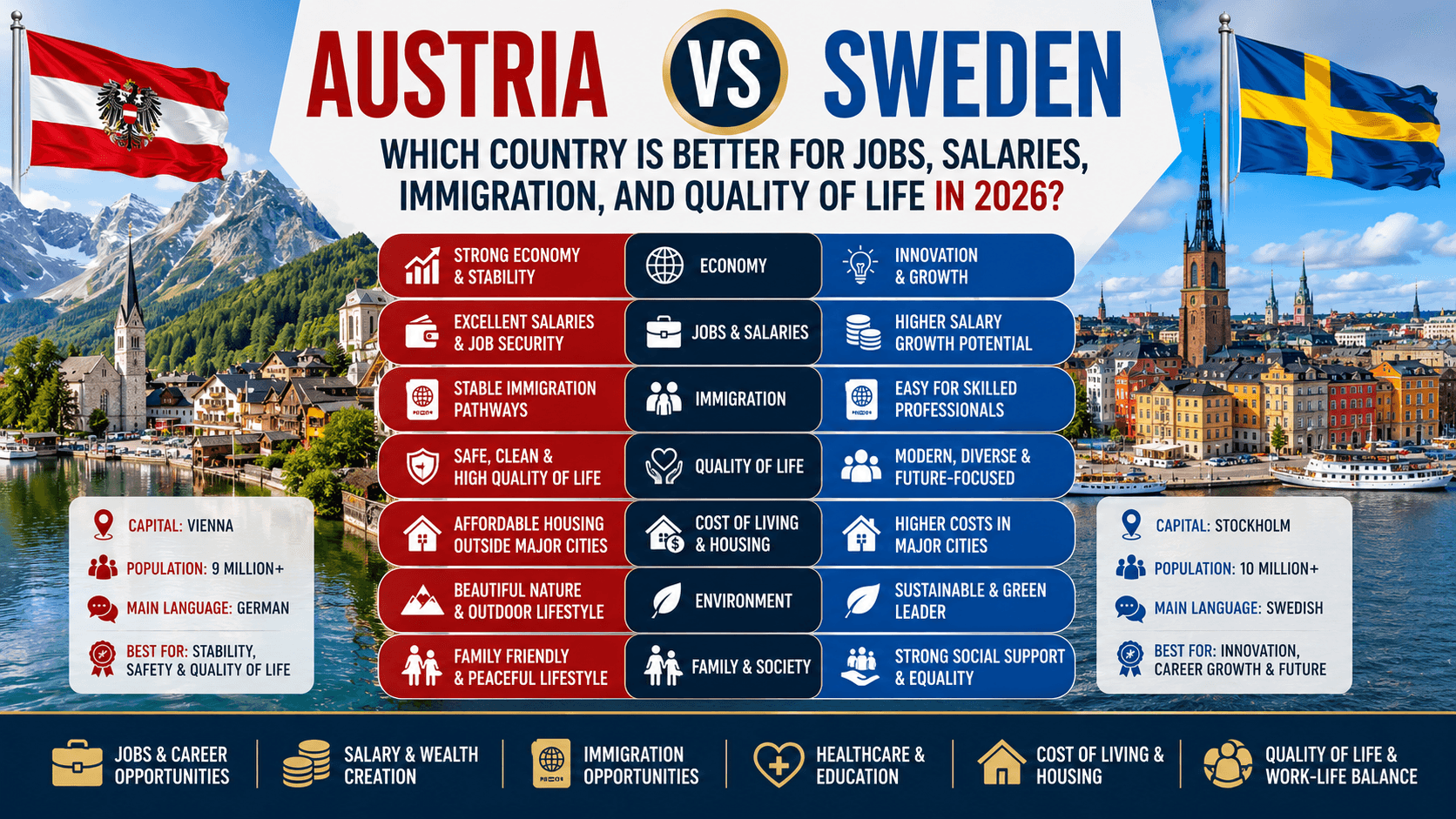
Choosing between Austria and Sweden in 2026 is far more difficult than many people expect.
At first glance, both countries appear remarkably similar. Both are wealthy European nations with strong economies, excellent healthcare systems, highly educated populations, advanced infrastructure, low corruption, and some of the highest living standards in the world.
Yet beneath the surface, they represent two very different models of success.
Austria is built around stability, security, tradition, industrial excellence, and long-term quality of life.
Sweden is built around innovation, technology, globalization, sustainability, and future-focused economic growth.
One offers a more traditional European lifestyle centered around family, safety, and stability.
The other offers one of the world’s most innovative and internationally connected societies.
This distinction becomes increasingly important as more professionals, students, entrepreneurs, and families look toward Europe as a place to build their future.
The real question is not which country is richer.
The real question is which country gives you the best combination of career opportunities, earning potential, immigration accessibility, wealth creation, personal security, and long-term happiness.
That is exactly what this comparison aims to answer.
At a Glance: Austria vs Sweden
| Category | Austria | Sweden |
|---|---|---|
| Capital | Vienna | Stockholm |
| Population | Smaller | Larger |
| Economy Type | Industrial and service-based | Technology and innovation-driven |
| Best For | Stability, family life, quality of living | Innovation, technology, global careers |
| Main Language | German | Swedish |
| English Usage | Moderate to High | Extremely High |
| Technology Sector | Strong | Excellent |
| Startup Ecosystem | Growing | One of Europe’s best |
| Safety | Excellent | Excellent |
| Healthcare | Excellent | Excellent |
| Work-Life Balance | Excellent | Excellent |
| Wealth Creation | Strong | Very Strong |
| Quality of Life | Excellent | Excellent |
At first glance the comparison appears balanced.
However, the deeper analysis reveals substantial differences.
Austria excels in traditional strengths.
Sweden excels in future strengths.
Austria is one of Europe’s most stable countries.
Sweden is one of Europe’s most innovative countries.
Austria attracts people seeking security.
Sweden attracts people seeking opportunity within the global knowledge economy.
Understanding this distinction is the key to making the right decision.
Why This Comparison Matters in 2026
The world is changing rapidly.
Artificial intelligence is transforming industries.
Remote work is reshaping employment.
Global talent mobility is increasing.
Housing affordability is becoming a major concern.
Governments across Europe are competing to attract highly skilled workers.
As a result, choosing a country is no longer just about finding a job.
It is about positioning yourself for the future.
Austria and Sweden both rank among Europe’s most attractive destinations for international talent, but they achieve that status in very different ways.
Austria benefits from its central location in Europe, close economic ties with Germany and Switzerland, strong manufacturing industries, excellent infrastructure, and one of the world’s highest standards of living.
Sweden benefits from its global technology leadership, startup culture, world-class innovation ecosystem, international business environment, and strong reputation for sustainability.
For an engineer, software developer, entrepreneur, healthcare worker, student, or skilled professional, the choice between these two countries can significantly affect future earnings, career growth, and lifestyle satisfaction.
That is why this comparison has become increasingly relevant in 2026.
The Fundamental Difference Between Austria and Sweden
The biggest difference can be summarized in one sentence:
Austria optimizes for stability. Sweden optimizes for innovation.
Austria’s economy is built around industries that have been successful for decades.
Engineering.
Manufacturing.
Tourism.
Healthcare.
Industrial production.
Professional services.
Transportation.
These sectors create predictable economic performance and long-term stability.
Sweden follows a different model.
The Swedish economy places greater emphasis on innovation, research, technology, digitalization, sustainability, and entrepreneurship.
Many of Europe’s most influential global companies originated in Sweden despite the country’s relatively small population.
This innovation-first culture affects nearly every aspect of life.
The workplace.
Education.
Business.
Government services.
Technology adoption.
Investment opportunities.
Future career prospects.
Austria often feels more traditional.
Sweden often feels more future-oriented.
Austria rewards consistency.
Sweden rewards creativity.
Austria feels grounded.
Sweden feels dynamic.
Neither approach is inherently better.
They simply attract different types of people.
Strategic Comparison
When evaluating long-term strategic positioning, Sweden enjoys a unique advantage.
The country consistently ranks among the world’s leading innovation economies.
It has produced globally recognized companies in technology, telecommunications, fintech, gaming, music streaming, advanced manufacturing, and clean energy.
Sweden’s influence extends far beyond its population size.
Stockholm is frequently described as one of Europe’s leading startup hubs.
Many investors consider Sweden one of the best places in Europe for technology entrepreneurship.
Austria follows a different strategy.
Rather than chasing rapid innovation at all costs, Austria focuses on maintaining high standards across industry, public services, education, healthcare, and quality of life.
This creates a more stable but somewhat less disruptive economic environment.
For ambitious entrepreneurs and technology professionals, Sweden’s strategic position is often stronger.
For families and long-term residents seeking predictability, Austria remains extremely attractive.
Economic Strength
Both countries operate highly developed economies.
Both rank among Europe’s wealthiest nations.
Both enjoy strong institutions and high productivity.
However, the structure of their economies differs significantly.
Austria’s economy is supported by:
- Manufacturing
- Engineering
- Tourism
- Logistics
- Healthcare
- Industrial services
- Professional services
Sweden’s economy is supported by:
- Technology
- Telecommunications
- Software
- Advanced manufacturing
- Renewable energy
- Life sciences
- Innovation-driven industries
The Austrian economy tends to be more conservative and resilient.
The Swedish economy tends to be more dynamic and growth-oriented.
This creates an interesting trade-off.
Austria may provide greater economic stability.
Sweden may provide greater economic upside.
| Economic Factor | Austria | Sweden |
|---|---|---|
| Economic Stability | Excellent | Very Good |
| Innovation | Strong | Excellent |
| Technology Leadership | Strong | Excellent |
| Manufacturing Strength | Excellent | Strong |
| Future Growth Potential | Strong | Excellent |
| Global Business Influence | Strong | Very Strong |
Overall Winner: Sweden
Its innovation-driven economy provides stronger long-term growth potential and greater exposure to future industries.
Jobs and Employment
The job market comparison reveals one of the most important differences between the two countries.
Austria offers a strong labor market, particularly in engineering, healthcare, manufacturing, tourism, construction, logistics, and skilled trades.
However, German language proficiency remains extremely important.
Many positions require advanced German skills.
Sweden is different.
Although Swedish remains important for full integration, English proficiency is exceptionally high throughout the country.
Many multinational companies operate primarily in English.
Technology firms, startups, research institutions, consulting companies, and international organizations frequently recruit international talent.
This creates a lower entry barrier for highly skilled professionals.
For software engineers, data scientists, AI specialists, cybersecurity professionals, product managers, and technology consultants, Sweden often provides more accessible opportunities.
Austria remains highly competitive for engineers, healthcare workers, industrial specialists, and manufacturing professionals.
The job market comparison therefore depends heavily on your profession.
| Employment Factor | Austria | Sweden |
|---|---|---|
| Engineering Jobs | Excellent | Very Good |
| Manufacturing Jobs | Excellent | Strong |
| Technology Jobs | Strong | Excellent |
| Startup Jobs | Good | Excellent |
| International Opportunities | Moderate | Excellent |
| English-Friendly Employment | Moderate | Excellent |
Overall Winner: Sweden
Its international job market and technology ecosystem provide broader opportunities for global talent.
Salaries
Salary comparisons between Austria and Sweden are often surprisingly close.
Both countries offer high wages by European standards.
Both maintain strong worker protections.
Both provide extensive social benefits.
The difference emerges when examining high-skilled professions.
Sweden frequently offers stronger earning potential in technology, innovation, software development, fintech, biotechnology, and executive leadership.
Austria remains highly competitive in engineering, industrial management, healthcare, and manufacturing.
The practical difference is that Sweden offers a larger number of high-growth sectors where salaries can accelerate rapidly.
Austria offers more predictable salary progression.
One provides greater upside.
The other provides greater stability.
For highly ambitious professionals, Sweden often wins.
For individuals prioritizing security and consistency, Austria remains exceptionally attractive.
| Salary Factor | Austria | Sweden |
|---|---|---|
| Average Salaries | High | High |
| Technology Salaries | Strong | Excellent |
| Engineering Salaries | Excellent | Very Good |
| Salary Growth | Strong | Excellent |
| Executive Potential | Strong | Excellent |
| Long-Term Upside | Strong | Excellent |
Overall Winner: Sweden
The country’s innovation-driven economy creates stronger opportunities for long-term salary growth.
Immigration
Immigration is often one of the deciding factors for international professionals.
Austria uses structured immigration pathways including the Red-White-Red Card system.
The process is well-defined but often heavily influenced by qualifications, language ability, occupation shortages, and employer sponsorship.
Sweden has traditionally maintained one of Europe’s more open labor markets for skilled international workers.
Its highly international business environment makes integration easier for English-speaking professionals.
For many immigrants, Sweden feels easier during the first years.
Austria often becomes easier after language integration.
This creates a practical distinction.
Sweden may offer a faster start.
Austria may offer stronger long-term stability.
For skilled international professionals seeking immediate access to international workplaces, Sweden generally holds the advantage.
Wealth Creation: The Opening Perspective
When discussing wealth creation, most people immediately focus on salary.
That is a mistake.
Real wealth is built through a combination of income growth, investment opportunities, housing costs, entrepreneurship, taxation, purchasing power, and economic mobility.
This is where Austria and Sweden become especially interesting.
Sweden possesses one of Europe’s strongest wealth-creation ecosystems.
Its startup culture, technology sector, innovation economy, and global business environment create exceptional opportunities for ambitious individuals.
Austria offers a different path.
It may not generate wealth as aggressively as Sweden, but it often helps residents preserve wealth more effectively through stability, lower volatility, and predictable economic conditions.
Sweden offers a higher ceiling.
Austria offers a stronger foundation.
The question is not whether you can become successful in either country.
The question is which environment is better aligned with your personal goals.
That deeper financial comparison will reveal some surprising conclusions as we continue examining entrepreneurship, technology, artificial intelligence, education, healthcare, safety, family life, and work-life balance.
The comparison between Austria and Sweden becomes even more fascinating when we move beyond salaries and immigration.
Many people assume that the country with the better job market automatically provides the better life.
Reality is far more complex.
Some professionals move abroad, increase their salary, and discover they are less happy.
Others earn slightly less but enjoy a significantly better lifestyle, stronger social support, healthier work environments, and greater long-term satisfaction.
This is why entrepreneurship, technology, artificial intelligence, education, healthcare, safety, family life, and work-life balance often become the deciding factors.
These areas determine not only how much money you earn, but also the quality of the life you build.
Entrepreneurship
If there is one area where Sweden has built a global reputation beyond its size, it is entrepreneurship.
Sweden has become one of the most successful startup ecosystems in the world.
Considering its relatively small population, the country has produced an astonishing number of globally recognized companies.
The reason is not luck.
Sweden has spent decades building a culture that encourages innovation, risk-taking, digital transformation, research commercialization, and global thinking.
Entrepreneurs benefit from:
- Strong digital infrastructure
- Access to venture capital
- International talent
- High technology adoption
- Innovation-friendly regulations
- Global business networks
Stockholm is frequently ranked among Europe’s leading startup cities and is often compared with London, Berlin, and Amsterdam when discussing Europe’s innovation landscape.
Austria approaches entrepreneurship differently.
The Austrian business environment is extremely stable and reliable.
Starting and operating a business is generally supported by strong institutions and predictable regulations.
However, Austria’s entrepreneurial culture is more conservative.
Businesses often prioritize long-term sustainability rather than aggressive scaling.
This creates a safer environment but sometimes limits rapid growth.
For founders building industrial businesses, engineering firms, manufacturing operations, healthcare services, tourism companies, or specialized consulting practices, Austria can be an excellent choice.
For founders seeking rapid scaling, technology investment, and international startup ecosystems, Sweden has a clear advantage.
| Entrepreneurship Factor | Austria | Sweden |
|---|---|---|
| Startup Culture | Strong | Excellent |
| Venture Capital | Moderate | Excellent |
| Global Startup Reputation | Good | Excellent |
| Innovation Funding | Strong | Excellent |
| International Scaling | Strong | Excellent |
| Business Stability | Excellent | Very Good |
Winner: Sweden
The gap is meaningful.
Sweden belongs among Europe’s startup leaders.
Technology
Technology is one of the most important economic drivers of the modern world.
The countries that lead technology often create the highest-paying jobs, attract the strongest talent, and generate the greatest future wealth.
Austria performs very well in technology.
Its strengths include:
- Industrial automation
- Engineering technologies
- Advanced manufacturing
- Energy systems
- Transportation technologies
- Environmental technologies
Austria’s technological expertise is often hidden inside industrial sectors.
Many Austrian companies are global leaders within highly specialized engineering niches.
Sweden, however, operates on a broader technological scale.
The Swedish technology ecosystem includes:
- Software development
- Artificial intelligence
- Fintech
- Telecommunications
- Gaming
- Cloud services
- Digital infrastructure
- Health technology
- Renewable energy technology
Sweden’s technology sector has become deeply integrated into the global economy.
Technology companies recruit talent from across Europe and beyond.
This creates stronger opportunities for international professionals.
Austria excels in industrial technology.
Sweden excels in digital technology.
The future increasingly favors digital technology.
That reality gives Sweden a significant advantage.
| Technology Category | Austria | Sweden |
|---|---|---|
| Industrial Technology | Excellent | Strong |
| Software Industry | Strong | Excellent |
| Fintech | Moderate | Excellent |
| Digital Innovation | Strong | Excellent |
| International Tech Ecosystem | Good | Excellent |
| Future Growth Potential | Strong | Excellent |
Winner: Sweden
Artificial Intelligence
Artificial Intelligence is likely to become one of the most important economic forces of the next decade.
Countries that successfully integrate AI into research, education, business, healthcare, and government services will likely enjoy stronger productivity growth and higher-value industries.
Sweden is exceptionally well positioned.
The country combines:
- Strong technical universities
- World-class research institutions
- Technology companies
- Venture capital ecosystems
- International talent attraction
This creates ideal conditions for AI development.
Swedish companies are already investing heavily in AI adoption across multiple industries.
The government also actively supports digital transformation and innovation.
Austria is making progress as well.
Vienna has become increasingly important in European research, machine learning, data science, and advanced analytics.
Austrian universities continue producing highly qualified researchers and engineers.
However, Austria’s AI ecosystem remains smaller than Sweden’s.
Sweden currently offers:
- More AI startups
- More AI investment
- More AI-related employment opportunities
- Greater AI commercialization
For professionals seeking careers in artificial intelligence, Sweden is one of Europe’s most attractive destinations.
| AI Factor | Austria | Sweden |
|---|---|---|
| AI Research | Strong | Excellent |
| AI Startups | Moderate | Excellent |
| AI Investment | Moderate | Excellent |
| AI Jobs | Strong | Excellent |
| AI Commercialization | Moderate | Excellent |
| Future AI Potential | Strong | Excellent |
Winner: Sweden
Education
Education is one area where both countries perform exceptionally well.
Students in both Austria and Sweden benefit from:
- High academic standards
- Modern institutions
- Strong research output
- International recognition
- Excellent public investment
However, their educational philosophies differ.
Austria’s system emphasizes structure, academic rigor, technical expertise, and vocational excellence.
The country is particularly strong in:
- Engineering
- Manufacturing
- Healthcare
- Applied sciences
- Technical professions
Sweden emphasizes:
- Creativity
- Critical thinking
- Innovation
- Collaboration
- Problem-solving
These differences often mirror the broader cultural differences between the two countries.
Austria teaches stability.
Sweden teaches adaptability.
For international students, Sweden often feels more accessible because English-language programs are widespread.
Swedish universities also maintain strong global research partnerships.
Austria remains highly attractive due to educational quality and value.
The difference is small.
| Education Factor | Austria | Sweden |
|---|---|---|
| Academic Quality | Excellent | Excellent |
| Research Strength | Strong | Excellent |
| International Reputation | Strong | Excellent |
| English Programs | Good | Excellent |
| Innovation Focus | Strong | Excellent |
| Technical Education | Excellent | Very Strong |
Winner: Sweden (slight advantage)
Healthcare
Healthcare is one of the rare categories where separating the two countries becomes extremely difficult.
Both systems rank among Europe’s best.
Both provide universal access.
Both produce excellent health outcomes.
Both maintain highly trained medical professionals.
Austria’s healthcare system is often praised for accessibility and patient satisfaction.
Many residents appreciate the ease of specialist access and extensive hospital network.
Sweden’s healthcare system emphasizes efficiency, preventive care, digitalization, and long-term population health.
The difference is largely philosophical rather than practical.
Austria often feels more accessible.
Sweden often feels more optimized.
For most people, either system will provide outstanding care.
Winner: Tie
Safety
Safety is one of the strongest categories for both countries.
Crime levels remain low.
Political institutions are stable.
Public trust remains high.
Corruption levels are among the lowest in the world.
The difference emerges in atmosphere.
Austria often feels calmer.
Sweden often feels more urban and globally connected.
Many international families describe Austria as having a stronger sense of traditional European security and social stability.
Sweden remains very safe by international standards but tends to feel slightly more dynamic and diverse.
Winner: Austria (slight advantage)
Family Life
Family life is where Austria begins to recover significant ground.
Austria offers:
- Excellent healthcare
- Safe communities
- High-quality education
- Beautiful natural environments
- Strong public infrastructure
- Lower population density
Many parents prioritize these factors above salary growth.
Sweden also performs exceptionally well.
The country is globally recognized for family support systems, parental leave policies, childcare programs, and gender equality.
In fact, Sweden may offer the strongest government support for parents among the two countries.
However, Austria often provides a slightly more relaxed environment and easier access to nature.
This category is extremely close.
Winner: Tie
Work-Life Balance
Both Austria and Sweden are world leaders in work-life balance.
Compared with many developed economies, workers in both countries enjoy:
- Generous vacation policies
- Strong labor protections
- Healthy working cultures
- Respect for personal time
- Family-friendly policies
The difference lies in emphasis.
Austria promotes balance through lifestyle.
Sweden promotes balance through social systems.
Sweden’s culture encourages flexibility and trust.
Austria’s culture encourages personal well-being and leisure.
Both approaches work remarkably well.
Few countries globally perform better.
Winner: Tie
At this stage of the comparison, Sweden has established a noticeable lead in entrepreneurship, technology, artificial intelligence, innovation, and future economic potential.
Austria remains highly competitive because of its strengths in safety, stability, family life, healthcare, and overall quality of living.
The next stage of the comparison may ultimately decide the winner.
Income growth, cost of living, housing affordability, taxation, investing opportunities, purchasing power, banking systems, and long-term wealth creation often matter more than any other category.
And surprisingly, this is where Austria begins to fight back very aggressively against Sweden’s innovation advantage.
Money influences almost every major life decision.
Where you live.
What kind of home you can afford.
Whether you can raise a family comfortably.
How much stress you experience.
How quickly you can achieve financial freedom.
How early you can retire.
That is why wealth creation is often the most important part of any country comparison.
A country can offer excellent healthcare, strong education, and beautiful cities, but if people struggle to build financial security, long-term satisfaction often suffers.
This is where Austria and Sweden become especially difficult to compare.
Both are wealthy.
Both are stable.
Both have advanced economies.
Both offer high living standards.
Yet they create wealth in very different ways.
Sweden operates as a growth-oriented economy.
Austria operates as a stability-oriented economy.
One rewards acceleration.
The other rewards preservation.
Understanding that difference is the key to understanding which country is truly better for your financial future.
Income Growth Potential
Most people focus on starting salaries.
Successful people focus on income growth.
The most important financial question is not:
“How much will I earn next year?”
The real question is:
“How much can my income grow over the next decade?”
This is where Sweden begins with a major advantage.
Sweden’s economy is heavily connected to innovation, technology, research, startups, global corporations, and knowledge-based industries.
These sectors tend to produce stronger salary growth over time.
A software engineer, AI specialist, product manager, data scientist, fintech professional, or technology executive can often experience rapid income acceleration as their career advances.
Sweden rewards specialization.
It rewards innovation.
It rewards expertise.
The more valuable your skills become, the larger the potential financial upside.
Austria offers a different experience.
Income growth tends to be steadier and more predictable.
Career progression often follows clearer structures.
Many professionals enjoy stable long-term earnings with lower volatility.
The result is less dramatic growth but greater consistency.
This is particularly attractive for individuals prioritizing security rather than aggressive career expansion.
| Income Growth Factor | Austria | Sweden |
|---|---|---|
| Career Mobility | Strong | Excellent |
| High-Growth Industries | Strong | Excellent |
| Executive Salary Potential | Strong | Excellent |
| Technology Upside | Strong | Excellent |
| Income Acceleration | Moderate | Excellent |
Winner: Sweden
Cost of Living
High income means very little if expenses consume most of it.
This is where Austria starts closing the gap.
Sweden’s high living standards come with significant costs.
Housing.
Food.
Services.
Transportation.
Utilities.
Daily living expenses.
Many international workers arrive in Sweden expecting rapid wealth accumulation only to discover that living costs absorb a substantial portion of their earnings.
Austria is not cheap.
Vienna consistently ranks among Europe’s most desirable cities.
However, Austria generally provides a more balanced relationship between income and expenses.
Outside Vienna, many regions offer excellent living standards at noticeably lower costs.
This creates an important advantage for families and middle-income earners.
The Austrian financial experience often feels less pressured.
In Sweden, earning well is important.
In Austria, spending efficiently is often easier.
| Cost Category | Austria | Sweden |
|---|---|---|
| Housing Costs | Better | Worse |
| Food Costs | Better | Higher |
| Family Expenses | Better | Higher |
| Daily Living Costs | Better | Higher |
| Financial Pressure | Lower | Higher |
Winner: Austria
Purchasing Power
Purchasing power reveals the true value of income.
It measures how much life your salary can actually buy.
This category often surprises people.
Despite Sweden’s higher income potential, Austria performs exceptionally well because living costs are generally more manageable.
A middle-income family in Austria can often achieve a standard of living comparable to or better than a family earning more money in Sweden.
Housing costs play a major role.
So do daily expenses.
This creates a surprisingly balanced outcome.
Top earners often enjoy stronger purchasing power in Sweden.
Average earners frequently enjoy stronger purchasing power in Austria.
The overall result is extremely close.
Winner: Tie
Housing Affordability
Housing is one of the most important wealth-building variables in any country.
The difference between affordable housing and expensive housing can determine whether a family builds wealth or remains financially constrained for decades.
Austria performs exceptionally well here.
Although Vienna is not inexpensive, Austria generally maintains a healthier housing environment than many wealthy countries.
The housing market feels more accessible.
Families often find larger living spaces.
Long-term housing stability is easier to achieve.
Sweden faces greater challenges.
Stockholm, Gothenburg, and several major urban areas experience substantial housing pressure.
Demand remains strong.
Supply remains constrained.
This often creates longer waiting times and higher costs.
For many residents, housing becomes the largest financial challenge.
Austria therefore gains a meaningful advantage.
| Housing Factor | Austria | Sweden |
|---|---|---|
| Rental Availability | Better | Worse |
| Housing Affordability | Better | Worse |
| Family Housing | Better | Worse |
| Long-Term Stability | Excellent | Good |
| Housing Stress | Lower | Higher |
Winner: Austria
Investing Opportunities
Building wealth is not only about earning money.
It is also about making money work for you.
This category strongly favors Sweden.
Sweden possesses one of Europe’s most sophisticated investment cultures.
The country encourages entrepreneurship, innovation, equity ownership, pension investing, and participation in financial markets.
Many Swedish households actively invest.
The startup ecosystem creates additional wealth-generation opportunities.
Employees frequently gain exposure to stock options, equity participation, and growth-oriented companies.
Austria’s investment culture is generally more conservative.
The focus is often on wealth preservation rather than wealth acceleration.
This creates lower risk but can also limit upside potential.
For ambitious investors, Sweden offers significantly more opportunities.
Winner: Sweden
Taxation
Taxes are frequently misunderstood.
People often focus exclusively on tax rates while ignoring what they receive in return.
Both Austria and Sweden operate advanced welfare states.
Both collect substantial tax revenues.
Both provide high-quality public services.
Both support healthcare, education, infrastructure, social protection, and public safety.
The practical reality is that neither country can be considered a low-tax destination.
The difference between them is far smaller than many people expect.
For most residents, career growth and housing costs have a much greater impact on financial outcomes than tax differences.
Winner: Tie
Banking and Financial Systems
Strong banking systems create confidence.
Confidence encourages investment.
Investment supports wealth creation.
Both Austria and Sweden rank among Europe’s safest financial environments.
However, Sweden possesses one major advantage.
Digitalization.
Sweden is one of the world’s most advanced cashless societies.
Banking services are highly efficient.
Financial technology adoption is exceptionally high.
Digital payments are nearly universal.
Austria maintains a highly reliable banking system as well but often feels more traditional.
For financial innovation, Sweden clearly leads.
For financial stability, both perform exceptionally well.
Winner: Sweden
Global Economic Influence
The size of a country’s influence affects career opportunities.
Countries with stronger global influence often attract larger companies, more investment, and greater economic activity.
Sweden’s influence significantly exceeds what its population size would suggest.
Global companies.
Technology leadership.
Innovation exports.
Research strength.
Brand recognition.
International investment.
Sweden consistently punches above its weight.
Austria possesses substantial influence within Central Europe but generally exerts less global economic impact.
This creates additional opportunities for professionals seeking international careers.
Winner: Sweden
Economic Resilience
Rapid growth is valuable.
Resilience is essential.
The ability to withstand economic shocks often determines long-term prosperity.
This is one of Austria’s greatest strengths.
Austria’s economy is diversified, stable, and highly predictable.
Manufacturing, healthcare, engineering, tourism, transportation, and professional services create balanced economic foundations.
Sweden is also resilient.
However, its greater dependence on innovation, technology, and global economic conditions introduces slightly more volatility.
Both countries are strong.
Austria is slightly stronger.
Winner: Austria
Wealth Creation Model vs Wealth Preservation Model
At this stage, the comparison reveals a fascinating reality.
Sweden and Austria are not competing using the same economic philosophy.
Sweden is a wealth creation machine.
Austria is a wealth preservation machine.
Sweden excels at:
- Entrepreneurship
- Technology
- Innovation
- Startup creation
- High-growth careers
- Investment opportunities
- Future industries
Austria excels at:
- Stability
- Housing affordability
- Lower financial pressure
- Predictable wealth accumulation
- Family security
- Long-term lifestyle sustainability
One creates more opportunities to become wealthy.
The other creates more opportunities to stay wealthy.
The difference is subtle but extremely important.
A young entrepreneur may dramatically outperform financially in Sweden.
A family focused on long-term security may experience greater overall prosperity in Austria.
The surprising conclusion is that Sweden has the higher financial ceiling.
Austria has the stronger financial foundation.
Sweden may help you build a larger fortune.
Austria may help you enjoy that fortune with less stress.
As the comparison moves beyond money and into healthcare quality, safety, environmental conditions, happiness, sustainability, family well-being, and future quality of life, the battle becomes even closer.
And that final stage may completely change the outcome of this comparison.
Money is important.
Career growth is important.
Building wealth is important.
But once people achieve a certain level of financial security, their priorities often change.
The questions become different.
How safe is the country?
How good is the healthcare system?
Can I raise a family comfortably?
Will I enjoy my daily life?
Can I imagine living here for the next twenty years?
These are the questions that separate good countries from exceptional countries.
And this is where the Austria versus Sweden comparison becomes incredibly close.
Because while Sweden often dominates future-oriented categories such as technology, innovation, entrepreneurship, and global competitiveness, Austria excels in many of the factors that directly affect daily happiness and long-term life satisfaction.
The result is one of the most balanced comparisons in Europe.
Healthcare Quality
Healthcare is one of the strongest categories for both countries.
Regardless of whether you choose Austria or Sweden, you will gain access to one of the world’s most advanced healthcare environments.
Both countries provide:
- Universal healthcare access
- Highly trained medical professionals
- Advanced hospitals
- Modern medical technology
- Strong preventive care
- Excellent health outcomes
However, the healthcare experience differs.
Austria is often praised for accessibility.
Patients frequently experience easier access to specialists and shorter pathways to treatment.
The system feels highly responsive.
Many residents appreciate the combination of public coverage and high-quality medical services.
Sweden takes a different approach.
The healthcare system emphasizes efficiency, prevention, digitalization, and long-term population health.
Sweden consistently ranks among the healthiest countries in Europe.
The system is highly effective but can sometimes feel more structured and centralized.
Austria often feels more personal.
Sweden often feels more systematic.
The difference is not about quality.
It is about experience.
| Healthcare Factor | Austria | Sweden |
|---|---|---|
| Medical Quality | Excellent | Excellent |
| Hospital Standards | Excellent | Excellent |
| Specialist Access | Excellent | Very Good |
| Preventive Care | Excellent | Excellent |
| Healthcare Innovation | Strong | Excellent |
| Patient Experience | Excellent | Very Good |
Winner: Austria (slight advantage)
Safety and Personal Security
Both Austria and Sweden rank among the safest countries in Europe.
Violent crime rates remain low.
Political stability is high.
Public institutions function effectively.
Trust in government remains relatively strong.
However, there is an important distinction.
Austria consistently benefits from an image of exceptional social stability.
Cities such as Vienna, Salzburg, Graz, and Innsbruck are frequently ranked among Europe’s safest urban environments.
Austria often feels calm.
Orderly.
Predictable.
Sweden remains highly safe by international standards.
However, as a larger and more internationally connected society, it occasionally faces challenges that attract greater media attention.
For most residents, daily life remains extremely secure.
Yet many people still perceive Austria as slightly safer.
This perception influences quality of life more than statistics alone.
When people feel safe, they enjoy greater peace of mind.
Austria excels in this area.
| Safety Category | Austria | Sweden |
|---|---|---|
| Violent Crime | Very Low | Very Low |
| Public Safety | Excellent | Excellent |
| Political Stability | Excellent | Excellent |
| Family Security | Excellent | Excellent |
| Feeling of Safety | Excellent | Very Good |
Winner: Austria
Quality of Life
Quality of life is where Austria becomes exceptionally difficult to beat.
Many international rankings consistently place Austrian cities among the most livable in the world.
There are several reasons.
Beautiful natural surroundings.
Excellent public transportation.
Strong healthcare.
High environmental standards.
Clean cities.
Reliable public services.
Cultural richness.
A slower pace of life.
Austria combines these factors in a way that creates a remarkably comfortable living experience.
Sweden also offers outstanding quality of life.
Its strengths are slightly different.
Sweden excels in:
- Social equality
- Innovation
- Sustainability
- Digital services
- Public trust
- Environmental awareness
Life in Sweden often feels highly efficient.
Life in Austria often feels highly comfortable.
For many people, comfort eventually becomes more valuable.
| Quality of Life Factor | Austria | Sweden |
|---|---|---|
| Public Services | Excellent | Excellent |
| Environmental Quality | Excellent | Excellent |
| Urban Comfort | Excellent | Very Good |
| Infrastructure | Excellent | Excellent |
| Lifestyle Satisfaction | Excellent | Very Good |
| Long-Term Livability | Excellent | Excellent |
Winner: Austria
Work-Life Balance
Both countries rank among the world’s best performers for work-life balance.
Unlike many high-income economies, neither Austria nor Sweden encourages a culture of constant overwork.
Personal time is respected.
Family life matters.
Vacations are valued.
Employee protections are strong.
Yet the approaches differ.
Austria achieves balance through lifestyle.
Sweden achieves balance through social systems.
Austrian culture places significant emphasis on leisure, family, holidays, and outdoor recreation.
Sweden places significant emphasis on flexibility, equality, and workplace trust.
The outcome is excellent in both countries.
However, Austria often feels slightly more relaxed.
Sweden often feels slightly more structured.
Winner: Tie
Family Life
For many people, family life is the most important category in this entire comparison.
A country may offer excellent salaries, but if family life suffers, the overall experience often feels incomplete.
Austria performs exceptionally well.
Families benefit from:
- Safe neighborhoods
- Excellent healthcare
- Strong education
- Lower housing pressure
- Access to nature
- Family-oriented communities
Sweden also provides extraordinary support for families.
The country is internationally famous for:
- Parental leave policies
- Childcare support
- Gender equality
- Family-focused social programs
In fact, Sweden arguably offers stronger institutional support for parents.
Austria often offers a more relaxed family environment.
This makes the category extremely close.
| Family Factor | Austria | Sweden |
|---|---|---|
| Child Safety | Excellent | Excellent |
| Education | Excellent | Excellent |
| Healthcare Access | Excellent | Excellent |
| Family Support Programs | Strong | Excellent |
| Family Lifestyle | Excellent | Excellent |
| Housing Comfort | Excellent | Good |
Winner: Tie
Education Beyond Academics
Education is not only about universities.
It is about preparing people for life.
Austria and Sweden both perform exceptionally well but emphasize different values.
Austria’s system prioritizes:
- Technical excellence
- Professional preparation
- Vocational pathways
- Academic rigor
Sweden prioritizes:
- Creativity
- Innovation
- Independent thinking
- Collaboration
These educational philosophies mirror their broader societies.
Austria develops stability.
Sweden develops adaptability.
For future-focused industries, Sweden has a slight advantage.
For technical and professional preparation, Austria remains outstanding.
Winner: Sweden (slight advantage)
Environment and Sustainability
This is one of the most fascinating categories.
Sweden has become a global symbol of sustainability.
The country is a leader in:
- Renewable energy
- Climate policy
- Green technology
- Environmental innovation
- Sustainable urban development
Austria, however, possesses one major advantage.
Natural beauty.
The country’s mountains, forests, lakes, and landscapes create one of Europe’s most attractive living environments.
Both countries care deeply about environmental protection.
Sweden leads in environmental innovation.
Austria leads in natural living quality.
The result is effectively a draw.
Winner: Tie
Happiness and Life Satisfaction
Perhaps the most important metric of all is happiness.
Not wealth.
Not GDP.
Not salaries.
Actual life satisfaction.
Both Austria and Sweden consistently rank among the happiest societies in Europe.
Strong institutions.
Low corruption.
Excellent healthcare.
Reliable public services.
Economic security.
Social trust.
These factors create high levels of life satisfaction.
Yet the sources of happiness differ.
Sweden’s happiness often comes from freedom, equality, flexibility, and opportunity.
Austria’s happiness often comes from stability, comfort, beauty, security, and lifestyle quality.
Both approaches work remarkably well.
Winner: Tie
Future Outlook
Looking toward 2030 and beyond introduces another important dimension.
Which country is better prepared for the future?
This category strongly favors Sweden.
Sweden’s strengths align directly with many of the industries expected to drive global growth:
- Artificial Intelligence
- Technology
- Renewable Energy
- Digital Transformation
- Biotechnology
- Advanced Research
- Innovation
Austria will continue performing extremely well.
Its economy remains highly competitive and resilient.
However, Sweden appears better positioned to benefit from future economic shifts.
Winner: Sweden
The Most Important Discovery Before the Final Verdict
After examining healthcare, safety, quality of life, work-life balance, family life, education, sustainability, happiness, and future outlook, a surprising pattern emerges.
Sweden wins many of the categories related to future success.
Austria wins many of the categories related to present happiness.
Sweden offers stronger upside.
Austria offers stronger comfort.
Sweden helps people build extraordinary careers.
Austria helps people build extraordinary lives.
That distinction may ultimately determine which country deserves the overall victory.
And it is exactly what will be tested in the final verdict.
Final Verdict
After comparing Austria and Sweden across economic strength, jobs, salaries, immigration, entrepreneurship, technology, artificial intelligence, healthcare, education, family life, safety, housing, wealth creation, sustainability, and future prospects, one conclusion becomes clear:
This is one of the closest comparisons in Europe.
Both countries belong among the world’s most desirable places to live.
Both offer outstanding public services.
Both provide high standards of living.
Both maintain strong economies.
Both rank among Europe’s safest societies.
Yet they achieve these results through very different models.
Austria succeeds through stability.
Sweden succeeds through innovation.
Austria focuses on preserving quality of life.
Sweden focuses on building the future.
Neither approach is wrong.
The better country depends entirely on what kind of life you want to build.
Overall Scorecard
| Category | Austria | Sweden |
|---|---|---|
| Economic Strength | 9.2 | 9.5 |
| Jobs & Employment | 9.0 | 9.5 |
| Salaries | 9.0 | 9.4 |
| Immigration | 8.7 | 9.3 |
| Entrepreneurship | 8.6 | 9.8 |
| Technology | 8.8 | 9.8 |
| Artificial Intelligence | 8.6 | 9.9 |
| Education | 9.4 | 9.5 |
| Healthcare | 9.8 | 9.7 |
| Safety | 9.9 | 9.5 |
| Family Life | 9.7 | 9.7 |
| Work-Life Balance | 9.8 | 9.8 |
| Housing | 9.2 | 8.3 |
| Cost of Living | 9.0 | 8.4 |
| Wealth Creation | 9.0 | 9.8 |
| Sustainability | 9.6 | 9.8 |
| Future Outlook | 9.1 | 9.9 |
| Quality of Life | 9.9 | 9.5 |
Final Score
| Country | Score |
|---|---|
| Austria | 9.27 / 10 |
| Sweden | 9.54 / 10 |
🏆 Overall Winner: Sweden
Sweden wins because it combines strong salaries, exceptional innovation, world-class technology industries, a powerful startup ecosystem, excellent work-life balance, advanced digital infrastructure, and one of the strongest future growth profiles in Europe.
For ambitious professionals, entrepreneurs, technology specialists, and highly skilled workers, Sweden offers extraordinary opportunities.
However, the margin is not overwhelming.
Austria remains one of the strongest countries in the world and may actually be the better choice for many families and long-term residents.
Best Country for Different People
Choose Austria If You:
- Prioritize stability and security
- Want lower housing pressure
- Prefer a calmer lifestyle
- Value natural beauty and outdoor living
- Are raising a family
- Want exceptional quality of life
- Prefer predictable long-term living conditions
Choose Sweden If You:
- Work in technology, AI, fintech, or innovation
- Want stronger career growth
- Plan to start a business
- Seek international opportunities
- Want access to one of Europe’s best startup ecosystems
- Prioritize future industries
- Aim to maximize long-term wealth creation
Wealth Winner
🏆 Sweden
Sweden’s innovation economy, startup ecosystem, investment culture, and technology sectors create superior long-term wealth-building opportunities.
Security Winner
🏆 Austria
Austria offers exceptional safety, stability, social cohesion, and one of Europe’s most comfortable living environments.
Quality of Life Winner
🏆 Austria
Austria’s combination of healthcare, safety, housing, environment, family comfort, and lifestyle balance remains among the best in the world.
Future Winner
🏆 Sweden
Artificial intelligence, green technology, digital transformation, biotechnology, and innovation place Sweden among Europe’s strongest future economies.
Career Growth Winner
🏆 Sweden
Highly skilled professionals generally enjoy faster career progression and greater international opportunities in Sweden.
FAQ
Is Austria or Sweden better for immigrants?
Sweden is generally easier for highly skilled international professionals because English is widely used in professional environments. Austria becomes increasingly attractive for those willing to learn German.
Which country has higher salaries?
Sweden generally offers stronger salary growth potential, particularly in technology, AI, software development, and innovation-driven industries.
Which country is safer?
Both countries are extremely safe, but Austria maintains a slight advantage in overall social stability and perceived security.
Is Austria cheaper than Sweden?
Yes. Austria generally offers lower housing costs and slightly lower overall living expenses.
Which country is better for families?
Both perform exceptionally well, but Austria often provides a slightly more relaxed and affordable family environment.
Which country is better for technology careers?
Sweden clearly leads in technology, startups, artificial intelligence, fintech, gaming, and innovation.
Related Articles
- Austria vs Germany
- Austria vs Switzerland
- Austria vs Netherlands
- Finland vs Sweden
- New Zealand vs Sweden
Conclusion
Austria and Sweden represent two of the most successful societies in modern Europe.
Austria delivers security, stability, family comfort, environmental beauty, and one of the highest qualities of life available anywhere in the world.
Sweden delivers innovation, opportunity, entrepreneurship, technological leadership, and future-focused economic growth.
For individuals seeking a peaceful, secure, and exceptionally comfortable life, Austria remains one of the best choices on the planet.
For individuals seeking maximum professional growth, exposure to future industries, and long-term wealth creation, Sweden emerges as the stronger option in 2026.
The most interesting discovery from this comparison is that Austria tends to optimize life itself, while Sweden tends to optimize opportunity.
Austria helps people live well.
Sweden helps people grow faster.
Ultimately, success means different things to different people.
If your definition of success is happiness, stability, and quality of life, Austria may be your winner.
If your definition of success is innovation, ambition, career growth, and future opportunity, Sweden is likely the better choice.
That is why Sweden wins this comparison overall—but only by a margin small enough that many readers may still choose Austria.