The answer in 30 seconds
Europe’s best window is the early morning of 13 August. The UTC maximum favors western and central Europe, while eastern locations should begin earlier before dawn brightens the sky.
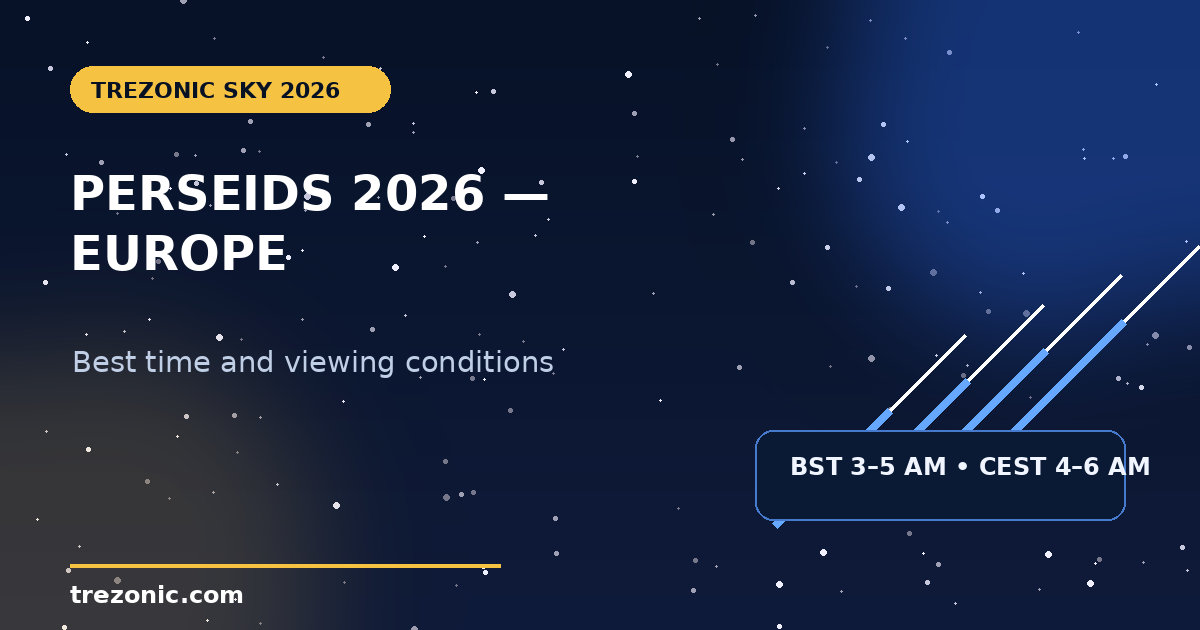
When should Europe watch the Perseids in 2026?
The main maximum is expected around 02:00–04:00 UTC on 13 August. That places the strongest activity in the early morning across Europe. Western and central Europe align well with darkness; farther east, morning twilight arrives sooner.
| Zone | Approximate maximum | What it means |
|---|---|---|
| UTC / Iceland | 2:00–4:00 AM | Strong alignment with the deep night |
| British Summer Time | 3:00–5:00 AM | Best before dawn brightens the eastern sky |
| Central European Summer Time | 4:00–6:00 AM | Start earlier and continue until twilight |
| Eastern European Summer Time | 5:00–7:00 AM | The formal maximum increasingly overlaps dawn |
What changes across Europe?
The strongest hours arrive close to dawn. Coastal cloud and short summer darkness make the hourly forecast important.
Warm nights and the new Moon are favorable, but some viewers may be recovering from the evening eclipse. Choose a site that works for both horizons.
Higher elevations can be dark, but local cloud, valley fog and access restrictions require backup sites.
The radiant is useful through the night, while the formal maximum approaches morning twilight.
Very short or absent astronomical darkness at high latitude can reduce contrast despite clear skies.
Begin well before the UTC maximum because dawn can overtake the final peak hours.
Use a movable plan
European cloud patterns can vary sharply over short distances. Do not lock the final site too early. Identify one primary location and two alternatives reachable within a practical drive, then use the closest reliable forecast window.
Compare cities and coordinates
Check darkness, radiant direction and forecast cloud for each backup location.
The total solar eclipse changes the travel picture
The total eclipse crosses Greenland, Iceland, Spain and a small corner of Portugal on 12 August. Spain sees totality close to sunset, while the Perseids peak a few hours later under a new Moon.
Weather, clouds, local obstructions and light pollution can change the real result. Use the live Trezonic calculator for your location before travelling.